
Interpreter Confidentiality: Why It Matters in High-Stakes Conversations
Interpretation
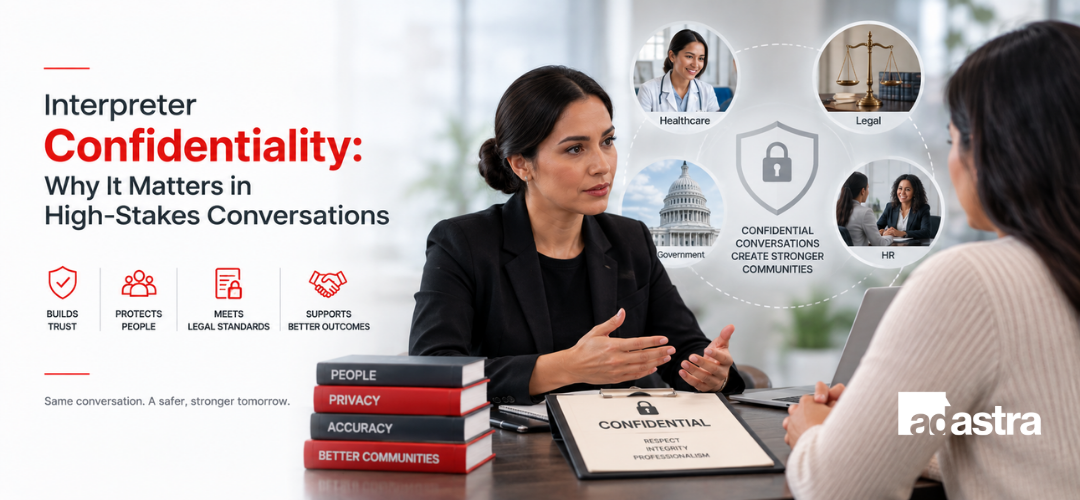
Think about what gets said in a room where an interpreter is present.
A patient tells a physician about symptoms they have not told anyone else, including their family. A defendant explains what happened the night in question to their attorney. A government official discusses a sensitive policy matter through a cleared interpreter. An HR director conducts a termination conversation with a non-English-speaking employee.
Every one of these conversations is private. Every one of them requires an interpreter who understands that what is said in that room stays there, and who has the training, the contractual obligations, and the professional accountability to back that up.
Interpreter confidentiality is not a courtesy. It is a professional standard, a legal requirement in many settings, and a foundational condition for the conversations that matter most to work at all.
What Interpreter Confidentiality Actually Requires
Confidentiality in interpretation means that the interpreter does not disclose, discuss, or retain information learned during an assignment. Not to colleagues. Not informally. Not after the fact. Not in notes that persist beyond the session.
This obligation is codified in the professional codes of ethics governing every major interpretation discipline. The National Council on Interpreting in Health Care, the Registry of Interpreters for the Deaf, and the National Association of Judiciary Interpreters and Translators all list confidentiality as a core ethical principle, not a guideline.
Professional interpreters routinely handle conversations involving deeply personal, sensitive, or legally significant information and are entrusted to accurately convey meaning while strictly protecting privacy. That trust is not incidental to the role. It is the foundation of it. Without it, the people in those conversations cannot speak freely, which means the communication fails regardless of how linguistically accurate the interpreter is.
For organizations using interpretation services, this means two things. First, the interpreters you work with need to operate under a formal confidentiality obligation, not just an informal understanding. Second, the systems through which interpretation is delivered need to be built so that sensitive information cannot be retained, accessed, or exposed after the session ends.
Healthcare: HIPAA, Business Associates, and Protected Health Information
In healthcare settings, interpreter confidentiality is not just an ethical standard. It is a regulatory requirement under HIPAA.
When an interpreter accesses protected health information (PHI) while providing services to a covered entity, they are functioning as a business associate under the law. Interpreters are business associates when they provide services for a covered entity involving PHI, and a Business Associate Agreement is legally required to outline permitted uses, required safeguards, breach reporting, and subcontractor obligations.
Any interpretation service provider handling PHI on behalf of a healthcare organization must operate under a signed BAA. Without one, the healthcare organization is exposed to HIPAA liability for every interpreted encounter where patient information was shared.
Beyond the BAA, HIPAA interpretation compliance requires that interpreters follow the minimum necessary standard, accessing only the patient information required to perform the interpretation, and nothing more. They cannot record sessions or store identifiable patient information on personal devices. They cannot reuse session notes. Using unqualified interpreters such as family members or untrained staff can result in miscommunication, legal liability, and even loss of federal funding.
For remote interpretation specifically, HIPAA compliant interpreting services use AES-256 encryption, zero-retention policies, and SOC 2 Type II certified infrastructure to ensure that sensitive data is not retained after the call or video session concludes. This matters for both over-the-phone interpreting and video remote interpretation, where the technical environment is as important as the interpreter's personal ethics.
The practical consequence of a confidentiality failure in a healthcare setting is not limited to regulatory penalties. A breach of trust can lead patients to withhold important details or avoid care entirely, which creates direct patient safety consequences that compound well beyond the original incident.
Legal Settings: Privilege, Proceedings, and Professional Accountability
In legal contexts, interpreter confidentiality intersects with attorney-client privilege and the formal integrity of legal proceedings.
When an interpreter is present during a privileged attorney-client communication, the privilege extends to the interpreter. The interpreter is not a third party who breaks the privilege. They are a necessary condition for the communication to occur. But that protection depends on the interpreter understanding and honoring its terms. An interpreter who discusses what they heard, even informally, potentially damages the privilege that protects the client.
In courtroom and deposition settings, court interpreters in the United States are bound by the Code of Professional Responsibility for Court Interpreters, which explicitly requires confidentiality as a condition of appointment. Violations of confidentiality can result in serious legal consequences including fines, lawsuits, or loss of certification, and non-compliance with attorney-client privilege may expose both interpreters and their clients to significant liability.
For organizations using legal interpretation services for depositions, arbitration, immigration hearings, or client consultations, the question to ask any provider is direct: are your interpreters trained on the confidentiality requirements specific to legal settings, and are they bound by a formal confidentiality agreement that covers each assignment?
Government Settings: Sensitive Conversations Require Cleared Professionals
Government agencies regularly conduct conversations that are sensitive by nature, whether or not they are formally classified. Investigative interviews, policy discussions, benefits adjudications, law enforcement interactions, and constituent services for vulnerable populations all involve information that cannot leave the room.
The risk in government settings often comes not from formal data breaches but from informal disclosure. An interpreter who mentions the details of a sensitive case to a colleague, or who works for a vendor with inadequate vetting and background check procedures, creates exposure that no policy document can easily remedy.
For agencies working in national security, law enforcement, or highly sensitive social services, interpreter vetting needs to be commensurate with the sensitivity of the information being handled. This means background checks, formal confidentiality agreements, and in some cases security clearances, depending on the nature of the work.
The Real Risk: Informal Interpreters
The most common confidentiality failure in interpretation does not come from a professional interpreter who violates their ethics. It comes from using someone who was never a professional interpreter to begin with.
Bilingual employees, family members, community volunteers, and colleagues recruited in the moment are all regularly asked to interpret in healthcare, legal, and government settings. The problems this creates go well beyond language accuracy. These individuals have no formal confidentiality obligation. They have no training in role boundaries. They have no understanding of HIPAA, attorney-client privilege, or government information handling requirements.
Concerns associated with the use of ad hoc interpreters include greater likelihood that patients will withhold information, violations of patient privacy and confidentiality, and higher risk of negative outcomes. In a legal setting, using a family member as an interpreter in a sensitive conversation may inadvertently make that person a witness. In a healthcare setting, it almost certainly violates HIPAA. In a government setting, it creates an unvetted third party with access to sensitive information and no accountability for what happens to it.
Professional interpreters exist precisely because these conversations cannot be left to informal arrangements.
What to Look for in a Confidential Interpretation Provider
When evaluating interpretation providers for high-stakes settings, confidentiality should be part of the qualification criteria, not an assumption.
Ask whether the provider signs Business Associate Agreements for healthcare work. Confirm that interpreters are bound by formal confidentiality agreements specific to each assignment, not just a general employment policy. For remote interpretation, ask about the technical infrastructure: whether sessions are recorded, how data is handled, what encryption standards are in place, and whether the platform is SOC 2 Type II certified.
Ask how interpreters are vetted, whether background checks are standard, and what happens if a confidentiality concern arises during or after an assignment. A provider that cannot answer these questions clearly is not equipped for high-stakes work.
Accurate and confidential interpretation requires HIPAA compliance protocols, formal BAAs, and zero-retention policies as the baseline, not as optional features. For organizations in healthcare, legal, and government settings, these are the standards that separate a professional interpretation partner from a general language service.
Confidentiality Is What Makes High-Stakes Conversations Possible
When a patient knows their diagnosis will not leave the room, they can speak honestly. When a client knows their attorney consultation is protected, they can give complete information. When a government constituent knows their personal circumstances are handled with discretion, they can engage with the services they need.
Interpreter confidentiality is what makes that openness possible. Organizations that take it seriously, by requiring formal obligations, vetted professionals, and technically secure delivery, build the conditions for communication that actually works.
Ad Astra's professional interpretation services are built for high-stakes settings. Our interpreters work under formal confidentiality agreements, and our remote OPI and VRI infrastructure meets HIPAA compliance standards including BAA availability, encrypted connections, and zero session retention. If your organization handles sensitive conversations and needs interpretation you can trust, we are ready to help.