
AI Captioning vs Human Dubbing: What Works for You?
Video content is everywhere.
Marketing campaigns, product demos, training materials, customer support videos. Most of it now needs to reach audiences across multiple languages.
That is where the real question starts!
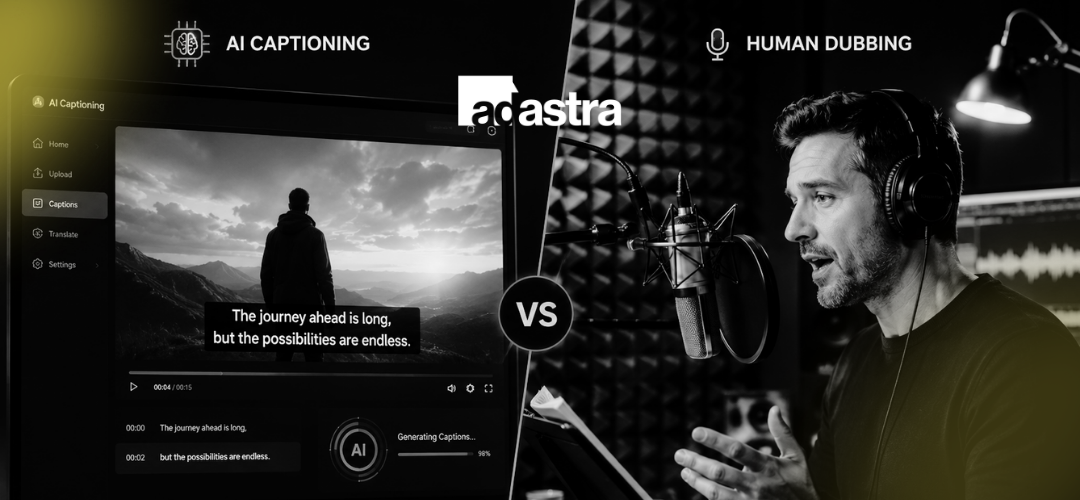
Do you use AI captioning to scale quickly? Or invest in human dubbing for a more polished experience?
Both options are widely used in 2026. Both solve real problems.
But they deliver very different outcomes.
This guide breaks down where each one works and how to choose the right approach for your content.
Key Takeaways
- AI captioning is fast, scalable, and cost-effective for high-volume content
- Human dubbing delivers stronger engagement, clarity, and brand alignment
- The right choice depends on content type, audience, and business goals
What Is AI Captioning?
AI captioning uses speech recognition and machine translation to generate subtitles automatically.
It converts spoken language into text and can translate that text into multiple languages within seconds.
Where AI Captioning Works Best
AI captioning is ideal when speed and scale matter.
Common use cases include:
- Social media videos
- Internal training content
- Product walkthroughs
- Large video libraries
It allows teams to quickly make content accessible across languages without heavy production effort.
Limitations of AI Captioning
AI captioning has improved significantly, but it still has clear limitations.
Accuracy Challenges
AI struggles with:
- Accents
- Background noise
- Industry-specific terminology
This can lead to captions that are technically correct but confusing in context.
Lack of Tone and Emotion
Captions do not capture:
- Tone of voice
- Emotion
- Intent behind speech
This reduces the overall impact of the content.
Viewer Engagement
Many users do not fully engage with caption-only content, especially for longer videos.
Reading requires effort.
Watching does not.
What Is Human Dubbing?
Human dubbing replaces the original audio with a translated voice track performed by professional voice actors.
It recreates the content in another language while preserving tone, emotion, and intent.
Where Human Dubbing Excels
Stronger Audience Engagement
Dubbing allows viewers to watch and listen naturally without reading.
This creates a smoother and more immersive experience.
Better Brand Representation
Voice actors adapt delivery to match:
- Brand tone
- Audience expectations
- Cultural context
This is critical for marketing and customer-facing content.
Improved Clarity
Dubbing eliminates the need for reading captions, which improves understanding, especially for complex topics.
Limitations of Human Dubbing
Human dubbing requires more time and investment.
- Production process is longer
- Costs are higher
- Scaling across many languages takes planning
This makes it less suitable for fast-moving, high-volume content.
AI Captioning vs Human Dubbing: What Actually Matters
Instead of comparing features, it is more useful to look at how each option performs in real business scenarios.
Speed and Scalability
AI captioning can process large volumes of content instantly.
Human dubbing requires time for scripting, recording, and editing.
Cost
AI captioning is significantly more cost-effective, especially at scale.
Human dubbing requires more investment but delivers higher quality output.
Accuracy and Clarity
AI captioning provides acceptable accuracy for simple content but may struggle with nuance.
Human dubbing delivers clearer communication, especially in complex or sensitive content.
Audience Experience
Captioned content requires active reading.
Dubbed content creates a more natural viewing experience.
This directly impacts engagement and retention.
Brand and Cultural Alignment
AI captioning translates words.
Human dubbing adapts meaning, tone, and cultural context.
This makes a difference in marketing, training, and customer communication.
When Should You Use AI Captioning?
AI captioning is the right choice when:
- You need to scale content quickly
- Budget is limited
- Content is informational rather than emotional
- Speed matters more than experience
Examples include:
- Social media clips
- Internal videos
- Knowledge base content
When Should You Use Human Dubbing?
Human dubbing is the better choice when:
- Audience engagement is critical
- Content represents your brand
- Clarity and tone matter
- You are targeting global customers
Examples include:
- Marketing campaigns
- Product videos
- Customer onboarding content
Can You Use Both?
Yes. In many cases, the best approach is to combine both.
For example:
- Use AI captioning for fast distribution and accessibility
- Use dubbing for high-impact content that drives engagement
This allows organizations to balance cost, speed, and quality.
The Business Impact of Choosing the Right Approach
Language is directly tied to customer experience.
When content is easy to understand, engagement increases.
When content feels natural and localized, trust improves.
Research consistently shows that people prefer to consume content in their own language, especially when it feels native to them.
Choosing the right approach is not just about translation.
It is about how your audience experiences your content.
How to Choose the Right Approach
To make the right decision, ask:
- Is this content high-impact or high-volume
- Does engagement matter more than speed
- Does this represent our brand
- How many languages do we need to support
Your answers will guide the best approach.
Where Ad Astra Fits In
At Ad Astra, the focus is on enabling both approaches.
With us, organizations can:
- Scale video content with AI-assisted workflows
- Access professional linguists and voice talent
- Maintain quality and consistency across languages
- Adapt content based on audience and use case
The goal is simple.
Deliver content that works across languages without losing meaning or impact.
Final Thoughts
AI captioning and human dubbing both play a role in global content.
They are not competing solutions.
They solve different problems.
The organizations that succeed are not choosing one over the other.
They are using each where it makes sense.
Because the goal is not just to translate content.
It is to connect with your audience.
FAQs
What is the difference between AI captioning and human dubbing?
AI captioning generates subtitles automatically, while human dubbing replaces audio with a translated voice track.
Is AI captioning accurate enough?
It can be accurate for simple content, but may struggle with complex language, accents, and context.
Is dubbing better than captions?
Dubbing provides a more natural experience, but captions are faster and more cost-effective.
When should businesses use dubbing?
When content is customer-facing, brand-driven, or requires strong engagement.
Can you use both captioning and dubbing together?
Yes. Many organizations use captioning for accessibility and dubbing for engagement.