
Localization vs Globalization: What’s the Difference and Why It Matters
Localization
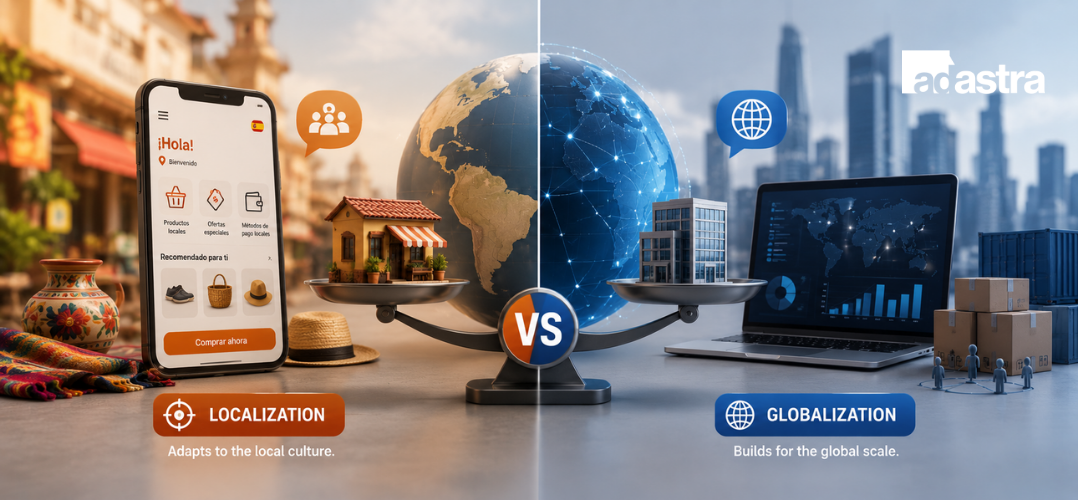
When business leaders map out a global expansion strategy, their initial vocabulary often gets cluttered with overlapping industry terms. "Globalization," "internationalization," and "localization" are frequently tossed around interchangeably in boardrooms as if they describe the exact same process.
However, failing to understand the distinction between these concepts is one of the primary reasons international launches stall.
Conquering global markets isn't achieved by a single, monolithic corporate push. It requires a delicate balance between scaling up operations centrally and adapting products regionally. To build a sustainable, revenue-generating international footprint, your executive and marketing teams must understand the core tension between localization vs globalization—and how to deploy both effectively.
Key Takeaways
-
Macro vs. Micro: Globalization is the overarching corporate strategy to standardize a business for the world market; localization is the hyper-targeted process of adapting that business for a specific local culture.
-
The Scale Efficiency: True global growth requires implementing internationalization before localization, building a flexible infrastructure that can scale without breaking.
-
Resonance Drives Conversion: A brilliant globalization plan gets your brand across borders, but it takes an intentional localization strategy to actually convert international users into loyal customers.
Defining the Terms: Globalization vs. Localization
To eliminate confusion across your product development and marketing teams, it is best to view these terms not as opposing concepts, but as sequential phases of a unified international expansion funnel.
[ GLOBALIZATION ] ──► Systemizing business operations to scale universally
│
▼
[ INTERNATIONALIZATION ] ──► Engineering code and assets to support multiple regions
│
▼
[ LOCALIZATION ] ──► Fine-tuning the product experience for an exact local market
What Is Globalization (G11n)?
Globalization is the high-level operational process of designing a business, its supply chains, its product lines, and its corporate structures to expand into multiple foreign countries.
The ultimate goal of globalization is scalability and standardization. It focuses on finding operational efficiencies that allow a business to operate globally with a unified identity, an interconnected logistics network, and a consistent core value proposition.
What Is Localization (L10n)?
Localization is the hyper-focused process of taking a product, service, digital platform, or marketing campaign and modifying it to meet the exact cultural, linguistic, technical, and regulatory expectations of a specific target market.
While globalization seeks to unify, localization seeks to differentiate. It ensures that when a consumer interacts with your digital asset, the experience reads, feels, and operates as if it was created natively in their hometown.
Where Brands Stumble: The Pitfalls of Over-Standardization
Many corporations fall victim to the "one size fits all" trap. They assume that if their domestic product line, digital application, or enterprise software is wildly successful in its home country, it will naturally succeed abroad through sheer brand power alone.
This operational blind spot leads to predictable, costly failures in international marketing:
1. The Literal Translation Trap
A basic globalization plan often treats text translation as a secondary administrative step. This results in standard word-swapping that completely misses regional idioms, localized humor, and emotional nuances. As highlighted in our deep dive into how poor translation impacts customer experience, deploying unvetted, literal text directly destroys brand authority and introduces immense buying friction at checkout.
2. Functional and Technical Friction
A globalized digital strategy that ignores localized functionality will see high bounce rates. For instance, launching an online store in Europe that forces users into a US-centric address format or fails to support dominant regional payment options will trigger massive cart abandonment. Complete optimization requires moving past word substitution and aligning your platform with the rigorous operational standards outlined in our guide to website localization vs translation.
3. Broken User Interfaces
When product management teams build interfaces with static, fixed-width containers, they fail to realize that languages like German or Italian take up 30% more visual space than English. Failing to integrate the fluid design principles utilized in professional software localization causes translated strings to clip, text to overlap, and critical action buttons to break entirely on screen.
The Strategic Sweet Spot: Think Globally, Act Locally
Sustainable international growth doesn't ask you to choose between globalization and localization. Instead, elite organizations use an approach colloquially known as "Glocalization." This strategy focuses on centralizing backend corporate systems while decentralizing frontend customer experiences.
Step 1: Standardize Core Infrastructure Centrally
Use your globalization phase to align your master supply chains, coordinate your global legal structures, and secure your fundamental brand architecture. This ensures your corporate identity remains distinct and operational costs stay optimized as you scale.
Step 2: Build with Flexible Code Architecture (Internationalization)
Before translating a single string, have your engineering teams separate all user-facing content into external, dynamic resource files. This ensures your software or digital platform can support varied character sets, right-to-left text flows, and localized date/currency formatting without requiring complex code rewrites for every new country.
Step 3: Empower Native Experts Regionally
When executing your frontend campaigns or localizing product interfaces, hand the reins to native linguists and regional marketing specialists. They hold the cultural insights necessary to alter imagery, reframe marketing hooks, adjust pricing models, and verify compliance with local data-privacy laws (like GDPR).
Conclusion: Balancing Scale with Cultural Relevance
Globalization provides your company with the operational legs to step across international borders, but localization provides the voice that allows you to connect with the people standing on the other side.
By building an elastic framework that combines centralized business scaling with deep, respectful cultural adaptation, you insulate your company from expansion risks, remove operational friction, and unlock reliable revenue channels across the globe.
Frequently Asked Questions
What is the difference between localization vs globalization?
Globalization is the broad operational strategy of scaling a business, its brand identity, and its logistics networks across multiple international borders. Localization is the granular process of customizing that business's products, software, and marketing assets to align perfectly with the specific culture, language, and legal compliance of a single target region.
How does internationalization fit into this framework?
Internationalization is the structural engineering step that sits between globalization and localization. It involves designing a product's underlying codebase or asset layout from the ground up so it can handle multiple languages, currencies, and layouts easily without needing to alter the core source code.
Why is localization critical for a successful international marketing campaign?
A purely globalized marketing message often falls flat because it ignores regional humor, cultural sensitivities, and consumer buying habits. Localizing your campaign content ensures your value proposition resonates deeply with local audiences, maximizing trust and dramatically improving your conversion rates.