
Why Translation Management Systems Matter for Enterprise Localization
Localization
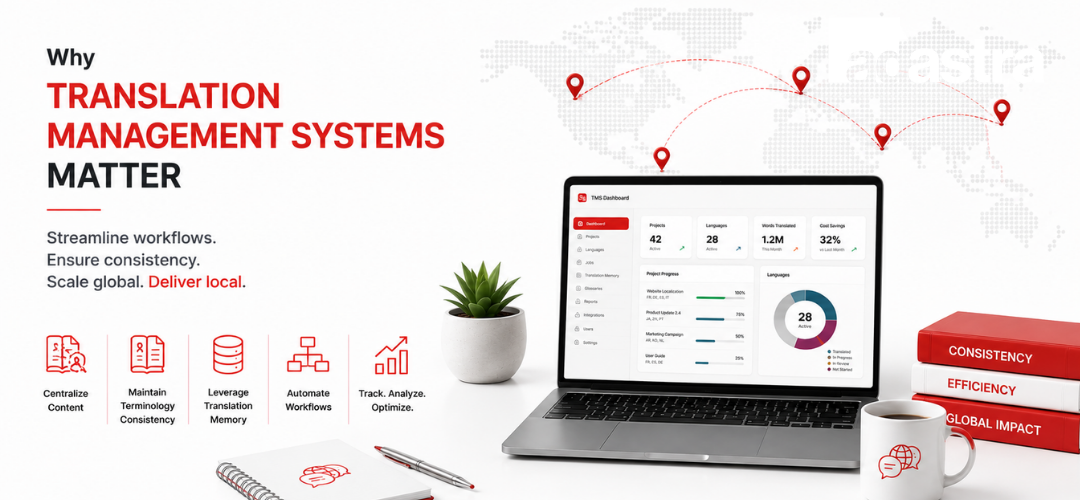
Expanding into global markets is exciting until localization starts slowing everything down.
For many organizations, the early stages of multilingual expansion are manageable. A few translated product pages, a handful of marketing campaigns, or occasional software updates can often be coordinated through spreadsheets, shared folders, and long email threads.
Eventually, though, that approach reaches its limit.
As the business grows, so does the complexity. Marketing teams are launching campaigns across multiple regions, developers are releasing frequent product updates, support teams are publishing multilingual knowledge bases, and legal departments are reviewing country-specific documentation. Suddenly, dozens of stakeholders are working across multiple languages, time zones, and deadlines.
At that point, localization stops being a translation challenge and becomes an operational one.
This is where a translation management system becomes more than a helpful tool. It becomes the infrastructure that keeps multilingual projects organized, scalable, and efficient.
Rather than managing every translation request manually, enterprise organizations use TMS software to centralize content, automate workflows, maintain terminology, and keep multilingual projects moving without creating bottlenecks across departments.
How a Translation Management System Simplifies Enterprise Localization
Despite the name, a translation management system doesn't actually perform translations.
Instead, it serves as the central hub where every part of the localization process comes together.
Think of it as the operational backbone of enterprise localization. Rather than having content scattered across email attachments, spreadsheets, cloud folders, and individual translators, everything is managed from a single platform.
A modern TMS helps organizations:
-
Store translation memories, glossaries, and approved terminology in one place.
-
Route content automatically to translators, reviewers, and approvers.
-
Connect directly with content management systems, software repositories, and marketing platforms.
-
Track project progress across multiple languages in real time.
-
Maintain version control as source content changes.
The result is a far more organized approach to localization management. Instead of chasing files and manually coordinating projects, teams can focus on delivering high-quality multilingual content faster.
Perhaps more importantly, a translation management system gives everyone involved in the process visibility into what's happening. Marketing teams know when campaigns are ready, developers know which software strings have been localized, reviewers can see pending approvals, and project managers no longer need to send constant status updates.
For organizations managing multilingual content every day, that visibility is just as valuable as the translations themselves.
The Cost of Managing Localization Without a TMS
Many organizations don't realize they need a translation management system until localization begins creating operational problems.
At first, those problems seem minor.
A translator works from an outdated document.
A product description gets translated twice.
Marketing publishes one version of a product name while the website uses another.
An engineer spends half a day searching through email threads to find the latest translated software strings.
Individually, these issues may seem manageable. Collectively, they slow product launches, increase costs, and create inconsistent customer experiences across markets.
One of the biggest hidden costs is duplicate translation work.
Without a centralized translation memory, identical sentences are often translated repeatedly across different projects, departments, or vendors. Over time, organizations end up paying multiple times for content they've already translated.
According to industry research, organizations using translation memory effectively can reduce translation costs on repeated content by 30% to 70%, depending on the type and volume of content. Those savings become increasingly significant as multilingual content grows.
Terminology inconsistency is another common challenge.
Imagine one translator referring to a feature as a "Customer Portal," another calling it a "Client Dashboard," and a third using a completely different term in another language. Individually, these variations may seem harmless, but they weaken brand consistency and create confusion for users.
Version control becomes equally problematic.
Without a centralized system, teams often struggle to determine which source file is the latest, whether translated content reflects recent product updates, or which reviewer approved the final version. Publishing outdated translations can lead to customer confusion, support issues, and unnecessary rework.
These problems rarely happen because translators lack expertise.
They happen because the translation workflow itself has become too complex to manage manually.
For enterprise organizations handling hundreds or thousands of multilingual assets, spreadsheets and email simply don't scale.
As organizations expand into new markets, localization becomes much more than translating content. It becomes a continuous operational process involving marketing teams, developers, product managers, legal reviewers, translators, and regional stakeholders.
A translation management system brings these moving parts together in one environment, helping organizations manage complex multilingual projects without adding unnecessary administrative work.
Here are the capabilities that have the biggest impact on enterprise localization.
Translation Memory: Stop Paying to Translate the Same Content Twice
Every enterprise creates content that is repeated in one form or another.
Product descriptions often share similar specifications. Software interfaces reuse the same buttons and navigation labels. Support articles repeat common troubleshooting steps. Marketing campaigns build on existing messaging.
Without a Translation Memory (TM), every new project starts from scratch, even when much of the content has already been translated.
A Translation Memory changes that.
Instead of retranslating approved content, the system automatically identifies identical or similar segments that already exist in your database. Translators can then reuse approved translations while focusing their attention on new or modified content.
Over time, this creates significant advantages.
Projects move faster because less content requires fresh translation. Costs decrease as duplicate work is eliminated. Most importantly, customers receive a more consistent experience because the same terminology and messaging are used across every language.
The more multilingual content an organization produces, the more valuable Translation Memory becomes.
Terminology Management Keeps Your Brand Consistent
Every organization has terminology that should never change.
Product names.
Feature names.
Industry-specific language.
Legal wording.
Compliance statements.
Even simple phrases like "Customer Portal" or "Account Manager" should appear consistently across every language.
Without centralized terminology management, different translators may choose different words for the same concept. Individually these decisions may seem harmless, but together they create an inconsistent customer experience and weaken brand identity.
A translation management system solves this by maintaining approved glossaries and terminology databases that every linguist can access throughout the localization process.
Instead of asking translators to remember preferred wording, the platform reinforces those decisions automatically.
For organizations operating in regulated industries such as healthcare, finance, or government, terminology consistency is more than a branding issue. It also helps reduce compliance risks by ensuring critical language remains accurate across every market.
Workflow Automation Removes Administrative Bottlenecks
One of the biggest challenges in localization management isn't translation itself.
It's managing everything that happens before and after the translation.
Content needs to be exported.
Files need to be assigned.
Reviewers need to be notified.
Approvals need to be tracked.
Final files need to be returned to the correct system.
When these tasks are handled manually, projects slow down quickly.
Imagine a product team releasing software updates every week. If someone has to manually download language files, email them to translators, collect completed versions, send them for review, and upload everything again, valuable time is lost before customers ever see the update.
A translation management system automates much of this process.
Once content is ready, predefined workflows route it to the appropriate translators, reviewers, and approvers. As each stage is completed, the next task begins automatically, keeping projects moving without constant manual coordination.
Automation doesn't replace people.
It removes repetitive administrative work so people can focus on quality, review, and decision-making.
AI Works Best When Guided by Human Expertise
Artificial intelligence has become an important part of modern localization, but successful organizations understand that automation works best when combined with human expertise.
A modern translation management system can connect directly with machine translation engines, allowing organizations to process large volumes of content much faster than traditional workflows.
However, not every type of content carries the same level of risk.
A product catalog containing thousands of specifications may benefit from machine translation followed by human review.
A software interface with repetitive user interface strings may also be suitable for AI-assisted workflows.
Legal contracts, healthcare documentation, marketing campaigns, and regulated content require a much higher level of human oversight.
Instead of treating every project the same, a translation management system allows organizations to build different workflows for different content types.
This hybrid approach improves efficiency without compromising quality, helping businesses scale multilingual content while protecting accuracy and brand reputation.
Built-In Quality Assurance Helps Prevent Costly Errors
Finding a translation mistake after content has been published is always more expensive than preventing it in the first place.
Modern TMS platforms include automated quality assurance checks that review multilingual content before it reaches customers.
These checks can identify issues such as:
-
Missing translations
-
Inconsistent terminology
-
Incorrect numbers or dates
-
Formatting problems
-
Broken tags
-
Spelling inconsistencies
While automated quality assurance doesn't replace human review, it provides another layer of protection that helps teams identify common issues before publication.
For organizations working in regulated industries or managing high-volume multilingual projects, these automated checks significantly reduce the likelihood of costly revisions later.
Managing Multiple Vendors Becomes Much Simpler
Enterprise organizations rarely rely on a single translator.
Many work with multiple language service providers, regional reviewers, freelance linguists, and internal subject matter experts simultaneously.
Coordinating all of these resources manually can quickly become overwhelming.
A translation management system centralizes assignments, tracks progress, manages permissions, and provides visibility across every project regardless of who is completing the work.
Instead of wondering who has the latest file or which reviewer is responsible for the next step, project managers can see the entire localization process from a single dashboard.
This visibility becomes increasingly valuable as multilingual projects grow in both volume and complexity.
Analytics Turn Localization Into a Business Function
One capability that is often overlooked is reporting.
Enterprise localization isn't just about translating content. It's about understanding how localization performs as part of the business.
A translation management system provides visibility into metrics such as:
-
Project turnaround times
-
Translation costs
-
Language volumes
-
Workflow efficiency
-
Linguist performance
-
Translation Memory savings
-
Review cycle durations
These insights help organizations identify bottlenecks, forecast budgets, and continuously improve their localization processes.
Instead of relying on assumptions, teams can make decisions based on measurable performance data.
As localization becomes a larger investment, this level of visibility becomes increasingly important for operations leaders, procurement teams, and executives responsible for global growth.