
Understanding Executive Order 13166: A Guide for Government Agencies
Language Services
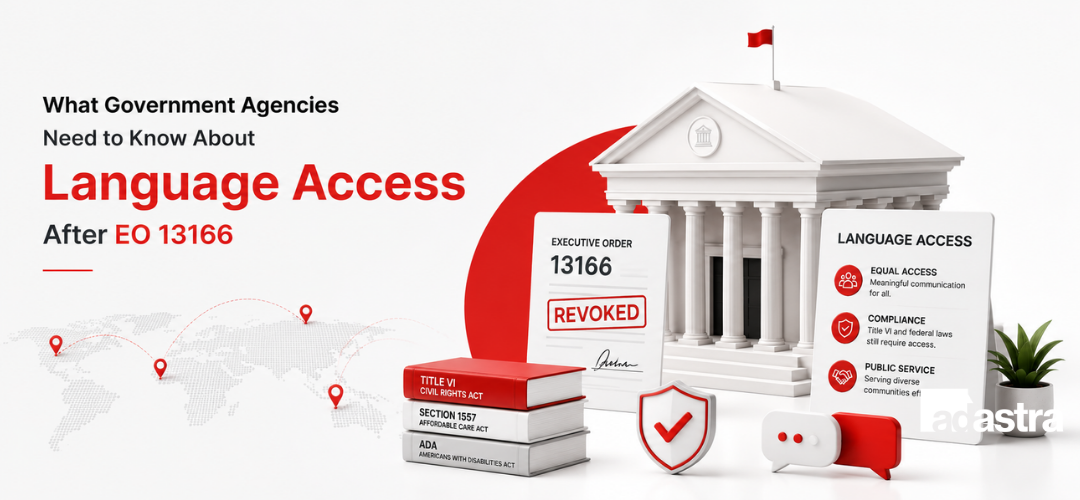
Many government agencies are operating with outdated assumptions about their language access obligations.
On March 1, 2025, President Trump signed Executive Order 14224, designating English as the official language of the United States and formally revoking Executive Order 13166 — the 25-year Clinton-era mandate that had required federal agencies to develop and implement language access plans for residents with limited English proficiency (LEP).
The headlines that followed created significant confusion. Some agencies interpreted the change as permission to scale back multilingual services entirely. Others were unsure whether their existing language access plans still had any legal basis.
The answer requires separating what EO 14224 actually changed from what it did not — and cannot — change. For agencies receiving federal financial assistance, the legal obligations are more durable than a single executive order.
What Executive Order 13166 Was and What It Required
Executive Order 13166, signed by President Clinton in August 2000, required two things.
First, every federal agency had to develop a plan to ensure that people with limited English proficiency could meaningfully access federally conducted programs and activities. Second, federal agencies that distributed financial assistance — grants, contracts, cooperative agreements — were required to issue language access guidance for the organizations receiving those funds.
The order directed the Department of Justice to publish a general LEP guidance framework, which agencies then used to develop their own tailored plans. That guidance, finalized by DOJ in 2002, became the operational backbone of language access compliance for most federal and federally funded organizations for more than two decades.
In practical terms, EO 13166 is why most federal agencies published language access plans, why recipients of federal grants were expected to provide interpreter services and translated vital documents, and why government call centers in federally funded programs developed multilingual communication infrastructure.
What Changed on March 1, 2025
Executive Order 14224 revoked EO 13166 and directed the Attorney General to rescind all policy guidance documents issued under it. DOJ acted quickly. On March 21, 2025, the department rescinded its 2002 LEP guidance. The lep.gov website, which had served as the primary federal resource for language access guidance, was suspended in July 2025 following implementation guidance issued by Attorney General Bondi.
What EO 14224 explicitly removed was the affirmative federal mandate for agencies to develop language access plans and the requirement for federal agencies to issue language access guidance to their grantees and contractors.
What it did not do — and this is the part that matters most for compliance teams — is override federal civil rights law.
EO 14224 includes this language in its general provisions: the order "does not require or direct any change in the services provided by any agency" and agencies "are not required to amend, remove, or otherwise stop production of documents, products, or other services prepared or offered in languages other than English."
The mandate is gone. The legal obligations are not.
The Laws That Still Require Language Access
Executive orders direct agency behavior. They cannot repeal statutes passed by Congress. Several federal laws independently require language access, and those laws remain fully in effect.
Title VI of the Civil Rights Act of 1964
Title VI prohibits discrimination on the basis of race, color, and national origin in any program or activity receiving federal financial assistance. The Supreme Court's 1974 ruling in Lau v. Nichols established that denying meaningful access to federally funded programs because of a person's language constitutes discrimination on the basis of national origin under Title VI.
As the Federal Register notice rescinding the 2022 DOJ LEP guidance explicitly states: "All recipients of Department financial assistance have a continuing obligation to comply with Title VI, all applicable Title VI implementing regulations, all applicable federal civil rights laws and nondiscrimination provisions."
Title VI cannot be revoked by executive order. Any government agency or organization that receives federal financial assistance — including state agencies, municipalities, hospitals, public schools, courts, and housing authorities — still has enforceable language access obligations under this statute.
Section 1557 of the Affordable Care Act
For healthcare agencies specifically, Section 1557 of the ACA independently prohibits discrimination on the basis of national origin in health programs receiving federal funding. This requirement covers hospitals, community health centers, Medicaid-funded programs, and any provider accepting Medicare or Medicaid.
Healthcare agencies must continue to provide qualified interpretation services and translated patient-facing documents at no cost to LEP patients. EO 14224 did not alter this requirement.
The Court Interpreters Act
Federal courts are required under the Court Interpreters Act to provide qualified interpreters in criminal and civil proceedings where a party or witness has limited English proficiency. This is a statutory obligation that operates entirely independently of any executive order.
For agencies whose work intersects with the justice system — law enforcement, public defenders, courts, or legal aid organizations receiving federal support — professional legal interpretation remains a required component of due process.
The Rehabilitation Act of 1973
Federal agencies and recipients of federal financial assistance are required under the Rehabilitation Act to ensure that communications with people with disabilities are as effective as communications with others. For individuals who are Deaf or Hard-of-Hearing, this means providing qualified sign language interpreters or other appropriate accommodations.
Deaf and Hard-of-Hearing accessibility services are not affected by EO 14224. The Rehabilitation Act's requirements exist independently and remain fully enforceable.
State-Level Requirements Are Unaffected
For agencies operating at the state and local level, EO 14224 has no effect on state language access laws.
New York's Language Access Law, enacted in 2022, requires all state agencies that interact with the public to provide interpretation in any language and to translate vital documents into the 12 most commonly spoken non-English languages in the state. California has long-standing statutory language access requirements. Washington, Illinois, and other states have their own frameworks.
An agency in New York, California, or any state with its own language access statute is subject to that state law regardless of what happens at the federal level. Compliance teams should audit their state-level obligations separately from their federal ones.
What Agencies Should Do With Their Language Access Plans
Many agencies built their language access plans around explicit references to EO 13166 and the 2002 DOJ LEP guidance. Those references are now outdated. That does not mean the plans themselves are invalid — it means they need to be updated to reflect the current legal basis.
As Caltrans' Division of Local Assistance guidance to its local public agencies states: agencies should "review and revise language access plans and civil rights policies" and "replace references to EO 13166 with Title VI obligations."
Practically, this means:
-
Review every internal policy and compliance document that references EO 13166. Update the legal basis to Title VI and the applicable sector-specific statutes rather than the executive order.
-
Audit your current language access services against the populations you serve. The four-factor analysis that HHS and DOJ have historically used — the number of LEP persons served, frequency of contact, nature and importance of the service, and resources available — remains a practical framework for determining what is required.
-
Maintain vital document translations. The obligation to provide translated versions of documents essential to accessing agency services still exists under Title VI for recipients of federal assistance.
-
Preserve interpreter access. Whether through over-the-phone interpretation for high-volume call center interactions or on-site interpreters for hearings and proceedings, the mechanisms that deliver language access are still legally necessary for federally funded agencies.
The Practical Case for Not Scaling Back
Beyond legal obligations, there is an operational case for maintaining language access infrastructure even where the mandate has been loosened.
The 29.6 million people in the United States with limited English proficiency do not interact with government services less frequently because a federal executive order changed. They still apply for benefits, attend hearings, report emergencies, and contact agencies for assistance. The volume of multilingual government interactions has not decreased.
Agencies that scale back language support in response to EO 14224 will not see the needs disappear. They will see those needs manifest as missed benefits, delayed proceedings, repeat contacts, in-person visits that could have been resolved by phone, and — in healthcare and legal settings — consequences that create legal exposure regardless of what the executive order says.
The agencies navigating this period most effectively are those treating language access as a service delivery standard rather than purely a compliance checkbox. For detailed guidance on how government call centers can structure multilingual support across departments, the infrastructure decisions remain the same regardless of the regulatory environment.
The Legal Floor Has Not Changed
EO 13166 is gone. The compliance obligations it helped operationalize are not.
For any government agency or federally funded organization, the starting point is straightforward: if you receive federal financial assistance, Title VI applies and your language access obligations are enforceable. If you operate in healthcare, the ACA applies. If your work intersects with the courts, the Court Interpreters Act applies. If you serve Deaf constituents, the Rehabilitation Act applies. State laws add their own floor on top of all of that.
The executive order removed the affirmative mandate that pushed agencies to be proactive. It did not remove the legal floor that prohibits discrimination. Agencies that treat this as permission to stop providing language access are misreading what the order actually says — and creating legal exposure in the process.
Ad Astra works with government agencies and public sector organizations across federal, state, and local levels to provide interpretation, translation, and multilingual communication services that meet their legal access obligations. If your agency is reviewing its language access program in light of the changes to EO 13166, our team can help you assess your current obligations and identify the right services for your constituent population.