
How Businesses Can Maintain Translation Quality Across Global Teams
Translation
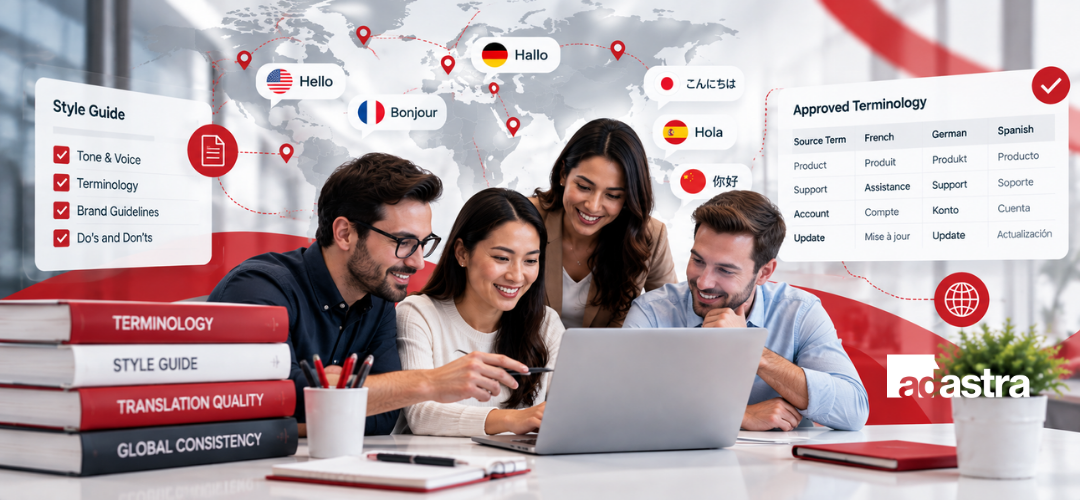
Here is a problem that scales with every market you enter.
Your brand has a distinct voice in English. It is clear, consistent, and reflects years of positioning work. Then you expand into French, Spanish, and German. Different translators handle each market. Some are freelancers, some are agencies, one is an in-house bilingual employee who covers two territories. Nobody has given any of them the same brief. Six months later, your brand reads like three different companies depending on which country a customer is in.
This is not a translator problem. It is a translation quality infrastructure problem. And it is the most common reason that multilingual content underperforms relative to the original.
Translation quality does not degrade because of carelessness. It degrades because businesses scale their markets without scaling the systems that keep language consistent. The good news is that the fixes are largely process-based, not technology-based. You do not need to overhaul your entire workflow to see significant improvement.
Why Translation Quality Breaks Down at Scale
In a single-language business, brand consistency is managed through editorial guidelines, review processes, and institutional knowledge. Writers learn the voice over time. Editors enforce it. There is a feedback loop.
Multilingual content breaks that loop at every point.
A freelancer translating your French product descriptions does not sit in your marketing meetings. They do not know that the company never uses certain competitor comparisons, or that the brand tone is deliberately understated, or that a specific product feature has an approved name that must not be translated. They work from the source text alone, and they make good-faith decisions about every ambiguity they encounter.
When you add a second freelancer for the same market, or switch agencies between projects, or bring translation in-house for some content and outsource the rest, those good-faith decisions diverge. Terms drift. Tone shifts. The same concept gets expressed differently depending on who was working that week.
Studies show that inconsistent terminology is one of the top sources of translation error in enterprise multilingual programs, and it compounds over time. Every inconsistency that goes uncorrected becomes a reference point for the next translator who encounters the same content.
The solution is not tighter control over individual translators. It is giving every person who works on your content the same shared foundation.
Start With Terminology: The Single Highest-Impact Fix
If you do one thing to improve translation consistency across global teams, build a termbase.
A termbase is a list of approved translations for your key terms. Brand names, product names, feature names, technical terms, regulatory language, and any word or phrase that your company uses with a specific intended meaning. For each term, the termbase specifies the approved translation in each target language, whether the term should ever be translated at all, and what alternatives to avoid.
This is not a complex document. A well-structured spreadsheet with three columns, source term, approved translation, and notes, is sufficient to start. The critical part is that every translator, agency, and in-house reviewer working on your content has access to it and is required to follow it.
The impact is immediate and visible. A product feature that was appearing under four different names in German starts appearing under one. A brand term that was being translated into Spanish when it should have remained in English is now consistently left in the original. These are the most visible translation quality failures for customers and the easiest to fix once terminology management is in place.
Terminology management also reduces the back-and-forth between clients and translators. Most revision cycles in translation are driven by clients requesting term changes, not by linguistic errors. When terms are approved in advance and documented, that cycle shortens significantly.
A Style Guide Closes the Gaps Terminology Cannot
Terminology management tells translators what words to use. A style guide tells them how to use them.
Tone, formality register, how the brand addresses the reader, sentence length preferences, punctuation conventions, what the brand never says and why. A style guide for translators does not need to be long. Two pages that answer the questions a translator actually encounters, is this brand formal or conversational, does it use "you" directly or write in the third person, should humor be preserved or neutralized in translation, gives a translator more useful direction than any general brief.
The most important section of any translator style guide is the list of what not to do. Not because translators make obvious mistakes, but because every language offers multiple legitimate ways to express the same idea, and different choices produce very different brand impressions. Specifying the choices that do not fit your brand is faster and more actionable than describing the ones that do.
Style guides also serve a quality review function. When an in-market reviewer is checking a translation, they need a standard to review against. Without one, review becomes subjective. Reviewers change things based on personal preference rather than brand consistency, which introduces a new layer of variation rather than resolving the existing one.
Use What You Have Already Approved
Every translation your business has ever commissioned and approved is a quality asset.
When a translator encounters a sentence that is similar to something you translated six months ago, they should be working from the approved version of that earlier translation, not starting fresh. This is the core principle behind translation memory, and it applies whether you are using a dedicated platform or a simple reference file.
The practical implication for businesses managing multilingual content across multiple markets is straightforward. Maintain a record of approved translations for recurring content. Provide this record to translators at the start of each project. Require translators to flag when they are deviating from an approved precedent and explain why.
Over time, this accumulated reference becomes one of the most valuable assets in your localization program. It drives consistency, reduces cost on repeat content, and shortens review cycles because reviewers are comparing new content against an established approved baseline rather than evaluating every translation decision from scratch.
For businesses that have been translating content for years without maintaining this kind of record, the first step is an audit. Gather the best-performing translations across your markets, identify the ones that represent the voice and quality you want to replicate, and use those as the foundation of your reference library.
Build a Review Loop That Actually Works
Translation quality does not improve without feedback. A translator who submits work and never hears how it performed, whether it needed revision, whether the in-market team flagged issues, or whether customers responded positively, has no mechanism for improvement and no visibility into what the brand actually requires.
A functional review loop for translation quality has three components.
An in-market reviewer who is a native speaker of the target language and familiar with the brand. This person is not re-translating the content. They are checking for consistency with the termbase and style guide, identifying anything that sounds unnatural to a native speaker in that market, and flagging any deviations from approved precedent. The review step does not need to be comprehensive on every piece of content, but it should be consistent on high-visibility content: website copy, product descriptions, marketing materials, and anything customer-facing.
A feedback mechanism back to the translator. When revisions are made, the translator should know what changed and why. This is not about blame. It is about building shared understanding of the brand standard so that future projects require less revision. Translators who receive structured feedback improve faster and produce more consistent output than those who work in isolation.
A terminology update process. When the review step identifies a new term, a term used incorrectly, or a term that needs a different approved translation, the termbase gets updated. The review loop is also the quality management loop for the foundational resources.
Consistency Is a Business Outcome, Not a Language Outcome
The brands that maintain the strongest translation quality across global markets are not necessarily working with the best individual translators. They are working with translators inside a system that makes consistency possible.
Approved terminology, a clear style guide, a shared reference library of approved translations, and a structured review loop, these are the conditions under which translation quality holds at scale. Without them, even excellent translators diverge. With them, even a distributed team working across multiple time zones produces output that reads like a single, coherent brand.
If your business is managing translation workflow across multiple markets and finding that quality is inconsistent between them, the starting point is almost always documentation. What terms are approved. What the brand voice sounds like in each language. What has already been approved and should be reused.
Ad Astra works with businesses to build and maintain consistent multilingual content across languages, markets, and content types. Our translators work within client-specific terminology frameworks and style guides, and our project teams manage the review loops that keep quality consistent as programs scale. If your team is ready to bring more consistency to your multilingual content, our translation services team can help you assess where the gaps are and build the foundation to close them.