
How to Build an Enterprise Language Access Plan
Interpretation
Serving diverse communities has become a priority for organizations across healthcare, government, education, finance, and customer service. As communities become more multilingual, the ability to communicate effectively is no longer just a customer service advantage. It is a business and compliance requirement.
Many organizations still rely on bilingual employees or ad hoc solutions when language barriers arise. While these approaches may work occasionally, they rarely provide the consistency, accuracy, or accessibility that today's organizations need.
A well-designed language access plan provides a structured approach to multilingual communication. It helps organizations deliver equitable services, support compliance requirements, and ensure every customer, patient, or constituent receives accurate information regardless of the language they speak.
This guide explains how to build a language access plan that supports long-term growth while improving communication across your organization.
What Is a Language Access Plan?
A language access plan is a documented strategy that explains how an organization communicates with individuals who have limited English proficiency (LEP) or require other language support services.
Rather than reacting to language needs as they arise, organizations establish clear procedures for providing professional language assistance whenever it is needed.
A comprehensive language access plan typically outlines:
-
The languages most commonly spoken by customers or communities
-
When language support should be provided
-
The interpretation and translation services available
-
Employee responsibilities and training requirements
-
Procedures for maintaining quality and confidentiality
-
Methods for measuring effectiveness and improving services over time
Instead of leaving multilingual communication to chance, a language access plan creates consistency across every department and customer interaction.
Why Every Enterprise Needs a Language Access Plan
Communication barriers affect far more than customer satisfaction. They can influence compliance, operational efficiency, employee productivity, and organizational reputation.
Healthcare providers depend on accurate communication to improve patient safety and informed consent.
Government agencies must ensure public services remain accessible to everyone, regardless of the language they speak.
Financial institutions need clear communication when discussing loans, investments, insurance policies, and legal agreements.
Human resources teams often support multilingual workforces where accurate communication affects onboarding, workplace safety, and employee engagement.
Without a structured plan, organizations may experience:
-
Delayed service delivery
-
Miscommunication between staff and customers
-
Increased compliance risks
-
Higher operational costs
-
Inconsistent customer experiences
-
Greater reliance on unqualified interpreters
Building a formal language access strategy helps reduce these risks while creating a more inclusive experience for every individual your organization serves.
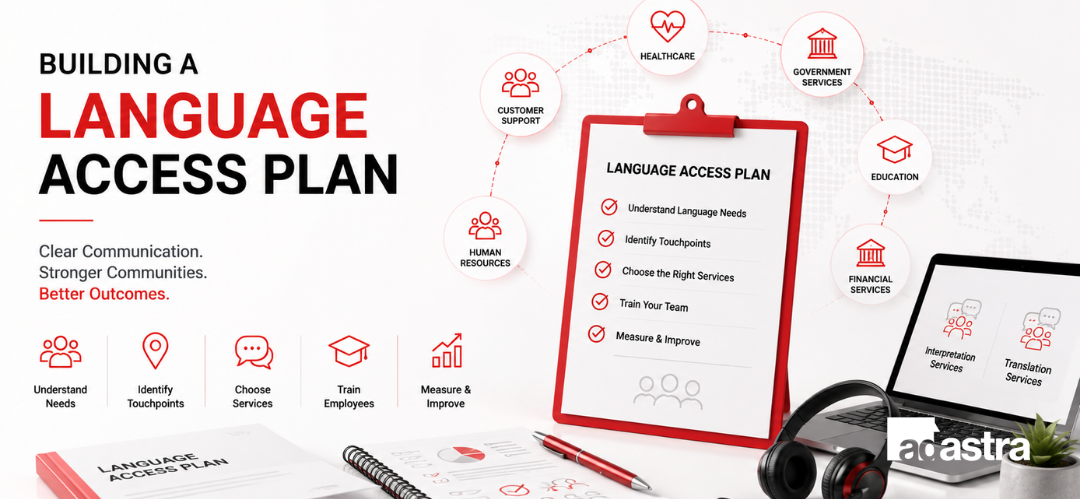
Five Steps to Build an Effective Language Access Plan
1. Understand the Language Needs of Your Audience
Every successful language access plan begins with understanding the people you serve.
Review customer demographics, census data, service requests, and historical interactions to identify which languages are most frequently requested. Don't focus only on today's needs. Consider future growth, new markets, and changing community demographics.
Questions to ask include:
-
Which languages are requested most often?
-
Which departments receive the highest number of multilingual interactions?
-
Are there seasonal or regional differences?
-
Which customer groups experience the greatest communication barriers?
This information forms the foundation of your entire strategy.
2. Identify Every Point Where Language Support Is Needed
Many organizations only think about language access during customer service calls. In reality, multilingual communication may be needed throughout the customer journey.
Consider situations such as:
-
Customer support
-
Patient appointments
-
Emergency communications
-
Legal consultations
-
Human resources meetings
-
Benefits enrollment
-
Virtual appointments
-
Community outreach
-
Public information campaigns
Mapping these interactions helps determine where professional interpretation services should be available.
3. Choose the Right Language Access Services
Different situations require different communication solutions.
Some conversations are best handled through on-site interpreters, while others may benefit from video remote interpreting or over-the-phone interpretation.
Similarly, written materials such as consent forms, contracts, employee handbooks, or public notices may require professional translation services.
Instead of relying on one solution for every situation, organizations should develop a flexible strategy that provides the appropriate language access services based on the complexity, urgency, and sensitivity of each interaction.
4. Train Employees to Use the Process
Even the best language access plan can fail if employees don't know when or how to use it.
Staff should understand:
-
When professional interpreters are required
-
How to request language assistance
-
Why bilingual employees should not automatically act as interpreters
-
How to protect confidentiality during interpreted conversations
-
Which departments provide language support
Training creates consistency across the organization and helps employees respond confidently when language barriers arise.
5. Measure Performance and Continuously Improve
A language access plan should evolve as your organization grows.
Monitor performance by reviewing metrics such as:
-
Interpreter response times
-
Customer satisfaction
-
Number of language requests
-
Most frequently requested languages
-
Employee feedback
-
Compliance outcomes
Regular reviews help identify gaps and ensure your language access strategy continues meeting organizational needs.
Common Mistakes Organizations Make
Many organizations recognize the importance of multilingual communication but still struggle because their approach lacks structure.
Some of the most common mistakes include:
Relying on Bilingual Employees
Speaking two languages does not automatically qualify someone to interpret sensitive medical, legal, or financial conversations. Professional interpreters receive specialized training in accuracy, confidentiality, and ethics.
Waiting Until a Problem Occurs
Organizations often create language procedures only after receiving complaints or facing compliance challenges. Planning ahead allows teams to respond quickly and consistently.
Offering Limited Language Support
Focusing only on the most common languages may leave smaller language communities without adequate access. Reviewing demographic trends regularly helps organizations adapt to changing needs.
Skipping Employee Training
Without clear guidance, employees may not know when to request professional language support, leading to inconsistent service delivery.
Treating Language Access as a One-Time Project
Communities change, organizations grow, and communication needs evolve. A language access plan should be reviewed regularly to remain effective.
Questions to Ask Before Implementing Your Language Access Plan
Before rolling out your strategy, ask yourself:
-
Which languages do our customers or communities speak most often?
-
Do we have clear procedures for requesting language assistance?
-
Can employees quickly access professional interpretation services?
-
Are multilingual communications available across every customer touchpoint?
-
How do we measure the quality of our language access services?
-
Are we meeting applicable accessibility and compliance requirements, including ADA compliance where appropriate?
-
Who is responsible for maintaining and updating the language access plan?
Answering these questions early helps create a stronger, more sustainable strategy.
Build a Language Access Plan That Can Grow With Your Organization
As organizations expand into new regions, serve more diverse communities, or introduce new services, language needs naturally become more complex.
A scalable language access plan prepares organizations for that growth. Instead of creating new processes every time demand changes, teams can rely on established procedures that support consistent multilingual communication across departments and locations.
Whether you're serving patients, customers, employees, or community members, investing in language access today helps build stronger relationships, improve operational efficiency, and reduce communication risks tomorrow.
Organizations that partner with experienced providers such as Ad Astra gain access to professional interpretation services, translation expertise, and customized language access solutions that can grow alongside their business. With the right strategy in place, multilingual communication becomes an integral part of delivering accessible, high-quality services to every audience.