
Choosing the Right Interpretation Service for Every Business Scenario
Interpretation
Most businesses do not fail at deciding to use interpretation. They fail at choosing the wrong type for the situation and only realizing it mid-meeting.
A manufacturing company brings an on-site interpreter to a routine vendor call that could have been handled in five minutes over the phone. A law firm books a remote phone-based session for a deposition where the attorney needs to read the witness's body language. A financial services company books a single consecutive interpreter for a 400-person international summit and wonders why the schedule runs three hours over.
These are not edge cases. They are the decisions that separate businesses that use interpretation services effectively from those that burn budget and create unnecessary risk.
This guide is built for businesses that have already decided they need professional interpretation. The question is which format is right, for which situation, and what to confirm before you book.
Start With the Scenario, Not the Service
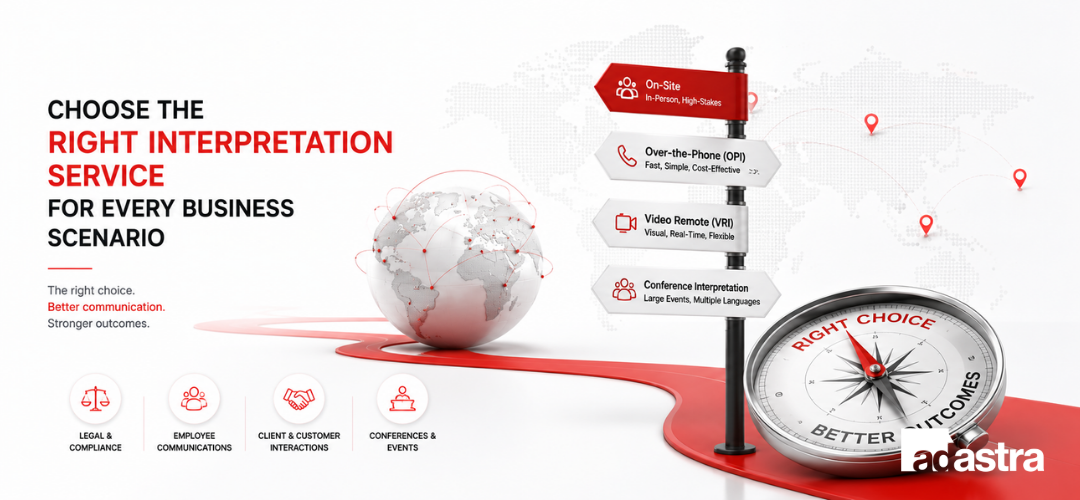
There are four primary interpretation formats available to businesses: on-site, over-the-phone (OPI), video remote (VRI), and conference interpretation (simultaneous). Each one was built for a specific context. Using the wrong format in the wrong context is where most mistakes happen.
The simplest way to choose is to answer three questions about your situation before looking at service options:
1. Does the interpreter need to be physically present? If the interaction involves legal proceedings, document signing, sensitive negotiations, or situations where the interpreter may need to certify their work, on-site is usually the right answer. For everything else, remote formats are equally effective and significantly more cost-efficient.
2. Does visual communication matter? If interpreting for Deaf or Hard-of-Hearing individuals, or if body language and facial expressions are material to the interaction, you need video. If it is a purely audio conversation, phone-based interpretation works well.
3. Is this a one-to-one or small-group interaction, or a large multilingual event? Small group and bilateral interactions work with consecutive interpretation. Large conferences and events with multiple language tracks require simultaneous interpretation with the appropriate equipment.
Once you have answered those three questions, the right format becomes clear.
High-Stakes Legal and Compliance Settings
For depositions, arbitration hearings, regulatory interviews, contract negotiations, and any interaction where the record matters, on-site interpretation is the standard.
The reason is accountability. An on-site interpreter is physically present, can be identified, can take an oath if required, and their credentials can be verified in the room before the proceeding begins. In legal settings, the interpreter may be asked to certify the accuracy of what was said. That is not possible to do effectively over a phone line.
On-site interpretation in legal settings also means the interpreter can read the room. A witness who hesitates before answering, an opposing counsel who leans in during a particular exchange, a negotiator who checks with a colleague before responding — these are signals that matter to legal strategy and that a remote interpreter has no access to.
For businesses managing regular multilingual legal work across multiple jurisdictions, it is worth establishing a relationship with an interpretation provider who has credentialed legal interpreters across the specific languages you need, rather than sourcing per-engagement from a general provider.
When on-site legal interpretation is not necessary: Routine attorney-client calls where the interaction is informational rather than evidentiary, and where the client simply needs to understand what is being explained, can be handled effectively via OPI. Reserve on-site for proceedings.
Multilingual Internal Meetings and Employee Communications
For HR conversations, employee onboarding, performance reviews, policy communications, and internal training sessions, the right format depends on the sensitivity of the conversation and the number of languages involved.
For one-on-one or small-group conversations where an employee needs to discuss a sensitive matter in their preferred language, VRI is the most practical and cost-effective solution. The interpreter joins by secure video, visual cues are available, and the session can be arranged with very little lead time.
For internal training sessions conducted in-person where employees speak different languages, consecutive on-site interpretation works well. The trainer delivers content in segments, the interpreter renders it in the target language, and participants have time to absorb the material before moving forward.
One format that does not work well for sensitive HR conversations is OPI. When an employee is discussing a disciplinary matter, a workplace accommodation, or a benefits issue, the absence of visual context on both sides of the call creates unnecessary friction. VRI or on-site is more appropriate here.
International Conferences and Large-Scale Events
This is where simultaneous conference interpretation comes in, and where the investment is most clearly justified by the alternative.
Simultaneous interpretation runs in real time. The interpreter works from a soundproof booth, listens to the speaker, and delivers the interpretation in the target language with a two-to-three second lag. Attendees wearing headsets hear the content in their language without any interruption to the flow of the event. For a conference with 300 attendees across four language groups, it is the only format that keeps the event running on schedule.
The setup requires booths, audio distribution equipment, and a minimum of two interpreters per language pair (simultaneous interpretation is cognitively intensive and interpreters rotate every 20 to 30 minutes). This makes it the most resource-intensive interpretation format, but for large events it is the only option that does not double the length of the program.
A common mistake is booking a single interpreter for a full-day conference to reduce cost. Simultaneous interpretation at professional quality requires interpreter rotation. A single interpreter working four consecutive hours will show measurable quality decline, and in a high-stakes business or investor conference, that is a visible problem.
Simultaneous interpretation is optimal for large, formal gatherings like international conferences where information must flow continuously to a diverse, multilingual audience. If your event has speakers presenting to audiences rather than facilitating conversations, this is the format to use.
High-Volume Customer-Facing and Call Center Interactions
For businesses handling multilingual constituent, customer, or client calls at volume, over-the-phone interpretation (OPI) is the right infrastructure.
OPI connects a call agent or representative with a professional interpreter via a three-way call. The interpreter joins in under 30 seconds, covers the conversation, and the session ends when the call does. Billing is by the minute, which means costs are directly proportional to actual usage rather than scheduled session time.
This format works for industries with high inbound call volume and unpredictable language demand: insurance, financial services, healthcare, government agencies, utilities, and retail banking. You cannot staff for every language your customers might speak, but with OPI access you can serve all of them.
The limitation of OPI is the absence of visual context. For complex interactions where the representative needs to walk a customer through a document they are holding, or where visual confirmation is important, VRI is the better option. A practical approach many organizations use is OPI for routine, high-volume inquiries and VRI for interactions that involve document review, sensitive health information, or situations where non-verbal communication matters.
Real-Time Virtual Meetings and the Remote Workplace
For businesses operating across language lines in a remote or hybrid environment, VRI has become the standard solution for scheduled virtual meetings.
VRI integrates with platforms like Zoom, Microsoft Teams, and Google Meet. The interpreter joins as a participant, and interpretation is delivered through the platform's interpretation channel or via a dedicated audio stream. Attendees listen to the interpreter in their language while the speaker continues without interruption.
This format is effective for scheduled multilingual business meetings, cross-border project calls, executive presentations to international teams, and any virtual interaction where visual cues are relevant.
It is also the appropriate format for interpretation involving Deaf or Hard-of-Hearing colleagues. ASL, BSL, and other signed languages require video, and VRI provides immediate access to qualified sign language interpreters without requiring anyone to travel.
One consideration for VRI in business settings: connection quality matters significantly more than in OPI. A dropped video feed mid-meeting is a more disruptive failure than a brief audio interruption. Confirm with your provider that interpreters are working from stable, professional-grade connections rather than consumer-grade home setups.
The Consecutive vs. Simultaneous Question for Business Negotiations
One of the most frequent mistakes in high-stakes B2B negotiations is defaulting to simultaneous interpretation because it feels more efficient.
Simultaneous interpretation keeps the pace of conversation moving, which is valuable in conferences. In a negotiation, that same pace can actually work against you. When you use consecutive interpretation in a negotiation, you gain two to five minutes of structured pause time while your counterpart listens to the translation. During that pause, you can observe body language, consult with your team, or process what was just said before you need to respond.
Consecutive interpretation in a negotiation is not slower communication. It is structured communication that gives both parties time to think, which in high-stakes deals is a strategic advantage, not a logistical inconvenience.
Use simultaneous for conferences and presentations. Use consecutive for negotiations, depositions, interviews, and any interaction where the quality of each exchange matters more than the speed of the overall session.
Five Questions to Confirm Before You Book
Regardless of which format you have selected, these questions should be answered before you confirm an interpretation engagement.
What is the interpreter's experience in this subject matter? A certified legal interpreter is not automatically qualified for a highly technical pharmaceutical discussion. Confirm that the interpreter has relevant domain experience.
For on-site bookings, what are the cancellation and travel terms? On-site interpretation involves logistics. Understand the lead time required, the cancellation window, and any travel costs before you are committed.
For simultaneous conference interpretation, how many interpreters per language pair? Professional simultaneous interpretation requires two interpreters per language pair who rotate. If a provider quotes you one interpreter per language for a full-day event, that is a quality warning.
What happens if the interpreter encounters a technical term they are uncertain about? Professional interpreters flag uncertainty rather than approximating. Ask how the interpreter handles terminology gaps in real time.
Is the interpretation session confidential, and how are recordings or notes handled? For legal, financial, or HR contexts, confirm the confidentiality terms explicitly. Some remote interpretation sessions are recorded by the platform for quality review, which may not be appropriate for your use case.
The Right Format Makes Every Interaction More Effective
Choosing interpretation services for businesses is not a single decision. It is a framework that your team should be able to apply consistently across different situations, languages, and event types.
On-site for legal proceedings and high-stakes negotiations. OPI for high-volume customer and call center interactions. VRI for scheduled virtual meetings and signed language interpretation. Simultaneous for conferences. Consecutive for bilateral negotiations and small-group discussions where depth matters more than pace.
Ad Astra provides the full range of business interpretation services, from on-site professional interpreters with domain specialization to OPI, VRI, and full conference interpretation with booth equipment and simultaneous delivery. If you are planning an engagement and are not certain which format fits your situation, our team can help you assess the scenario and confirm the right approach before you book.
Related reading: OPI vs. VRI: How to Choose the Right Remote Interpreting Solution