How AI Supports Government Contact Centers Without Replacing Human Expertise
AI
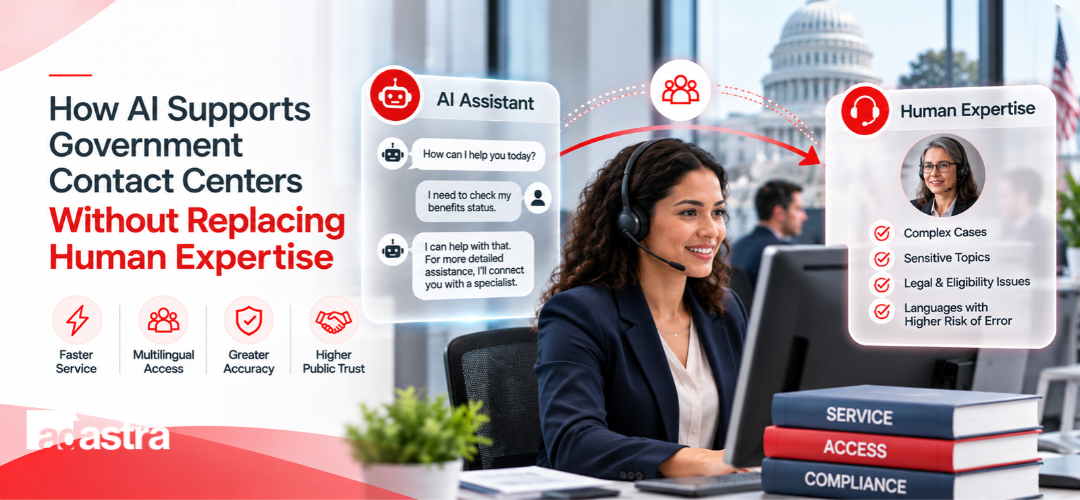
It's the Monday after renewal notices went out. The phones are lit up. Most callers are asking the same five questions: Did you get my form? What's my status? Where's the office? What do I bring? A few are frightened, because a notice says their benefits could end. A few don't speak English. All of them are in the same queue, and the team answering is the same size it was last month.
That is the case for AI in a government contact center. It is also the case for being careful with it.
Agencies are moving fast. A recent Twilio-commissioned survey found that public sector AI use cases grew 50 percent between 2024 and 2026. The same survey found that 88 percent of public sector organizations rate their digital resident engagement as good or excellent, while only 44 percent of residents agree. Adoption is running ahead of trust.
Closing that gap comes down to one question: what should AI do, and what should stay with people? This article walks through both sides.
What an AI Government Call Center Does Well
Used for the right jobs, AI takes real pressure off a contact center. The best uses share a pattern. They're repetitive, low-risk, and easy to check.
Answering routine questions at any hour. Office hours, document checklists, application status, payment deadlines. These make up a big share of contact volume, and residents don't need a person to hear them. They need a fast, accurate answer at 9 p.m. on a Sunday.
Sorting and routing. AI can identify the reason for a call, detect the caller's language, and send them to the right team. That saves the caller from repeating themselves three times.
Helping agents while they work. Suggested answers, call summaries, and after-call notes give agents back time they used to spend typing. The agent still owns the conversation. The software handles the paperwork.
Starting a conversation across languages. This is where AI can change the experience most. Instead of waiting for an interpreter to be available, a caller can begin right away with AI interpretation, and a person can step in if the call needs one.
Spotting patterns. If call volume jumps every time a particular letter goes out, AI can flag it. That helps agencies fix the letter instead of adding staff to absorb the confusion.
None of this replaces anyone. It clears the routine work so staff and interpreters have time for the calls that need them.
Where AI Falls Short, and Why It Matters More in Government
Commercial call centers can tolerate an occasional bad answer. Government rarely can. The people calling are often dealing with benefits, housing, healthcare, legal rights, or immigration, and a wrong answer can cost them something real.
Here's where AI runs into trouble.
Language coverage is uneven. AI performs best in languages with lots of training data and worst in the rest. Research on AI-mediated interpreting notes that performance is strongest for widely spoken languages and weakest for low-resource and Indigenous languages. Many government callers speak exactly those languages. Dialects, accents, and informal speech add to the problem.
Errors sound confident. A human who doesn't understand will usually say so. An AI tool may produce a smooth, wrong answer. The caller can't tell the difference, and neither can an agent who doesn't speak that language.
Some topics are sensitive by nature. In PayIt's 2026 survey of residents, benefit eligibility was the only government service where more than half of respondents said they were uncomfortable with AI. That fits what most agency staff would expect. People want a person when the outcome affects their livelihood.
Nobody is accountable. A professional interpreter works under a code of ethics, signs confidentiality agreements, and can be held to a standard. A software tool can't. That gap is why the National Center for State Courts has said AI shouldn't replace human interpreters for real-time spoken interpretation in court, a position summarized in the American Translators Association's overview of AI and interpreting.
Judgment and empathy. A caller who is scared, confused, or in crisis needs someone who can hear that, slow down, and adjust. Reading a room, even over the phone, is still a human skill.
The Calls Where Human Interpreters Stay Essential
You don't have to decide this call by call in the moment. It helps to set categories in advance. Calls that should lean toward a professional interpreter include:
-
Benefits eligibility, denials, and appeals
-
Legal rights, notices, and hearings
-
Health, safety, and medication information
-
Immigration-related questions
-
Anything involving a crisis, abuse, or distress
-
Languages and dialects where AI is known to be weaker
-
Any call where the caller asks for a person
For these, a trained interpreter on the line through over-the-phone interpreting or a broader professional interpretation service protects both the resident and the agency. It also creates a clear record of who was on the call and to what standard they worked.
What Human + AI Looks Like in Practice
The most workable model is a hybrid. AI starts the work and people take over when the conversation calls for it. In practice it runs something like this:
-
AI opens the call. It greets the caller, identifies the language, and handles simple requests.
-
Clear triggers escalate the call. A sensitive topic, a repeated misunderstanding, signs of distress, or a caller asking for a person all hand the call to a human. Agencies should define these triggers in writing before launch.
-
The person picks up with context. The caller shouldn't have to start over. The agent or interpreter should see what's already been said.
-
People review the results. Human staff audit samples, correct errors, and feed what they learn back into the process.
The hand-off is what makes or breaks this. If reaching a person feels like a maze, residents stop trusting the whole system, and the agency loses the benefits of the automation.
Questions to Ask Before You Add AI to Your Contact Center
If you're evaluating this now, start here:
-
Which types of calls are safe to automate, and which are not?
-
Can a caller reach a person at any point, quickly and without penalty?
-
Will callers know when they're talking to AI?
-
How does the tool perform in the languages your residents actually speak, not just the top few?
-
Who reviews quality, and how often?
-
Where does call data go, and who can access it?
If a vendor can't answer these plainly, that tells you something.
AI Handles the Volume. People Handle the Moments That Matter.
The goal isn't a contact center with fewer people. It's one where people spend their time on the calls that need them. AI makes it possible to answer more residents, faster, in more languages. Professional interpreters and trained agents make sure the answers are right when the stakes are high.
Agencies that get this balance right don't have to choose between efficiency and trust. They design for both from the start.
Ad Astra supports government agencies with government call center services and a Human + AI approach to language access. Conversations can begin instantly with AI interpretation, and a professional interpreter can join whenever the call requires one. If your agency is exploring AI for its contact center, our public sector team can help you decide where it fits and where it doesn't.