
Nice Wants to Be Liked. Kind Wants to Be Trusted.
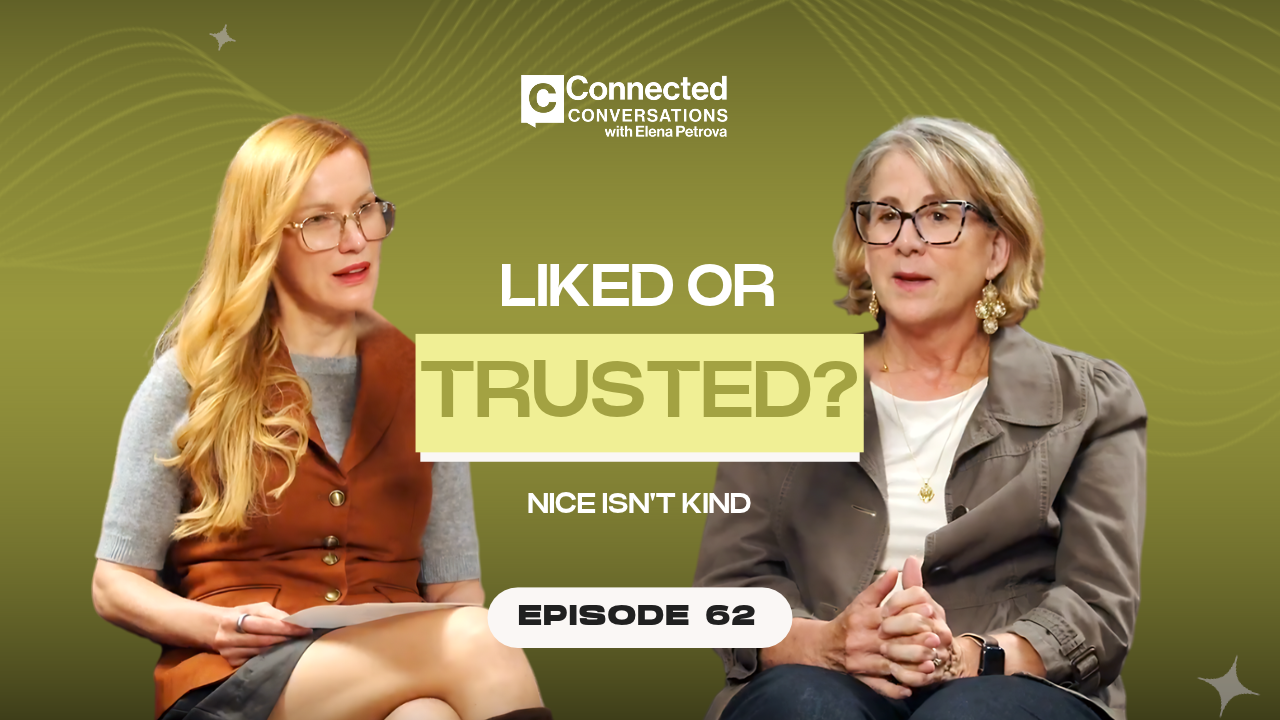
Debra Mitchell has spent more than 20 years helping large organizations through change. In this episode of Connected Conversations, she tells Elena Petrova why being nice quietly costs teams, and why the leaders who get change right are the ones who listen first.
Clear is kind
Elena opens with a hard question: when did being nice last cost you something? Debra answers with a distinction she lives by, borrowing Brené Brown's line that clear is kind.
"Nice is like wanting people to like you," she says. "Kind is about being clear. It's about being accountable to yourself and others." Kind is proactive. It gives feedback. Nice keeps the peace and lets problems grow.
She admits she was too nice early in her career, and she still sees the pattern in the leaders she coaches. One woman she works with gets talked over in meetings. She doesn't interrupt, catches the person afterward, and tells herself that's just the way he is. Debra's response is simple: it isn't okay, and we have to hold each other accountable. Leaders who are nice want to be liked. What they actually need is to be respected and trusted, and niceness alone doesn't earn either.
She also names something many new managers feel and few talk about. Every promotion comes with some loneliness. The peers who were your friends now report to you, and that distance pushes people toward being nice. Kind is the better answer.
Change that lands on the middle
Most failed change, in Debra's experience, follows the same path. Leaders decide a change is needed, often for good reasons, without digging into the why or the impact on people. The people who have to roll it out aren't part of the conversation. Then it lands on the desks of middle managers, who get a directive without understanding what's happening.
What works, she says, is leadership setting the direction and then letting middle managers and their teams figure out how they fit into the change, both for the company and for themselves. Not everyone needs to be on the same page at the same moment. People will arrive at different speeds. And rather than spending all her energy on the loudest critics, she looks for the influencers who understand the goal and can carry it across their teams.
Underneath every new process or tool, she adds, is a behavior change. If you don't know what that behavior is, you don't really know what you're changing.
A break room with no agenda
Debra's favorite example comes from a large food bank with five locations. The decision had been made at the top, and middle managers felt they'd had no say. The department wasn't tech savvy, and the client told her office hours never worked there.
She did them anyway. Once or twice a week, she sat in the break room with no agenda. "My agenda was to just listen." Every week, at least twelve people came. Some asked about the new system. Most wanted to talk about their concerns: the pace, team members who didn't know how to use computers, and a go-live date that would eat into Thanksgiving and Christmas. People were scared.
Leadership hadn't known. They had read the pushback as people being difficult. Debra translated what she heard into terms the executives could act on, and the project adjusted. One fix was simple: short explainer videos playing in the break rooms that walked employees through the new process in plain language. They were such a hit that the team made more.
Slow down to go faster
Some of the most expensive mistakes come from the calendar. Debra joined one technology project in August with a hard October 1 go-live. Roles and permissions weren't even set. The date held for weeks before being pushed to December 1.
She sees it constantly: the project plan becomes the driver, and nobody weighs what it costs to get it wrong. With something as consequential as AI, that cost multiplies. "Sometimes you really just have to slow down to be faster," she says. When everything is a priority, nothing gets done well.
That's also why she has turned down work. She once told a client their governance problem was really a trust problem, and that she shouldn't be hired for governance until they fixed it. He agreed. They worked on trust first, then governance.
Humility, and the words "I don't know"
Asked what matters most in any change besides trust, Debra adds transparency and the willingness to admit you didn't get it right. She learned that early, on a large Air Force technology implementation that failed publicly. In her telling, the work was directed from above, the people who would use the system weren't heard, and the outside teams never earned their trust. Her takeaway: working for a big company makes you fortunate, not smarter. Be humble. Be curious. Say "I don't know" and figure it out together.
Tell me more
For the conversations we avoid, her go-to opener works almost anywhere: "Tell me more about that." Then ask for a specific example, or whether it's a one-time thing or a pattern. Curiosity interrupts the horror movie we play in our heads, which rarely comes true. People won't always answer well the first time, she says, but keep asking and they learn to be clearer.
She sees the biggest gap at the first level of management, where people are rarely taught how to have hard conversations and never practice them. That's where engagement breaks down. The fix is everyday conversation, so trust already exists when the hard one comes.
One question worth asking
Debra closes with the question she tells everybody to ask: "Tell me one thing you don't think I want to know." Then stay quiet and listen.
When she asked someone on her team, he told her she said no all the time. Her first instinct was to say she didn't. Instead she asked him to tell her more, then asked for help staying accountable. They checked in on it every week. She has since asked the same question at home, and heard something she says she never would have known otherwise.
It's a fitting close to a conversation about kindness. Being kind sometimes means asking to hear the thing nobody wants to say and being ready to listen when they do.
Listen to Episode 62 of Connected Conversations, hosted by Elena Petrova, Founder and CEO of Ad Astra, Inc. and AdAstraConnect.
Connected Conversations is produced by Ad Astra, Inc.
You can watch/listen to this episode here:
🔴 YouTube: https://youtu.be/dj0y1zOASrc
🟢 Spotify: https://shorturl.at/pIbpU
⚫ Apple Podcast: https://shorturl.at/onopa
🔵 Amazon Music: https://shorturl.at/5NeId