
Reducing Business Risk with Professional Interpretation Services
Interpretation
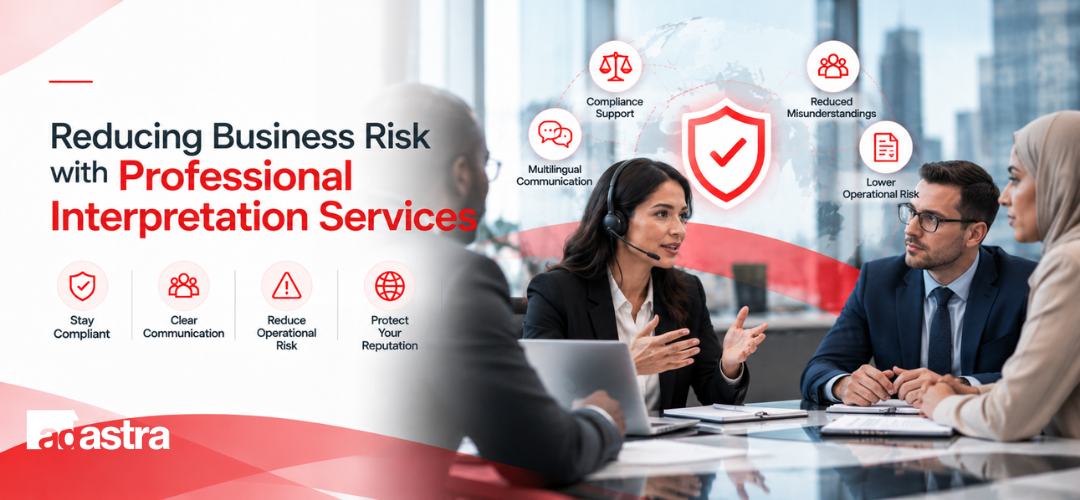
A shift supervisor at a distribution center needs to hand a new hire a written warning. The employee speaks Portuguese. Nobody in HR does. So the supervisor grabs a coworker from receiving who is "pretty fluent" and asks him to explain it.
Five minutes later, everyone nods. The paper gets signed. Three months on, the employee is let go, and a lawyer's letter shows up saying he never understood the warning, never knew what was at stake, and was never told he could respond.
Nobody in that story did anything malicious. There was a gap, and someone filled it with a favor. That is how most language-related risk starts. Not with a dramatic failure, but with a quick fix that felt reasonable at the time.
This article is for the people who end up owning that risk: compliance leads, HR directors, operations managers, legal and risk teams. We'll look at where the exposure comes from, what regulators expect, and what to look for when you buy professional interpretation services so the problem gets handled at the source.
The Risk Usually Starts With a Favor
Most organizations are not ignoring language needs. They are meeting them the wrong way. A bilingual coworker steps in. A patient's teenage daughter translates. A manager who took Spanish in college does their best. Someone opens a free app on their phone.
Every one of those fixes solves the problem in front of you and creates a new one behind it.
Being bilingual is not the same as interpreting. An interpreter has to carry everything across, in real time, without dropping details, adding opinions, or softening bad news. That takes training, vocabulary, and a habit of staying neutral. A coworker has a stake in how the conversation goes. A family member has feelings about it. Neither is built to stay out of the way.
The research on this is strongest in healthcare, and it makes the point well. In a study of pediatric emergency department visits, 12 percent of errors made by professional interpreters had potential clinical consequences, compared with 22 percent for ad hoc interpreters and 20 percent when no interpreter was used. Interpreters with more training made fewer mistakes still.
That's a medical setting, but the pattern isn't unique to hospitals. Omitted details, swapped words, and confident guesses show up in any room where two languages meet. Hospitals just happen to measure it.
Compliance: What Regulators Expect
The rules vary by sector, but they rhyme. If people can't understand what you are telling them, you haven't done your job.
Healthcare
Section 1557 of the Affordable Care Act requires covered entities to provide qualified interpreters at no cost to patients with limited English proficiency. It also prohibits relying on minors to interpret, and limits the use of accompanying adults to narrow circumstances. "Qualified" has a specific meaning here. A receptionist who speaks Spanish at home doesn't meet it.
Workplace Safety
OSHA's position is that required safety training has to be presented in a manner, language, and vocabulary employees can understand. A signed sign-in sheet proves someone attended. It doesn't prove they followed a word of it, and comprehension is the whole point. If your workforce includes people who don't speak English well, a live interpreter during training is a much stronger answer than a translated handout nobody reads.
Deaf and Hard-of-Hearing Communication
The ADA expects effective communication with Deaf and hard-of-hearing customers and employees. In anything beyond a simple exchange, that often means a qualified sign language interpreter, not handwritten notes and lip reading. If this applies to your organization, our Deaf services and American Sign Language interpreting pages cover how that support works.
Government-Funded Programs
If you receive federal funding, Title VI language access obligations remain in place. The 2025 executive orders changed federal guidance, but they didn't repeal the statute, and many states, New York among them, have their own language access laws on top. Agencies and contractors should audit both layers.
Legal and Financial Exposure
When something goes wrong, the first question is usually the same: what was actually communicated, and who can prove it?
Informal interpretation makes that hard to answer. The coworker who interpreted the warning is now a witness, and probably one with a job to protect. The family member who translated the consent conversation may remember it differently than the physician does. Nothing was recorded, nothing was verified, and "we thought they understood" is a weak thing to say to a regulator or in a deposition.
A professional interpreter gives you a cleaner record. There's a named, qualified person with no stake in the outcome, working under a confidentiality agreement, in a defined session. You can show who was there and what standard they worked to.
The money side is just as practical. A misunderstood safety instruction becomes an injury claim. A misread contract term becomes a dispute. A termination conversation nobody followed becomes a wrongful dismissal claim. The interpreter's fee is the smallest number in any of those files.
Reputation Moves Faster Than Compliance
Customers who can't get help in their language rarely file a formal complaint. They leave. Or they tell their neighbors, post a review, or call a local reporter.
In communities where word travels fast, that last one matters more than most companies expect. One badly handled interaction, a patient turned away, a customer talked over, a family told to "bring someone who speaks English," can end up in a review, a news segment, or a regulator's inbox. The cost of that is hard to put on a spreadsheet, but anyone who has managed through one knows it is real.
What "Professional" Should Actually Mean
Plenty of vendors use the word. Here is what to ask about before you sign anything.
-
Vetting and credentials. How are interpreters screened, tested, and background-checked? Ask for specifics, not a sentence about "rigorous standards."
-
Subject-matter fit. A medical interpreter and a legal interpreter are not interchangeable. Ask who would cover your type of work.
-
Real coverage numbers. Which languages are available at 2 a.m.? What is the average connection time on a phone call? Get the numbers in writing.
-
Confidentiality. Signed agreements, a Business Associate Agreement if you handle health information, and secure delivery for remote sessions.
-
Quality assurance. How are complaints handled, and how do they monitor interpreter performance over time?
-
Reporting. Can you see usage by language and department? If an auditor asks how you provide language access, you will want data, not a story.
-
A backup plan. What happens when the interpreter you usually get isn't available?
If a vendor answers with a brochure instead of specifics, that's your answer.
Where AI Interpretation Fits
Buyers are asking about this now, so here's a plain take.
AI tools can be useful for low-risk, high-volume exchanges: directions, store hours, basic intake questions, quick clarifications. They get faster and better every year.
They are a poor fit where an error carries legal, medical, or safety consequences. A tool can't sign a confidentiality agreement, answer to a code of ethics, or be held accountable the way a credentialed professional can. Put a rule in writing about which situations can use AI interpretation and which require a human. Decide it before the first incident, not after.
Match the Service to the Risk
Not every situation needs the same format, and over-buying wastes budget. A rough guide:
-
Always-on, high-volume contact. Over-the-phone interpreting connects in seconds and covers a wide range of languages without scheduling.
-
Conversations where faces and gestures matter. Video remote interpretation adds the visual layer, and it's essential for sign language.
-
High-stakes, in-person moments. Depositions, sensitive negotiations, and serious medical or HR conversations are usually worth an on-site interpreter.
Our professional interpretation services page covers all three in more detail.
Cheap Fixes Get Expensive Fast
Informal interpretation feels free. It isn't. You just pay later, in a different budget line, usually with a lawyer or a regulator attached.
Organizations that handle this well don't treat language support as a favor between coworkers. They treat it like any other control that protects the business: defined, documented, staffed by qualified people, and checked regularly.
Ad Astra provides professional interpretation services for healthcare, legal, government, and business settings, with vetted interpreters, confidentiality protections, and coverage across phone, video, and on-site formats. If you are reviewing how your organization handles language access, we're happy to look at your current setup and tell you where the gaps are.