
Why Financial Translation Requires Industry Expertise
Translation
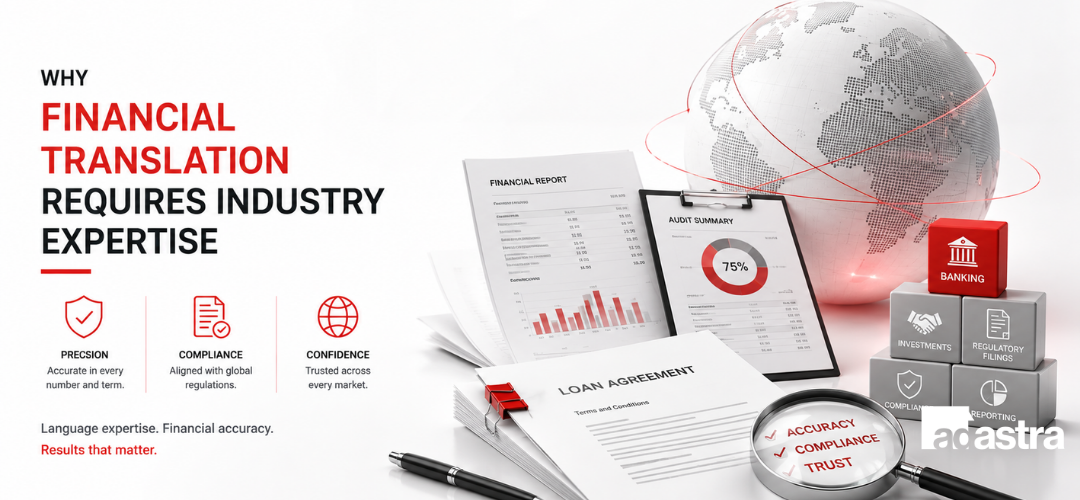
In most industries, a translation error causes a problem. In financial services, it can cause a federal investigation.
A misplaced decimal in a cross-border audit report. A mistranslated term in a regulatory filing that changes the reported liability of a fund. A loan agreement where the repayment conditions read differently in the target language than they do in the original. These are not hypothetical scenarios. They are the documented consequences of treating financial document translation as a general language task rather than a specialized discipline.
Cross-border payments alone are projected to grow from $194 trillion in 2024 to $320 trillion by 2032. The volume of financial documentation that needs to move accurately across languages and regulatory jurisdictions is growing at the same pace. Banks, investment firms, insurance companies, and fintech platforms expanding into new markets are generating more multilingual finance content than at any point in history.
This is a complete guide to financial translation services: what makes this field distinct, where generic approaches break down, and what enterprises should expect from a qualified financial translation partner.
Why Financial Translation Is a Category of Its Own
Financial translation sits at the intersection of language expertise, domain knowledge, and regulatory understanding. All three are non-negotiable. Weakness in any one of them creates risk.
A skilled linguist who does not understand accounting standards will produce a grammatically correct translation that misrepresents the financial position being described. A financial expert who translates without professional language training will produce accurate content that reads poorly in the target market and may not meet the linguistic requirements of local regulators. And both can produce technically sound work that still fails compliance review because neither understands the specific regulatory framework governing financial communications in the target jurisdiction.
This is why the financial translation services guide that most enterprises need is not a list of translation vendors. It is a framework for understanding what qualified financial translation actually requires, so the right questions get asked before a partner is selected.
Generic translation tools and non-specialist agencies are not equipped for this work. The stakes are too high and the domain is too specific.
The Documents That Require Specialist Handling
Financial document translation covers a wide range of content types, and each carries its own requirements.
Regulatory filings are the highest-risk category. Annual reports, 10-K and 20-F filings with the SEC, prospectuses filed with ESMA, and compliance submissions to national financial regulators must be accurate to the specific terminology standards of the receiving body. In 2022, the SEC filed 760 enforcement actions resulting in a record $6.4 billion in penalties and disgorgement. A mistranslated term in a filing that misrepresents a financial position or obligation is not a linguistic issue. It is a compliance issue with enforcement consequences.
Financial statements translated for cross-border reporting must reflect the accounting standards of the target jurisdiction. A company reporting under US GAAP that needs to produce IFRS-compliant financial statements for European investors is not simply translating words. The underlying accounting concepts may map differently between the two frameworks, and the translation must reflect those differences accurately.
Investment documentation including fund prospectuses, term sheets, subscription agreements, and risk disclosure documents requires absolute precision in describing investment risk, fees, and the conditions under which capital can be accessed or redeemed. Errors in these documents expose the issuer to investor disputes and regulatory action.
Banking contracts covering loan agreements, credit facilities, trade finance documentation, and correspondent banking agreements require consistent terminology across all language versions. A discrepancy in how a covenant condition is described in two language versions of the same loan agreement creates legal ambiguity that can be exploited in a dispute.
Client-facing communications including account statements, terms and conditions, product disclosures, and KYC documentation need to be clear, accurate, and compliant with consumer protection regulations in each market. Ambiguity in any of these documents creates both regulatory exposure and client trust problems.
The Terminology Problem Generic Translation Cannot Solve
Financial terminology is precise by design. The words used in financial documents have specific, agreed-upon meanings within regulatory and accounting frameworks. When those words are translated carelessly, the meaning changes.
The simplest example is the difference between "revenue" and "turnover." In everyday English, these terms are often used interchangeably. In financial reporting, they are not. Turnover can refer to asset ratios or specific regional sales metrics depending on context and jurisdiction. A translator who does not understand this distinction will produce a document where the reported financial position means something different to a European regulator reading it than it did in the original English.
The same problem exists across the entire vocabulary of financial services. "Net income" and "net profit" carry different implications in different accounting frameworks. "Capital" means something specific in banking regulation that it does not mean in general usage. "Provision" in the context of a financial statement is not the same concept as a provision in a contract, even though the word is identical.
These are not edge cases that appear occasionally. They are the daily working vocabulary of financial translation, and every one of them requires a translator who understands the financial domain as well as the languages involved.
This is also why banking translation in particular demands translators who understand the specific product and regulatory environment of retail banking, as opposed to capital markets, or insurance, or trade finance. The vocabulary differs significantly across these sub-sectors.
Regulatory Compliance Across Jurisdictions
Financial services is one of the most heavily regulated industries in the world, and the regulatory frameworks that govern financial communication differ significantly between jurisdictions.
In the European Union, MiFID II governs the language requirements and content standards for investment communications to retail and professional clients. Translated materials must meet not just linguistic standards but the specific disclosure requirements of the directive. ESMA publishes guidance on how financial instruments and their risks should be described, and translated documents need to reflect that guidance in each target language.
In the United States, SEC rules govern what foreign private issuers must disclose and in what form. Companies filing Forms 20-F or 6-K from non-English speaking jurisdictions must provide materials in English that accurately represent the original filings. A translation that introduces ambiguity or inaccuracy in those representations creates exposure.
In Asia Pacific, each major market has its own framework. Japan's Financial Services Agency, Hong Kong's SFC, and Singapore's MAS each have their own standards for financial disclosure, and those standards are reflected in local language requirements. A fund prospectus approved for distribution in one jurisdiction cannot be reused in another simply by updating the language. The underlying structure and disclosure requirements may differ.
For multilingual finance operations spanning multiple markets, regulatory compliance is not a single standard to achieve once. It is a jurisdiction-by-jurisdiction requirement that needs to be built into the translation process from the start.
How Financial Sub-Sectors Differ in Their Translation Needs
Financial services is not a single industry. The translation requirements of a retail bank are fundamentally different from those of an asset management firm, a fintech platform, or a reinsurance company. A qualified financial translation partner understands these differences and applies them.
Retail banking translation prioritizes clarity and accessibility. Product terms and conditions, mortgage documents, account agreements, and consumer disclosures need to be accurate and also comprehensible to non-specialist readers. Consumer protection regulations in most jurisdictions require that financial products be explained in plain language. A translation that is technically precise but difficult for a consumer to understand may be compliant in letter but not in spirit, and regulators have become increasingly attentive to that distinction.
Investment translation prioritizes precision in the description of financial instruments, risk factors, and performance data. Fund factsheets, KIID documents, and investor reports are read by sophisticated counterparties who will notice discrepancies in how a strategy or its risks are described across language versions. Investment translation also carries strict restrictions on the claims that can be made about past performance and future projections, and those restrictions vary by jurisdiction.
Fintech platforms expanding into new markets often have large volumes of UI content, product descriptions, terms of service, and compliance disclosures that need to be localized rapidly across multiple languages simultaneously. The challenge here is combining speed with precision, maintaining technical accuracy in product descriptions while meeting the linguistic standards of consumer protection regulation in each target market.
Insurance and reinsurance translation involves policy wording where every term has defined legal meaning under the governing jurisdiction's insurance law. A translated policy that uses a term differently than the original, even slightly, can affect whether a claim is covered. This is arguably the highest-stakes category in financial translation because the consequences are often not visible until a claim is made.
Confidentiality and Data Security
Financial translation involves some of the most sensitive documents organizations produce. Pre-announcement earnings data, M&A documentation, investor materials containing non-public information, and regulatory filings under embargo all require translation before publication or submission.
This creates a data security requirement that sits alongside the linguistic one. Translation workflows for financial content need to ensure that source documents and translated materials are handled under strict confidentiality agreements, transmitted through secure channels, and stored in environments that meet the security standards appropriate for financial data.
For publicly listed companies, this also means managing the timing and access controls around translation carefully. A translated earnings announcement that is accessible to the translation team before the embargo lifts creates regulatory risk that has nothing to do with the quality of the translation itself.
When evaluating a financial translation partner, security protocols deserve the same scrutiny as linguistic qualifications. Ask specifically about NDAs, data handling policies, access controls within the translator team, and the security of the platforms used to transmit and store documents.
Building a Reliable Financial Translation Workflow
For enterprises with ongoing financial translation needs across multiple markets, ad hoc project-by-project translation is not a sustainable model. The inconsistency compounds over time, and the cost of fixing terminology drift and compliance errors outweighs the short-term saving of choosing the cheapest available option each time.
A reliable financial translation workflow has four components.
Specialist translators with verified domain expertise. This means translators who have worked in financial services, hold relevant qualifications in accounting or finance, or have documented track records translating the specific content types your organization produces. Credentials matter here in a way they do not for general content translation.
A managed terminology glossary. Approved translations for your key financial terms, product names, and regulatory language need to be captured in a glossary that is applied consistently across every project and every translator. Without this, term drift is inevitable. TM tools reduce costs by 20 to 30 percent on repetitive annual filings while enforcing exactly this kind of consistency across document cycles.
A regulatory review step for compliance-critical documents. Linguistic quality review is not sufficient for documents that will be submitted to a financial regulator or distributed to investors under a regulated disclosure framework. Someone with understanding of the applicable regulatory framework needs to confirm that the translated content meets those requirements, not just that it is linguistically accurate.
Secure, documented handling. Every document should move through the workflow under a clear chain of custody, with documented access controls and audit trails appropriate to the sensitivity of the content.
Accuracy Is the Only Acceptable Standard
The financial services industry has a phrase that applies directly to translation: getting it wrong is not an option.
A mistranslated term in a consumer agreement can void an enforcement action or trigger a class action. An error in a regulatory filing can prompt SEC or ESMA scrutiny at a cost that dwarfs what a specialist translation team would have charged. A discrepancy between language versions of an investment prospectus can create the basis for an investor dispute years after the document was published.
The question for financial services organizations expanding into new markets is not whether to invest in professional financial translation services. It is whether the partner they choose has the domain expertise, regulatory awareness, and security standards the work requires.
Ad Astra works with financial institutions, investment managers, and fintech companies on financial document translation across multiple languages and regulatory jurisdictions. Our linguists combine language expertise with financial domain knowledge to produce translations that hold up to regulatory review and investor scrutiny. If your organization is managing financial translation for a new market or looking to bring consistency to an existing multilingual program, our team is ready to help.
Related reading: How Continuous Localization Helps Global Businesses Launch Faster