
How Professional Interpretation Improves Customer Experience Across Languages
Interpretation
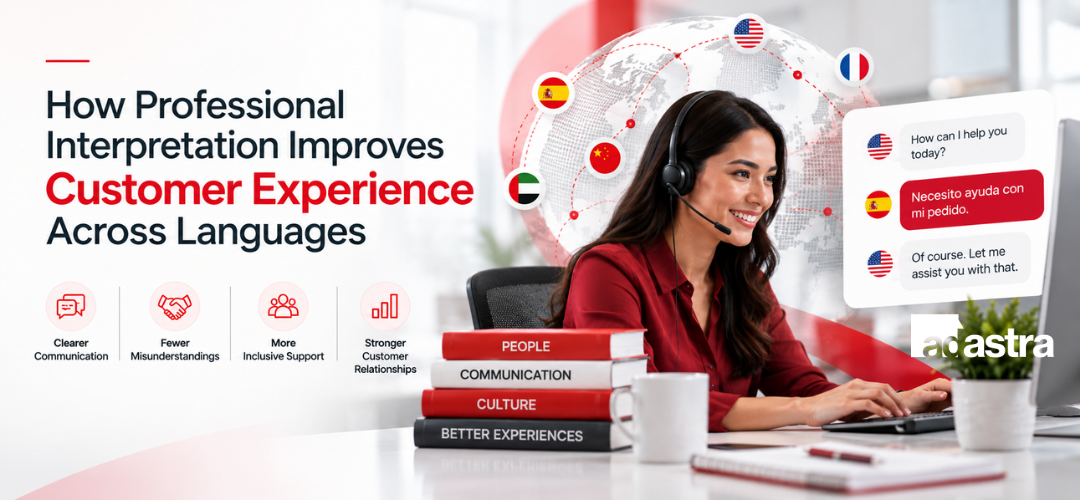
A customer may have a simple question about an order, a billing issue, a service, or an account. But when that customer and the support representative do not share the same language, a simple conversation can quickly become frustrating.
The customer may struggle to explain the problem. The representative may misunderstand important details. The conversation takes longer, the issue may need to be repeated, and the customer can leave feeling that the company did not understand them.
This is where multilingual customer support becomes part of the customer experience.
Professional interpretation helps businesses remove language barriers from customer conversations, allowing people to explain their needs clearly and receive support in a way that feels more natural and accessible.
Why Language Access Is Part of Customer Experience
Customer experience is shaped by every interaction a person has with a business.
That includes browsing a website, making a purchase, contacting support, asking a question, resolving a complaint, or managing an account.
When customers cannot communicate comfortably, each of these interactions can become harder.
Language access can help businesses make those conversations easier by giving customers a reliable way to communicate with support teams in their preferred language.
This matters because customers should not have to struggle to explain a problem simply because they are not comfortable speaking the company's primary language.
Professional interpretation services can help businesses provide that support when a real-time conversation requires more than translated written content.
How Professional Interpretation Improves Multilingual Customer Support
The value of interpretation goes beyond translating individual words. A professional interpreter helps the customer and representative communicate clearly throughout the conversation.
Customers Can Explain Their Problems More Clearly
Customers often know exactly what they need help with, but may not have the language skills to explain it comfortably.
An interpreter allows them to communicate the details in the language they know best.
This can be particularly useful when a conversation involves:
-
Account problems
-
Billing questions
-
Product issues
-
Orders and returns
-
Technical support
-
Service complaints
-
Policies and procedures
When customers can explain the situation clearly, support representatives have better information to work with.
Fewer Misunderstandings
Small misunderstandings can create bigger problems.
A customer might use an unfamiliar term. A support representative might misunderstand what they mean. The customer then has to explain the problem again, sometimes to another employee.
Professional interpretation helps both sides follow the same conversation and reduces the risk of important information being missed.
Good interpretation is not about making the conversation sound complicated. It is about making communication easier.
A More Comfortable Customer Experience
Customers are more likely to feel comfortable when they can communicate in a language they understand well.
This can be especially important when they are already frustrated or dealing with an unfamiliar process.
Instead of asking a customer to find the right words in another language, businesses can make language assistance part of the support experience.
That small change can make the interaction feel more welcoming and respectful.
Where Multilingual Customer Support Matters Most
Language barriers can appear in almost any customer-facing industry. However, some situations create more frequent opportunities for multilingual communication.
Retail and Ecommerce
Retail businesses may receive questions about products, orders, returns, payments, shipping, and account information.
Written translations can help customers browse and shop, but some issues still require a conversation with a support representative.
For example, a customer may need to explain why an order was not delivered correctly or clarify a return request. Real-time interpretation can make that conversation easier for both sides.
Financial Services
Financial conversations can involve account information, transactions, applications, policies, and other sensitive matters.
Customers need to understand what they are being told and have enough confidence to explain their situation accurately.
This makes clear customer communication especially important.
Professional interpretation can help support teams communicate with customers without relying on family members, friends, or employees who happen to speak another language.
Travel and Hospitality
Hotels, airlines, travel companies, and other hospitality businesses deal with customers from many countries.
Language assistance may be needed for:
-
Reservations
-
Changes and cancellations
-
Hotel services
-
Travel questions
-
Complaints
-
Special requests
-
Urgent situations
In these situations, the quality of communication can directly affect how a customer experiences the brand.
Technology and Telecom
Technology companies often deal with technical questions that are already difficult to explain.
Customers may need help with account access, billing, device setup, software, connectivity, or service problems.
A professional interpreter can help the customer communicate the issue while allowing the support representative to explain the solution clearly.
Why Businesses Should Not Rely on Bilingual Employees for Every Call
It may seem convenient to ask a bilingual employee to help when a customer needs another language.
Sometimes that may be practical for a simple internal conversation. But relying on employees as an informal interpretation solution can become difficult as multilingual support needs grow.
Employees may:
-
Have other responsibilities
-
Lack interpreter training
-
Be unfamiliar with interpretation techniques
-
Summarize instead of interpreting accurately
-
Struggle with technical terminology
-
Be uncomfortable handling sensitive conversations
Speaking another language does not automatically make someone a professional interpreter.
A structured approach gives businesses a more reliable way to handle customer conversations when language assistance is needed.
Choosing the Right Interpretation Method for Customer Support
Not every customer interaction needs the same type of interpretation.
Over-the-phone interpretation can be useful when customers need immediate language support without video.
Video remote interpretation can be helpful when visual communication adds useful context or when customers and representatives need a more personal interaction.
On-site interpretation may be appropriate for situations where face-to-face communication is important or where the conversation is particularly complex.
The right option depends on the type of interaction, the customer's needs, urgency, privacy considerations, and the organization's workflow.
The important thing is to make language support easy for employees to access when they need it.
Make Interpretation Part of the Customer Support Process
Providing interpretation occasionally is different from building multilingual customer support into everyday operations.
Businesses can make the process more consistent by establishing a few simple steps.
Identify Where Language Barriers Occur
Look at customer calls, support requests, complaints, and repeat contacts. This can help identify which languages customers need and where communication problems occur.
Make Language Assistance Easy to Request
Employees should know how to recognize when a customer needs language support and how to connect with an interpreter.
If the process is difficult, employees may try to manage the conversation themselves.
Train Customer Support Teams
Support representatives should know how to work with an interpreter.
That includes speaking directly to the customer, allowing enough time for interpretation, and avoiding unnecessary interruptions.
The interpreter supports the conversation, but the customer and representative remain the people having the conversation.
Review the Customer Experience
Businesses can monitor whether customers who need language assistance are experiencing more friction.
Useful measures can include:
-
Repeat contacts
-
Unresolved cases
-
Escalations
-
Customer complaints
-
Resolution time
-
Customer satisfaction where available
These insights can show whether language barriers are creating problems within the support journey.
Language Access Should Feel Like Part of the Service
Customers should not feel that asking for language assistance is creating extra work for the business.
The process should be simple.
A customer requests help, the representative connects with an interpreter, the customer explains the issue, and the conversation continues.
The less effort required from the customer, the better.
This is why language access should be considered part of customer experience rather than a separate service added only when communication becomes difficult.
Building Better Customer Experiences Across Languages
A strong customer experience depends on more than having a good product or helpful support team. Customers also need to be able to communicate with the business when they have questions or problems.
For companies serving multilingual audiences, professional interpretation can help remove one of the most basic barriers to that communication.
It gives customers a way to explain what they need, helps support teams understand the situation, and creates a smoother path toward resolution.
As businesses serve customers across more languages and markets, multilingual support becomes less of an exception and more of a normal part of customer service.
Professional interpretation can help make that experience more consistent, accessible, and customer-focused. Ad Astra provides interpretation services for organizations that need reliable communication across languages and customer-facing situations.