
The Future of Multilingual Communication: Trends Shaping 2027
Translation
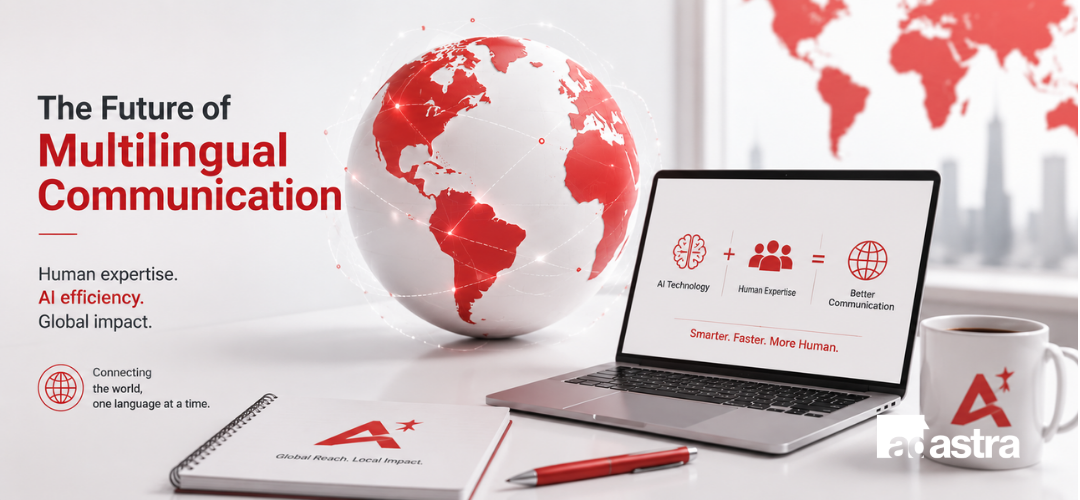
The conversation around global business growth is undergoing a massive shift. For years, the narrative was simple, clean, and dramatic: Artificial intelligence will completely replace the translation industry.
But as we cross the midpoint of 2026 and look toward 2027, that prediction has proven fundamentally wrong.
The global translation services market is not shrinking; it is sharpening. Driven by continuous localization pipelines, multimedia explosion, and strict regulatory mandates, the market is projected to grow from $64.99 billion in 2026 to over $97 billion by 2031 (Mordor Intelligence).
AI hasn’t eliminated the need for multilingual communication—it has democratized it, scaling up the sheer volume of content that requires cultural oversight. For forward-thinking brands, staying ahead means understanding how the relationship between human expertise and machine efficiency will evolve in 2027.
1. The Shift from Text Converters to Cultural Consultants
Literal, word-for-word translation has officially become a commodity. Large Language Models (LLMs) and advanced neural machine translation (NMT) can process thousands of words in seconds. However, when a brand's identity, user experience, or legal compliance is on the line, "good enough" automation isn't good enough.
In 2027, the role of the traditional linguist is completing its evolution into that of a Localization Strategist and Cultural Consultant.
Creative adaptation—or transcreation—is growing at an explosive 12.79% CAGR. Brands are realizing that while AI can mimic tone, it does not understand localized market positioning, humor, or fast-shifting regional slang. The value has shifted from output generation to strategic oversight, ensuring that content does not just read accurately, but feels right to the local audience.
2. High-Stakes and Regulated Verticals Demand Human Sign-Off
As AI-generated content floods the internet, the highest demand for human domain expertise sits exactly where the risk is highest. Mistranslations in casual settings cause minor confusion; mistranslations in regulated sectors cause lawsuits, financial ruin, or physical harm.
-
Healthcare & Life Sciences: In the U.S., strict regulatory frameworks like Section 1557 of the Affordable Care Act mandate qualified language access across top local languages. Clinical trials, medical device manuals, and pharmaceutical labeling allow zero margin for error.
-
Legal & Compliance: Cross-border data privacy laws (like GDPR) and complex international contracts require certified legal experts who understand the precise mechanics of both source and target legal systems.
-
FinTech & Financial Documentation: As digital banking expands into emerging markets, earnings reports, investment prospectuses, and compliance audits require absolute precision to build and sustain market trust.
-
Real-Time Speech Translation: Enterprise meetings and global live events are moving toward universal accessibility. Attendees can increasingly use scan-to-access technology to stream real-time audio and captions in their native language directly on their own devices.
-
Semantic Understanding: Translation engines are moving past token-by-token processing and focusing heavily on semantic intent—interpreting meaning, speaker context, and industry-specific terminology dynamically.
-
Voice and Interface Design: When voice becomes the primary interface for customer support automation or IVR (Interactive Voice Response) systems, tone and local dialect selection become central components of product design.
In these sectors, the operational model for 2027 is a highly secure, hybrid workflow: AI drives the initial upstream speed, but human specialists provide the ultimate governance and sign-off.
3. Multimedia, Audio, and Live-Stream Ubiquity
Text is no longer the sole center of global digital communication—video, audio, and interactive systems are taking over. Corporate training modules, product demos, international podcasts, and social media require multi-channel localization strategies.
Driven by tools that embed translation natively into enterprise platforms, several key technical capabilities are taking center stage:
4. Moving Quality Assurance Upstream
Historically, localization occurred at the very tail-end of a product or content lifecycle. Teams would write, design, and develop a campaign in the primary language, pass it off through multiple manual steps, and handle quality assurance (QA) right before launch.
In 2027, the trend is Continuous Localization. Organizations are leveraging advanced localization platforms to push linguistic checks directly into the initial content creation and development stages.
By integrating metadata, style guides, and explicit user interface (UI) character constraints straight into the AI prompting phase, systems can catch text-overflow issues or brand voice deviations before a human editor even begins their review. This eliminates traditional workflow bottlenecks and enables continuous, multi-market deployment cycles.
Navigating the 2027 Landscape
For global enterprises, navigating these trends means treating language not as an operational afterthought, but as a core growth driver. Balancing rapid AI-led automation with targeted, high-value human expertise is the only way to scale content without losing brand integrity or sacrificing compliance.