
The Role of Interpreters in Emergency & Crisis Situations
Interpretation
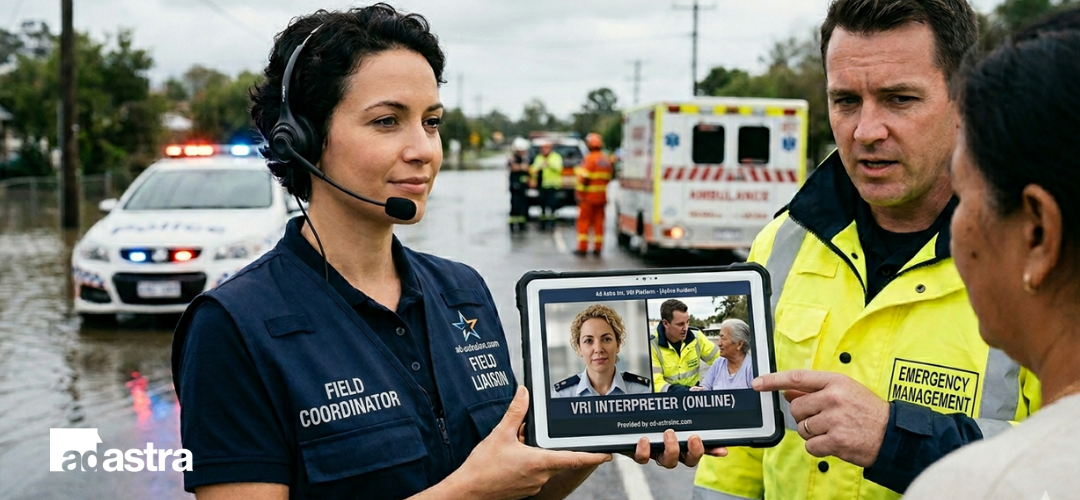
When a natural disaster strikes, a public health emergency arises, or an industrial crisis occurs, clear communication is not just an operational requirement—it is a matter of survival. During a crisis, emergency management agencies, healthcare systems, and public safety officials must deliver complex, rapidly changing instructions to entire populations simultaneously.
However, in diverse regions across the United States and Canada, a significant portion of the population speaks a language other than English or French or relies on American Sign Language (ASL). If emergency broadcasts, evacuation orders, and medical triage instructions are only delivered in dominant languages, vulnerable communities are left entirely in the dark.
In these high-stakes scenarios, emergency interpreting services serve as a critical pillar of first-response infrastructure. Ensuring accurate, real-time communication between public sector officials and non-native speakers is essential to mitigating risk, reducing casualties, and maintaining public trust.
Key Takeaways
-
Minutes Matter: In high-stakes crisis scenarios, rapid deployment technologies like Over-the-Phone Interpreting (OPI) and Video Remote Interpreting (VRI) ensure language access is available in seconds, not hours.
-
Legal and Ethical Mandates: Utilizing qualified public sector interpreting resources is legally required for government and emergency services to ensure equal access to life-saving information under federal civil rights and accessibility laws.
-
Cultural Competence Saves Lives: Effective crisis communication requires more than literal word translation; it demands cultural alignment to ensure instructions are understood, trusted, and acted upon immediately.
-
ASL Interpreting: Providing immediate access to American Sign Language for deaf or hard-of-hearing individuals during medical intake or emergency updates.
-
Visual Diagnostics: Allowing interpreters to see a patient’s physical condition or a citizen's surroundings, which helps ensure highly accurate contextual communication.
Crisis Interpretation: The Lifeline of First Response
During a localized disaster—whether it is a hurricane, an active shooter situation, or an industrial chemical spill—first responders operate under extreme cognitive loads. In these moments, language barriers compound chaos. If an emergency room physician cannot understand a patient's symptoms, or if a 911 dispatcher cannot parse an address due to a language barrier, the consequences are immediate.
Professional crisis interpretation eliminates this friction. Linguists specializing in emergency response are trained to work under intense psychological pressure, maintaining absolute accuracy, emotional neutrality, and processing speed. They act as a transparent communication conduit, allowing emergency managers and medical professionals to gather intelligence and deliver instructions seamlessly.
Overcoming Logistical Hurdles: The Power of OPI and VRI
Historically, deploying language support during a disaster meant waiting for an on-site interpreter to travel to a command center or hospital. In modern emergency management, physical travel is often impossible due to road closures, weather hazards, or immediate lockdowns.
To maintain continuous disaster response communication, public sector organizations rely heavily on remote interpreting modalities:
1. Over-the-Phone Interpreting (OPI)
OPI provides instant, on-demand audio access to professional interpreters in hundreds of languages. For 911 dispatch centers, search-and-rescue teams, and field triage units, OPI can be accessed from any standard telephone or mobile device within seconds. This allows field personnel to establish immediate comprehension during the initial, chaotic moments of a crisis.
2. Video Remote Interpreting (VRI)
For scenarios where visual context is vital, VRI connects personnel with professional interpreters via a secure video feed on a tablet, smartphone, or laptop. VRI is incredibly critical for:
Public Sector Interpreting and Regulatory Compliance
For government agencies, municipal authorities, and healthcare networks, providing comprehensive language access during a crisis is a strict regulatory obligation.
In the United States, Title VI of the Civil Rights Act mandates that any program receiving federal financial assistance must ensure meaningful access for Limited English Proficient (LEP) individuals. Failing to provide clear, timely translations and interpretations during an emergency can lead to devastating civil liabilities, federal audits, and severe systemic failures.
[Emergency Event occurs]
│
▼
[Public Sector Broadcasts Mandates] ──(Missing Language Access)──► [LEP Communities at Risk]
│
▼ (With Certified Emergency Interpreting)
│
[Simultaneous Multilingual Outreach] ──► [Compliant, Safe, and Protected Public]
Implementing an established public sector framework ensures that your municipal emergency operations plan (EOP) includes automated triggers for multilingual dissemination, keeping your agency compliant and your community protected.
Best Practices for Integrating Interpreters into Crisis Management Plans
To ensure language access functions flawlessly when a crisis hits, organizations must integrate linguistic assets into their operational frameworks before an event occurs.
1. Establish Pre-vetted On-Demand Language Contracts
Do not wait for an evacuation order to begin searching for a translation and interpretation provider. Secure ongoing, enterprise-level agreements with language service providers that guarantee 24/7/365 uptime for OPI and VRI channels. Ensure your field staff knows exactly how to access these lines instantly.
2. Standardize Clear, Simplified Source Copy
When public officials write emergency scripts or press releases, they should use clear, direct language. Avoid complex jargon, idioms, or highly technical acronyms. The simpler and more direct the source announcement is, the faster an interpreter can accurately relay it to the target audience.
3. Embed ASL Interpreters into Public Broadcasts
When holding televised press conferences or live-streamed updates, always place a certified ASL interpreter directly in the frame next to the public official. Do not rely solely on automated closed-captioning software, which regularly fails or lags during live, fast-paced broadcasts.
Conclusion: Language Access Is Public Safety
Emergency management is built on the principle of protecting every member of a community. If your disaster response pipeline lacks a clear, rapidly deployable language strategy, your public safety plan is incomplete.
By prioritizing specialized emergency interpreting services, public sector organizations can eliminate dangerous communication gaps. Investing in reliable OPI, VRI, and culturally precise linguists ensures that when a crisis hits, life-saving information reaches every citizen clearly, accurately, and immediately.
Frequently Asked Questions
What are emergency interpreting services?
Emergency interpreting services provide immediate, real-time language support during high-stakes scenarios like natural disasters, public health crises, medical emergencies, and public safety incidents. They ensure seamless communication between responders and non-native or deaf individuals.
Why is interpretation vital during a disaster response?
Without clear communication, vulnerable populations cannot understand evacuation routes, shelter locations, or safety instructions. Professional interpretation prevents confusion, reduces panic, saves lives, and ensures regulatory compliance for public agencies.
How do OPI and VRI help in a crisis?
Over-the-Phone Interpreting (OPI) and Video Remote Interpreting (VRI) allow emergency personnel to connect with professional linguists in seconds via phone or video screens. This bypasses the need for physical travel, allowing for instant communication during fast-moving events.