
The Night the Hotel Was on Fire: Rick Smolan on Fear, Guilt, and Learning to Stop Playing God
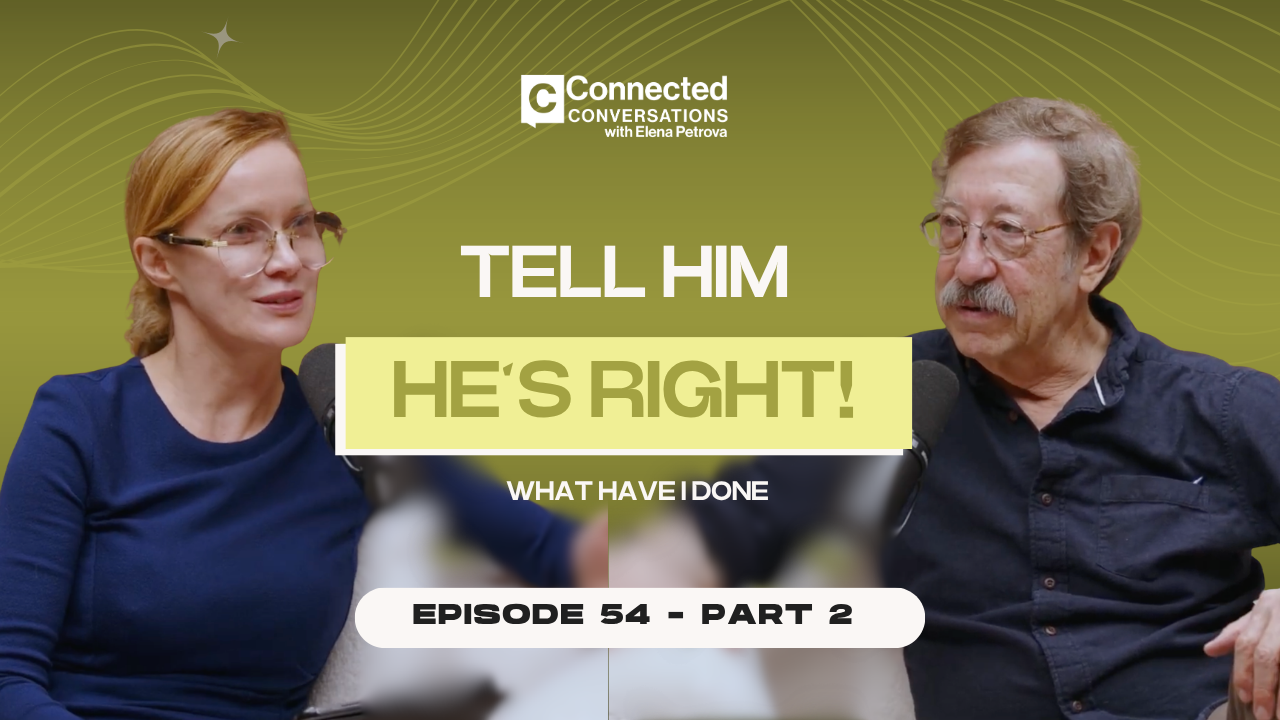
In Part 2 of his conversation with Elena Petrova, photographer Rick Smolan tells the story of a night that changed how he understands connection, and the small, specific choices it asks of us under pressure.
Eleven floors up, in the dark
Rick Smolan was on the eleventh floor of a hotel in Seoul when he woke to voices shouting outside. At first he assumed the bars had let out. Then he listened again. "That's not anger," he remembers thinking. "That's terror. I don't speak Korean, but when you hear terror, it translates."
The hotel was on fire. In the room were his best friend, his friend's young son, and Natasha, the eleven-year-old girl Rick had spent weeks trying to bring to a new family in America. None of them was supposed to survive that night.
What Rick does with that memory is the reason this episode matters. He does not tell it as a survival story. He tells it as the night he stopped believing his own press.
"I've been playing God"
Hours earlier, Rick and his friend had been lying in the dark congratulating themselves. They were the good guys. They were rescuing a child. They pictured the television segment that would surely be made about them.
Then the smoke started pouring in under the door. His friend's son collapsed. Natasha screamed and pulled away when Rick reached for her. And in that moment Rick felt something sharper than fear. "I've been playing God with all these people's lives," he recalls thinking, "and now they're all going to die, and it's all my fault for thinking I was so cool."
They survived. His friend soaked towels, taped the vents shut with room service menus, and held the smoke back until help arrived. But Rick walked out of that room a different person, carrying a promise to do something different with the certainty he had brought into it.
For any leader who has ever confused being right with being helpful, that reframe lands hard. The most dangerous moment is often the one right after we have decided we are the hero of the story.
Three words that ended a fight
The lesson had a rehearsal a few days earlier, one Rick now sees as the through-line of the whole episode.
Before any of this, Rick had confronted the relative caring for Natasha, convinced the child was being denied a future. It went badly. Rick brought others along to press his case, the group was thrown out of a restaurant, and the man ended up screaming at him in the street, humiliated and furious. A rich stranger with a camera had walked into his home and called him a bad person. Rick could have kept pushing. Instead, he turned to the translator and said three words: "Tell him he's right."
The yelling stopped. Not because Rick had given up, but because the fight had suddenly stopped being about who was right. From there, calmly, Rick could explain what he actually knew and what he was actually asking. The standoff became a conversation. That conversation eventually became Natasha's new life.
This is the quiet argument at the center of the episode. Connection is not a philosophy. It is a set of small, specific choices made under pressure, one at a time.
From the darkroom to the deepfake
The second half of the conversation moves from Rick's past into the present, and into the tools we are all now building.
Rick came up as one of only a few hundred photojournalists working at the highest level in the world. Today everyone carries a camera, and, as he puts it, a broadcast network in their pocket. He is not nostalgic about that. What worries him is what comes next. Smartphones gave everyone the power to capture what is real. AI gives everyone the power to manufacture what is not.
He describes watching a piece of video so convincing it was impossible to tell it had been generated, and notes that his wife now meets even harmless clips with a question: did that really happen? He points to a phrase for what this does to us, the "liar's dividend," the idea that once anything can be faked, anyone caught on camera can simply claim the evidence was faked too.
"Let's exchange algorithms for two days"
Out of that worry comes the most original idea in the episode, and the one worth quoting in full. Rick has been imagining a product he calls an algorithm exchange.
"Let's exchange algorithms for two days," he says. "I want to see the information you're being served, and you'll see the information I'm being served."
It is a simple thought experiment with a serious point underneath it. The systems deciding what each of us sees, buys, and believes are invisible, and we almost never stop to compare notes.
Rick's fear is not that these tools are evil. It is that they are quietly separating us while promising to bring us together, and that AI may leave us lonelier rather than less alone.
The conversation worth having
Rick closes with the question the show now asks every guest: what conversation do more people need to be having right now? His answer is not a warning. It is an invitation to look honestly at the tools we are building before they finish building us.
That is the thread running from a burning hotel in Seoul to a thought experiment about algorithms. Whether the moment is a fire, a furious stranger, or a feed we cannot see inside, connection comes down to the same thing: the choice to stop insisting we are right long enough to actually reach the person in front of us.
If you lead a team, care for patients, teach students, or hold a community together, this one is worth your time.
Listen to Episode 54, Part 2 of Connected Conversations, hosted by Elena Petrova, Founder and CEO of Ad Astra, Inc. and AdAstraConnect.Connected Conversations is produced by Ad Astra, Inc.
You can watch/listen to this episode here:
🔴 YouTube: https://www.youtube.com/watch?v=psXeqltnAd4
🟢 Spotify: https://shorturl.at/foW58
⚫ Apple Podcast: https://shorturl.at/OUwTf
🔵 Amazon Music: https://shorturl.at/BfC3j