
How Government Call Centers Can Improve Language Access for Diverse Communities
Language Services
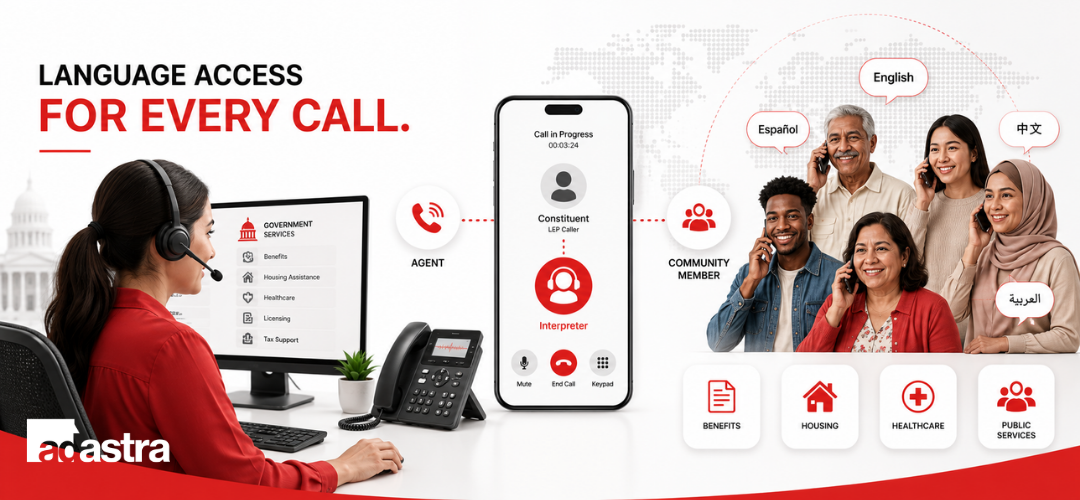
When someone calls a government agency for help, the last thing they should encounter is an interaction that leaves them more confused than before.
For the approximately 29.6 million people in the United States who have limited English proficiency, that is often exactly what happens. They call to ask about benefits, housing assistance, tax questions, or social services. They reach an agent who speaks only English. The call ends without resolution. The constituent either gives up, finds someone to call on their behalf, or worse, makes a consequential decision based on incomplete information.
This is not a niche problem. About 68 million people in the United States speak a language other than English at home, with 29.6 million of those identified as having limited English proficiency — enough to constitute one of the 50 largest countries in the world. And a significant portion of them interact with government services regularly, for benefits enrollment, licensing, emergency assistance, public health, housing, and more.
Government call centers are often the first and only point of contact between agencies and these constituents. When those call centers are not equipped to serve multilingual populations, it is not just a gap in communication. It is a failure in public service delivery.
The Gap Between Who Government Serves and Who Government Can Reach
Most government call centers were not built with language diversity in mind. They were designed for high-volume English-language interactions and optimized for efficiency metrics like average handle time and first-call resolution.
The problem is that those metrics only reflect the calls that get resolved. They say nothing about the calls that end in confusion, the constituents who hang up and never call back, or the communities that have collectively learned that calling the agency is not worth the effort.
The 2024 American Community Survey confirmed 44.9 million Spanish home speakers in the United States — placing the country ahead of Colombia, Spain, and Argentina in total Spanish-speaking population. Spanish is only the beginning. Mandarin, Cantonese, Vietnamese, Tagalog, Arabic, Somali, Amharic, and dozens of other languages represent communities with real, ongoing needs for government services.
States and municipalities across the country have been responding to this reality. New York State's language access law, enacted in 2022, requires all state agencies that interact with the public to provide interpretation services in any language, and to translate vital documents into the top 12 most commonly spoken non-English languages among LEP residents. California has long-standing language access requirements. Other jurisdictions are adding their own.
But legal requirements are not what should be driving this conversation. The more compelling reason is simpler: agencies exist to serve people, and they cannot do that effectively if they cannot communicate with a significant portion of the population they are responsible for.
Why English-Only Call Centers Fail on Both Sides of the Line
The consequences of inadequate language access in government call centers fall on constituents first, but they also fall on agencies.
When a LEP constituent cannot get what they need from a call, the issue rarely disappears. It resurfaces as a returned application, a missed deadline, an in-person visit to a field office that could have been handled by phone, or an escalated complaint that takes more time to resolve than the original issue would have. Agencies absorb these downstream costs without connecting them back to the language gap that created them.
There is also the problem of workarounds. When government call centers do not offer language access, constituents find informal solutions. They send a family member with better English proficiency to make the call on their behalf. They rely on community organizations to serve as intermediaries. They use minor children as interpreters in conversations that involve complex, sensitive, or legally consequential information.
Each of these workarounds introduces the potential for miscommunication, privacy concerns, and errors that compound over time. A child interpreting for a parent in a Medicaid eligibility call is not a reliable pathway to accurate public sector communication. Neither is a neighbor helping fill out a housing application based on a secondhand account of what was said during a phone call.
Multilingual government call centers address all of this at the source.
What Language Access Looks Like in Practice
Language access in a government call center is not a single solution. It is a set of capabilities that, when built well, work together to ensure that every constituent can get what they need regardless of what language they speak.
Over-the-Phone Interpretation for Real-Time Calls
For high-volume government call centers, over-the-phone interpretation (OPI) is the most practical and scalable approach to real-time language support.
OPI works by connecting a call agent and a constituent through a three-way call with a professional interpreter. The agent dials the interpretation service, selects the language, and within seconds a qualified interpreter joins the call. The conversation proceeds through consecutive interpretation, with the interpreter relaying each side's statements accurately in the other language.
Per-minute billing models are the standard for OPI services, saving organizations 40 to 60 percent compared to the two-hour minimums typically required for on-site interpreters, with leading providers connecting to 150 or more languages in under 30 seconds. For a government call center handling hundreds of constituent inquiries per day, that combination of speed, coverage, and cost efficiency is significant.
OPI does not require agencies to hire bilingual staff for every language spoken in their service area, which is logistically impossible at the scale most agencies operate. It also does not require scheduling in advance, which means it works for the unplanned, inbound calls that make up the majority of constituent services volume.
Bilingual Staff and Their Limits
Many agencies rely on bilingual staff members to handle non-English calls. This works well within its limits, but those limits are worth understanding clearly.
A bilingual staff member who speaks Spanish can handle Spanish-language constituent calls. But if a Somali-speaking constituent calls that same office on the same day, that staff member cannot help, and the agency has no plan for what happens next. The constituent is left on hold, transferred repeatedly, or asked to call back, none of which constitutes a functional language access program.
Bilingual staff are an asset for high-frequency languages in specific geographic areas. They should not be the entirety of an agency's language access strategy. The combination of bilingual staff for common languages and OPI for everything else gives agencies the range they actually need.
Translating Call Center Support Materials
Verbal interpretation handles the live call. But language access in constituent services extends beyond the call itself.
When a constituent is asked to reference a document, fill out a form, or follow up on instructions that were given verbally, the written materials they interact with need to match the language of the conversation. A constituent who completes a benefits call in Haitian Creole and is then mailed English-only follow-up documents has not received complete service.
Effective multilingual government call centers are connected to a broader language access infrastructure that includes translated forms, letters, website content, and follow-up communications in the languages most relevant to the agency's constituent base.
The Operational Argument for Investing in Language Access
Agencies that have invested in multilingual call center capabilities consistently report improvements across several operational dimensions.
First-call resolution rates increase because constituents can accurately communicate their situation and agents can ask clarifying questions without approximation. When both parties understand each other, issues get resolved correctly the first time.
Escalation and transfer rates decrease. Calls that bounce between agents or escalate to supervisors often do so because an agent could not handle the call effectively, not because the issue was inherently complex. Language is frequently the variable.
Repeat call volume drops. Constituents who did not understand the resolution of their first call will call back. Constituents who understood the conversation, the next steps, and the outcome will not.
These efficiency gains have real cost implications for agencies operating on constrained budgets. The investment in language access services typically returns value through reduced call volume, shorter average handle times, and less downstream resolution work.
Language Access Is a Measure of Government Effectiveness
The question of whether a government agency should invest in language access is sometimes framed as a question about compliance or equity. Both of those framings are valid, but they obscure a more direct point.
Public agencies are measured by outcomes. Whether those outcomes are benefits enrolled, licenses issued, services accessed, or emergencies resolved, they only happen when the agency can communicate effectively with the people it serves. Every constituent who cannot get through a call center interaction in their language is a case that did not reach resolution. That is a measurement problem as much as a service problem.
As the HHS Language Access Plan notes, higher rates of limited English proficiency exist in communities of color and among people with lower incomes, and a lack of meaningful language access leads directly to inequitable access to the programs and services agencies run. Agencies that take their mission seriously have to take language access seriously, because the communities most likely to need government services are often the same communities least served by English-only call centers.
State governments, county agencies, municipal departments, and public utilities all operate call centers that are direct contact points with their communities. Those contact points either build trust and deliver results, or they create friction that compounds over time into a real gap between government and the public it serves.
Building a Scalable Language Access Program
Government agencies looking to improve language access in their call centers do not need to overhaul everything at once. A practical approach looks like this.
Start with your language data. Census data, service records, and complaint data all tell you which languages your constituent base speaks and where the current gaps are. This shapes which languages to prioritize and at what scale.
Establish an OPI contract for real-time interpretation. This covers the full range of languages immediately and does not require hiring decisions or scheduling logistics. It is the fastest way to add meaningful language access to a functioning call center.
Train call center staff on the OPI process. The best language access infrastructure fails if agents do not know how to initiate an interpretation call confidently or do not feel comfortable working with an interpreter. Brief, practical training makes a significant difference in actual utilization rates.
Audit your constituent-facing documents. Identify which letters, forms, and notices are considered vital, meaning constituents cannot complete their service journey without them, and prioritize translating those first.
Build language access into call quality metrics. Track first-call resolution rates by language, monitor repeat call rates for non-English interactions, and use that data to continuously improve the program.
Language access is not a fixed target. Constituent demographics shift, languages change in frequency, and regulatory frameworks at the federal and state level continue to evolve. Agencies that build language access as an ongoing program rather than a one-time project are the ones that keep pace.
Every Call Is a Test of Public Service
A government call center that cannot communicate with a meaningful portion of its constituent base is not operating at full effectiveness. That is the practical reality of public sector communication in an increasingly diverse country.
The agencies doing this well are not treating language access as a separate compliance function. They are treating it as a core part of how they deliver services, building it into call center operations, training, metrics, and document workflows the same way they build in any other service quality standard.
Ad Astra works with government agencies and public sector organizations to implement over-the-phone interpretation, multilingual call center support, and translated constituent communications across hundreds of languages. If your agency is looking to build or strengthen its language access program, we can help you assess where you are and build the infrastructure to serve every constituent who calls.