
Why Traditional Government Call Centers Struggle with Language Access
Language Services
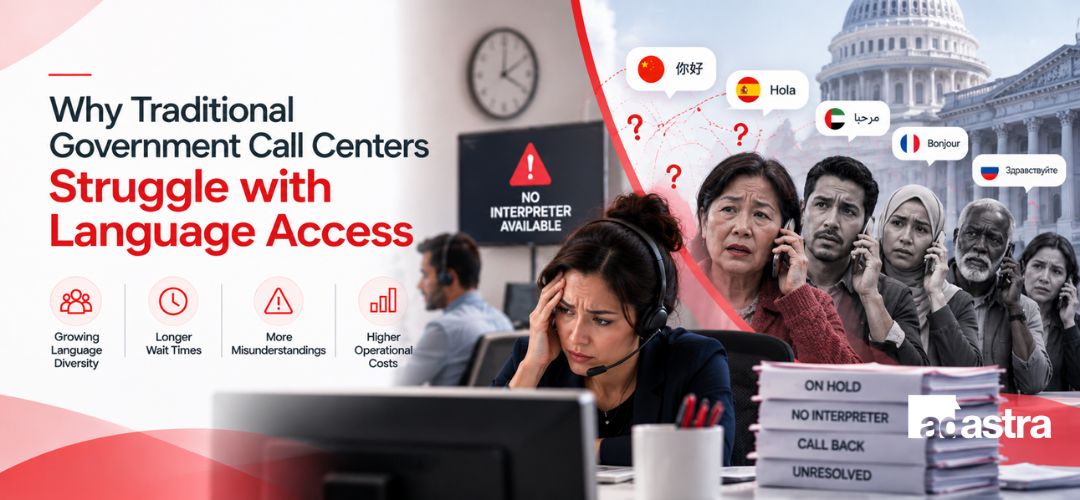
Government call centers were built to handle volume. They were designed around the assumption that the majority of callers speak English, with a small percentage needing some form of language assistance that bilingual staff could absorb.
That assumption no longer reflects the populations most government agencies serve.
More than 25 million US residents have limited English proficiency, approximately 80 percent of them immigrants, and the distribution of languages those residents speak is far more diverse than any staffing model built around Spanish and one or two other languages can address. The result is a structural mismatch between how traditional government contact centers operate and what the populations they serve actually require.
This is not a criticism of the people running these call centers. It is a description of a model that was designed for a different demographic reality and has not been updated to match the current one.
What the Traditional Model Looks Like in Practice
The typical traditional government call center approach to language access has three components, deployed in rough order of preference.
First, route the call to a bilingual staff member if one is available. Second, if no bilingual staff member is available, put the caller on hold while someone locates a solution. Third, if no solution is found quickly, advise the caller to call back or visit in person.
This model was adequate when LEP call volume was low and language diversity was limited. Neither of those conditions holds in most urban and many suburban and rural jurisdictions today.
New York City's Department of Social Services operated with 1,123 self-reported bilingual staff members who collectively spoke 90 languages. Despite that staffing level, call center staff still needed to request telephonic interpretation 743,822 times in a single year, demonstrating that bilingual staffing alone, even at significant scale, cannot absorb the actual volume and language range of LEP constituent contact.
The number of languages required expands that gap further. New York State agencies collectively provided interpretation services across more than 157 languages in 583,793 individual encounters in a single reporting year, a figure that increased 13 percent from the prior year. No staffing model can cover 157 languages with employed bilingual staff.
Where the Traditional Model Creates Operational Failure
The Bilingual Staff Problem
Bilingual employees are a genuine asset. They are also not professional interpreters, and treating them as one creates compounding problems.
When a bilingual staff member is pulled from their primary function to interpret for a colleague, two things happen simultaneously. Their actual work stops, and an unqualified interpretation takes place. Bilingual fluency does not confer the terminology knowledge, the neutrality, or the professional ethics training that distinguish a professional interpreter from someone who happens to speak two languages.
A New York City audit of hospital language access services found that H+H lacked a centralized list of qualified in-house interpreters and bilingual staff, and that interpretation services provided by some bilingual staff were not captured in language access service data at all. What this means operationally is that agencies using bilingual staff as their primary language access solution frequently do not know which interactions were interpreted, by whom, or at what quality level. The service is invisible to management.
There is also the coverage problem. A bilingual Spanish-speaking agent covers Spanish calls. When a Somali-speaking constituent calls, a Vietnamese-speaking constituent calls, or a caller uses a language the agency has no bilingual staff for, the bilingual staffing model produces no solution at all.
The Hidden Costs That Do Not Appear in the Language Budget
Traditional call center models generate costs that are attributed to other budget lines because the language gap that created them is never identified as the cause.
Repeat contacts are the most significant. When a LEP constituent cannot get resolution on the first call because language support was unavailable or inadequate, they call back. They visit in person. They send a family member. Each of those contacts generates cost that appears in call volume metrics, walk-in traffic data, or case management time, never in the language access budget.
Research on healthcare settings found that 29 percent of Spanish-speaking patients reported their condition was not resolved after an encounter, compared with 10 percent of English-speaking patients. The same dynamic applies in government services. An unresolved benefits inquiry does not disappear. It generates repeat contact, escalation, and in the worst cases, a missed service that the constituent had a legal right to receive.
Escalations follow the same pattern. A call that cannot be resolved at the agent level because of a language barrier escalates to a supervisor, a specialist, or a field office visit. Each step up the escalation path costs more per contact than the original call would have if language access had been available.
Staff burden is a third hidden cost. Agents who cannot serve a caller due to language barriers report higher stress and frustration than agents who have the tools to handle every interaction. In call centers already managing high turnover, this is a retention factor that does not get connected to the language access gap that contributes to it.
The Consistency Problem
Traditional models produce inconsistent language access across departments, shifts, and locations within the same agency.
A constituent calling the morning shift when the bilingual Spanish-speaking agent is working gets a different quality of interaction than the same constituent calling the afternoon shift when that agent is out. A caller to the housing department gets a different response than a caller to the benefits department, even within the same agency, if bilingual coverage varies between them.
Inconsistency is not just a service quality problem. For agencies subject to language access obligations under Title VI or state law, inconsistent service delivery creates legal exposure. Equal access to agency services cannot be guaranteed if the mechanism for providing that access depends on who happens to be working that day.
What Integrated Language Access Changes
The operational difference between traditional and integrated language access models is not primarily about technology. It is about coverage, consistency, and accountability.
An integrated model uses professional over-the-phone interpretation as the primary real-time language access solution, available to every agent on every call, in every language, without the call volume or language range limitations that bilingual staffing creates. The interpreter connects in under 30 seconds. The agent does not need to locate a bilingual colleague, put the caller on hold, or make a judgment call about whether the interaction can be handled without language support.
This changes the operational picture in measurable ways. First-call resolution rates improve because callers can communicate their actual situation and agents can ask clarifying questions and provide accurate information. Repeat contact rates fall. Escalations driven by communication breakdown decrease. The service provided in Spanish at 9am is the same service provided in Somali at 3pm, because the mechanism is the same in both cases.
It also makes language access visible to management for the first time. Professional interpretation contracts generate usage data: which languages were requested, when, in which departments, and at what volume. That data does not exist when bilingual staff absorb language access informally and interactions go unrecorded.
New York State's own Language Access Annual Report documents that agencies providing structured language access tracked encounters across 157 languages and recorded a 13 percent year-over-year increase in encounters, which reflects growing constituent demand being met by a structured system rather than absorbed invisibly by an informal one.
The Model Has Not Kept Pace With the Population
Traditional government call center models were built for a different time. They reflected a period when language diversity in most service areas was limited enough that bilingual staffing provided reasonable coverage.
That period has passed in most jurisdictions. The languages spoken by the populations government agencies serve have diversified faster than any staffing model can adapt. The repeat contacts, escalations, and unresolved interactions that result are real costs that appear in other budget lines because the language gap creating them is never identified.
Integrated language access is not a premium add-on to a call center. It is the operational infrastructure that allows a public sector contact center to serve the actual population it is responsible for, consistently, across every language, on every shift.
Ad Astra works with government agencies at the federal, state, and local level to implement language access solutions that address the coverage, consistency, and accountability gaps that traditional models leave open. If your agency is still relying primarily on bilingual staffing to manage LEP constituent contact, our team can help you assess the scope of the gap and the options for closing it.