
How Health & Wellness Apps Can Improve Global User Engagement Through Localization
Localization
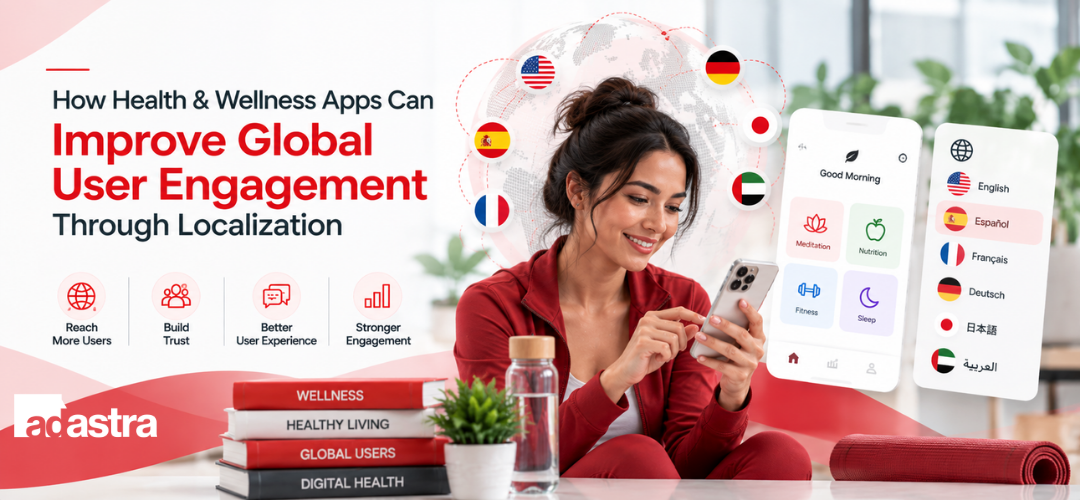
A wellness app can perform exceptionally well in one market and struggle in another.
The first reaction is often to look at pricing, competition, acquisition channels, or product-market fit. Those factors certainly matter. But there is another question worth asking:
Does the app actually feel right for the people using it?
An app that works well for users in the United States may not create the same experience for users in Germany, Japan, the Middle East, or other markets. The language may be translated correctly, yet the onboarding may feel intrusive, notifications may sound unnatural, measurements may be unfamiliar, or the wellness advice may not reflect local expectations.
This is where wellness app localization becomes more than a translation exercise.
It is about adapting the experience so users can understand, navigate, and engage with the app in a way that feels natural to them.
Why Wellness Apps Face a Different Localization Challenge
Localization matters for many types of digital products, but wellness apps have an additional challenge: they deal with subjects that can be highly personal and culturally sensitive.
Consider an app focused on:
-
Mental wellbeing
-
Meditation
-
Fitness
-
Sleep
-
Nutrition
-
Weight management
-
Stress
-
Personal goals
People do not necessarily approach these subjects in the same way everywhere.
The language used to discuss mental health may carry different levels of sensitivity in different cultures. Attitudes toward body image can vary. The way an app encourages users to exercise or change their habits may feel motivating to one audience and overly direct to another.
That means a wellness app can be linguistically accurate and still feel culturally disconnected.
Effective localization considers both what the app says and how users are likely to receive it.
Start With the Onboarding Experience
Onboarding is one of the first opportunities an app has to build trust.
For a wellness app, it can also involve highly personal questions. Users may be asked about their sleep, fitness goals, diet, weight, stress levels, or mental wellbeing.
The questions themselves may be appropriate, but the way they are presented can make a significant difference.
Localization should consider:
-
How questions are worded
-
The level of formality
-
The order of questions
-
Visual presentation
-
Examples used
-
Measurement units
-
Privacy and consent information
-
How personal information is requested
A direct translation may preserve the original meaning while losing the intended tone.
For example, a question that feels friendly and supportive in one market could sound overly personal or clinical in another.
The goal is to make onboarding feel like it was designed with the target audience in mind, not simply translated after the product was finished.
Make Notifications Feel Natural
Notifications are easy to overlook during localization, but wellness apps often depend on them to bring users back.
A fitness app may remind someone to exercise. A meditation app may suggest a session. A sleep app may remind users about their bedtime routine.
The wording, timing, and frequency of these notifications can all influence how users perceive the app.
A motivational message that feels energetic in one market may come across as pushy somewhere else. A reminder sent at a particular time may be useful for one audience but poorly timed for another because daily routines differ.
Localization should therefore consider:
-
Tone
-
Timing
-
Frequency
-
Formality
-
Local routines
-
Cultural expectations
-
The context of the message
The goal is not to translate a notification.
It is to make the notification feel appropriate for the person receiving it.
Make the UI Work Naturally in Every Language
Language can affect the physical design of an app.
Translated text may take up more or less space than the original. This can affect buttons, menus, headings, forms, notifications, and other interface elements.
A layout that looks perfect in English can become crowded when localized.
Some languages also introduce additional design considerations. Arabic and Hebrew, for example, use right-to-left writing systems. Dates, times, currencies, and measurement conventions can also vary between markets.
Wellness apps may need to support measurements such as:
-
Kilograms and pounds
-
Kilometers and miles
-
Celsius and Fahrenheit
-
Different date formats
-
Different time formats
These details may seem small, but users interact with them repeatedly.
A localized app should therefore be tested in its actual target language and environment. UI localization is not complete simply because every string has been translated.
Localize the App Store Experience Too
The localization journey begins before someone downloads the app.
A wellness app can have a fully localized interface and still miss potential users if its App Store or Google Play listing remains primarily in the original language.
App store localization can include:
-
App title
-
Subtitle
-
Description
-
Search terms
-
Screenshots
-
Promotional messaging
-
Feature descriptions
Search behavior can also vary by market. Users may use different terms when searching for meditation, fitness, sleep, nutrition, or other wellness products.
That means app store localization should consider both language and local search behavior.
A localized app that cannot be easily discovered by users in their own language is missing an important part of the customer journey.
Adapt Wellness Content to Local Expectations
The content inside a wellness app deserves the same attention as its interface.
Consider a meditation app that uses a particular approach to mindfulness, a fitness app that recommends certain activities, or a nutrition app that suggests specific foods.
Directly translating that content may preserve the words without preserving the relevance.
Localizing wellness content can involve adapting:
-
Examples
-
Food references
-
Exercise activities
-
Motivational language
-
Educational content
-
Cultural references
-
Wellness terminology
-
Images and illustrations
The goal is not to create a completely different product for every market.
It is to understand where local adaptation can make the existing experience more useful.
This is particularly important for multilingual apps where users expect the product to feel natural rather than simply available in another language.
Do Not Treat Accessibility as an Afterthought
A localized app also needs to remain accessible.
Features such as:
-
Screen reader support
-
Text scaling
-
Color contrast
-
Captions
-
Accessible labels
-
Clear navigation
-
Readable interface elements
need to work correctly across localized versions.
A translated interface can introduce new problems if text becomes longer, labels change, or interface elements behave differently in another language.
For wellness companies serving a diverse user base, accessibility should therefore be considered as part of the broader localization and product testing process.
The objective is simple: users should be able to access the same core experience regardless of their language or accessibility needs.
Measure Engagement Across Markets
Localization should ultimately be connected to the user experience the business is trying to improve.
If an app performs differently across markets, product and growth teams can examine metrics such as:
-
Onboarding completion
-
Activation
-
Session frequency
-
Feature usage
-
Notification engagement
-
Subscription conversion
-
Churn
-
Retention
-
Support requests
For example, if users in one market consistently abandon onboarding at the same step, that may be a sign that something about the experience needs investigation.
Localization should not automatically be blamed for every difference between markets. Pricing, competition, acquisition quality, product fit, and other factors can also influence engagement.
But localization should be part of the conversation when users are responding differently to the same product in different markets.
Test the Localized Experience With Real Users
Linguistic review is important, but it cannot identify every localization problem.
Real users can reveal issues that a translation review may miss.
Testing can help identify:
-
Confusing onboarding questions
-
Unnatural notifications
-
Difficult navigation
-
Cultural mismatches
-
Poorly adapted content
-
Accessibility problems
-
Broken layouts
-
Unclear calls to action
Testing with people who understand the target market can provide useful insight into whether the app actually feels natural in that market.
This is particularly valuable for wellness products because cultural expectations can influence how users respond to personal and motivational content.
Build Localization Into the Product Lifecycle
Localization should not be something a wellness company thinks about only before entering a new market.
Every product update can create new localization requirements.
A new feature may introduce new interface text. A redesigned onboarding flow may require new translations. A new notification campaign may need cultural adaptation. New App Store screenshots may need to be updated.
As the number of markets grows, handling these changes manually becomes increasingly difficult.
A scalable process should establish consistent terminology, review standards, translation workflows, and quality checks across languages.
Tools such as Translation Memory and terminology management can also help teams maintain consistency as the volume of multilingual content grows. But technology should support the localization process, not replace the cultural and linguistic judgment required to create a good user experience.
Make Every Market Feel Like the App Was Built for It
A wellness app can technically be available in ten languages and still provide ten very different user experiences.
The goal of localization is not simply to make the app understandable.
It is to make the experience feel natural, relevant, accessible, and trustworthy for the people using it.
For wellness companies expanding into new markets, that means looking beyond translated strings and considering the entire user journey, from app discovery and onboarding to notifications, content, accessibility, and daily engagement.
A thoughtful localization strategy can help businesses identify and remove language and cultural barriers before they become product or retention problems. Ad Astra's localization services support digital experiences across websites, software, mobile apps, metadata, and other multilingual content, helping businesses create experiences that work across markets without losing sight of the people using them.