
Ageism Is the One Bias We Still Laugh At
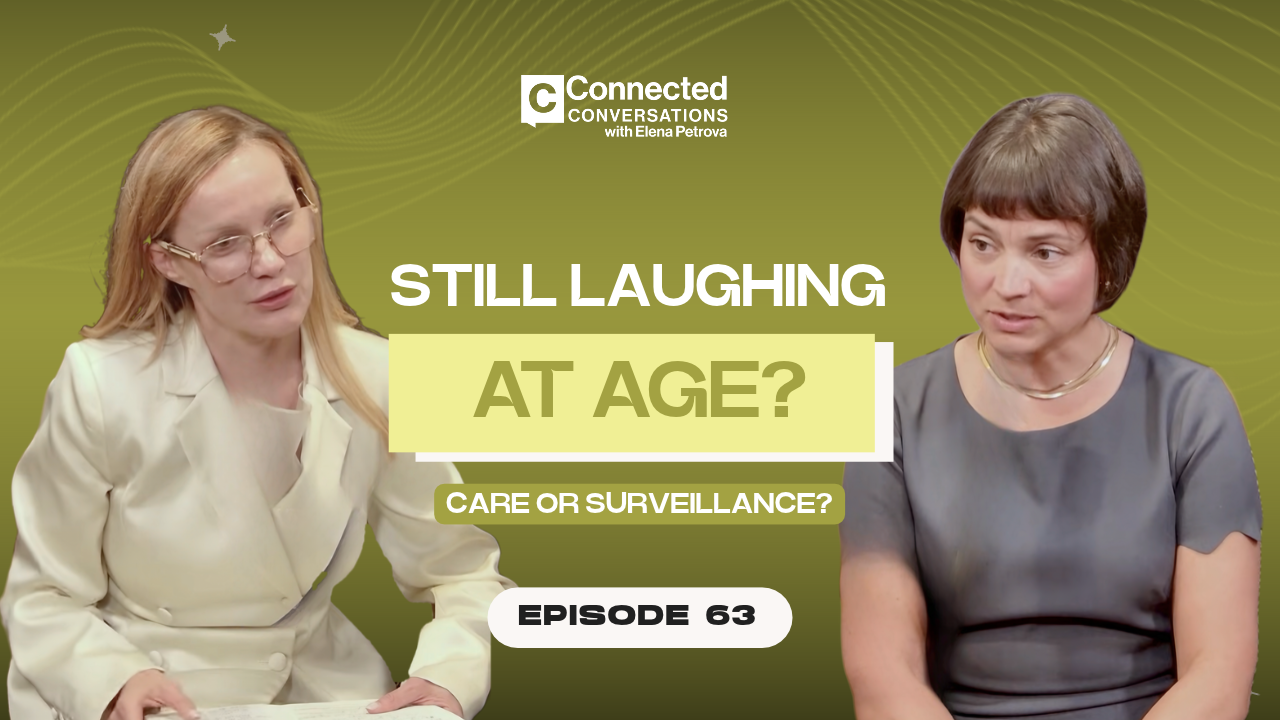
Erin Maruzzella spent fifteen years in senior living before moving into systems design and workforce innovation. In this episode of Connected Conversations, she tells Elena Petrova why ageism hides in our jokes, our products, and our hiring, and what it takes to design for people at every age.
The original anti-ageist
Asked about an older person who shaped her, Erin starts with her grandfather, Arthur. He grew up without electricity in Appalachia, and in his eighties he had Facebook on his iPhone. When relatives teased Erin about not being married, he waved them off: she'll do things in her own time. He loved every birthday, he liked to say, because it beat the alternative.
Erin calls him the original anti-ageist. She didn't have the language for it until about 2022, despite fifteen years working with older adults.
When the system is the problem
Most of Erin's healthcare career was in skilled nursing, long-term care, and assisted living. She watched people sent home as soon as they could walk, to houses where they couldn't drive, cook safely, or count on family nearby. She also saw people who could never go home at all because of one small gap in the system."
I saw that the system was broken," she says, "and there was nothing I could do to help people be successful from the seat that I was in." So she went back to school for an MBA around age 40, and people kept telling her she was both too old and too young to do it. One person said both in the same conversation.
Her framework now is to bring government, industry, and academia to the same table. Large problems don't get solved by one of them alone.
One chair can't fit every body
Universal design, the idea that anything can be designed so anyone can use it, is a good goal. Erin found it wasn't working for older adults. Her example is the kindergarten chair. We make chairs small for five-year-olds because they're small. Then, once people graduate from high school, "we sort of tell people goodbye and good luck, find a chair that works for you."
Some chairs have no armrests, which matters if your legs weaken with age. Some don't fit shorter people. Erin's answer borrows from targeted universalism, a concept from UC Berkeley's Othering and Belonging Institute: set one shared goal, then remove the specific barriers different people face in reaching it. Age-friendly design adds two more steps: actively removing age bias from the design, and checking that the surrounding systems can support it.
The bias we still laugh at
Ageism is everywhere, Erin says, and we rarely notice it. "Senior moment." An app that needs to be "grandma approved." The "grandma test" in startup culture, which assumes older people can't grasp complex ideas. At comedy shows, she notices that jokes most audiences would no longer accept about other groups still land when they're about age.
The research backs her up. The World Health Organization's 2021 Global Report on Ageism says every second person in the world is believed to hold ageist attitudes. A long-term study by Tessa Charlesworth and Mahzarin Banaji found implicit attitudes about sexuality and race shifted substantially between 2007 and 2020. Implicit age attitudes stayed stable.
Erin describes three layers. Internalized ageism is when we tell ourselves we're too old to learn something new, date, or move. Interpersonal ageism is the doctor who told her, at 29, that her sore knee was age. She had just walked across Spain on the Camino de Santiago, and she found a different doctor. Institutional ageism lives in hiring, marketing, and product decisions.
The first layer matters more than most people realize. Becca Levy's research found that people with more positive views of aging lived 7.5 years longer than those with negative views.
Skills, not birth years
Erin now leads workforce innovation at NOCTI, which builds skills-based credentials and assessments. She likes credentials because they don't care how or when you learned something. If you can pass the test, you can do the job, whether you learned through a degree, the military, years of caregiving, or practice.
That can cut through hiring bias, which leans on age, schools, and who you know. Colorado has moved in the same direction. Its Job Application Fairness Act bars employers from asking for age, date of birth, or graduation dates on an initial application. Erin's next hope is a trusted assessment for durable skills, like showing up, communicating well, and working on a team, so experience can show on a resume without revealing an age.
Care or surveillance
Erin mentors founders in age tech and asks them all the same question: how many people older than you, who you're not related to, have you talked to? One founder built what was essentially a baby monitor for older adults and couldn't understand why nobody wanted it. "I don't want a baby monitor in my house," Erin says.
There are real cases for monitoring, especially with dementia. Her rule is to center the person whose privacy is at stake, and to have that conversation with parents, siblings, and partners now, before a crisis forces it.
Community is the common thread
On longevity, Erin separates lifespan from health span. Living to 100 means little if the last twenty years are spent indoors. In Blue Zones like Okinawa and Loma Linda, regions known for people who live to 100, she points to a common thread beyond diet and genetics: social connection, good neighbors, and strong friendships. "If we don't have community," she says, "we're not going to age well."
For leaders with mixed-age teams, she argues that generational labels put people in boxes. Get to know individuals, anticipate friction, and make time to talk about age bias openly. Her closing wish is for more of us to learn what ageism is, take an implicit bias test, and treat ourselves and others better as we grow older. Her grandfather would have agreed. Every birthday beats the alternative.
Listen to Episode 63 of Connected Conversations, hosted by Elena Petrova, Founder and CEO of Ad Astra, Inc. and AdAstraConnect.
Connected Conversations is produced by Ad Astra, Inc.
Sources:
World Health Organization, "Ageism is a global challenge: UN" (Global Report on Ageism, March 2021): https://www.who.int/news/item/18-03-2021-ageism-is-a-global-challenge-un
American Psychological Association, on Levy et al. (2002), Journal of Personality and Social Psychology: https://www.apa.org/news/press/releases/2002/07/longevity
Association for Psychological Science, on Charlesworth and Banaji's research into long-term change in implicit attitudes: https://www.psychologicalscience.org/?p=194234
Colorado General Assembly, SB23-058, Job Application Fairness Act: https://leg.colorado.gov/bills/sb23-058
You can watch/listen to this episode here:
🔴 YouTube: https://www.youtube.com/watch?v=vlc6aCKzPPI
🟢 Spotify: https://shorturl.at/0ylQS
⚫ Apple Podcast: https://shorturl.at/RmkrZ
🔵 Amazon Music: https://shorturl.at/Qy336