
When Your Business Needs Certified Translation Instead of Standard Translation
Translation
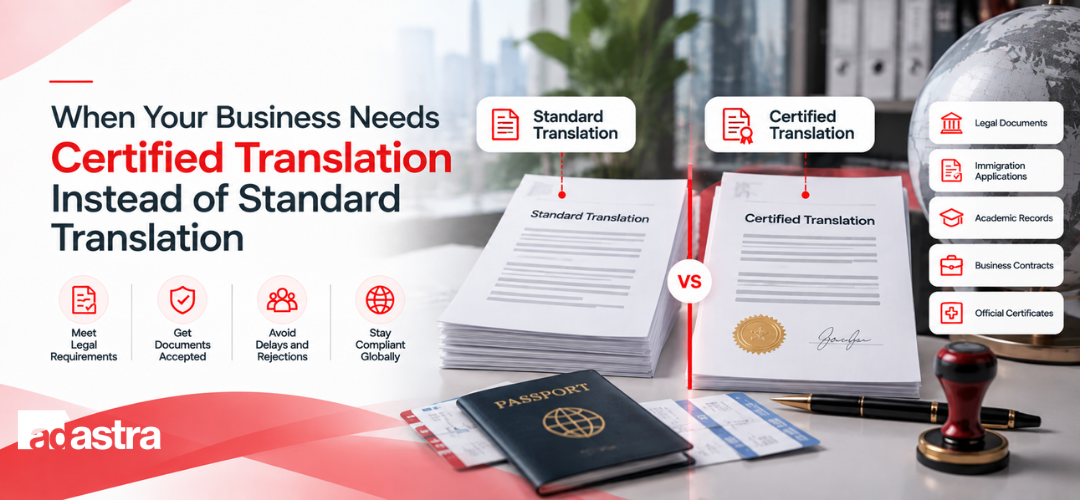
A filing gets rejected. The documents were translated, the translation was accurate, and the deadline is now two weeks closer. The reason is a single line in the rejection notice: the translation was not certified.
This happens to businesses more often than it should, and it is almost never a quality problem. It is a requirements problem. Someone ordered standard translation for a document that needed certified translation, or paid for extras the receiving authority never asked for.
If you are deciding which one your business needs, this guide will help you make that call before you spend the money or lose the time.
What Certified Translation Actually Means
Most people assume "certified" is a quality grade, as if it means a better translator worked on the document. It does not.
A certified translation is a complete translation delivered with a signed statement from the translator or translation company. That statement confirms the translation is complete and accurate, and that the translator is competent in both languages. The certificate is what makes the translation acceptable to a court, an agency, or an institution that needs someone to stand behind the work.
In the United States, this is the standard federal immigration authorities apply. USCIS requires a full English translation with the translator's signed certification of completeness, accuracy, and competence under 8 CFR 103.2(b)(3). Courts, universities, banks, and regulators apply similar logic, though each sets its own rules.
Standard translation is the same work without the signed attestation. The quality can be equally high. What is missing is the formal accountability that official bodies require.
Certified vs. Notarized vs. Apostilled
These three terms get mixed up constantly, and mixing them up is how businesses overpay or get rejected.
|
What it does |
Typical use |
|
|
Certified translation |
The translator attests the translation is complete and accurate |
USCIS filings, court submissions, regulatory filings, academic records |
|
Notarized translation |
A notary verifies the identity of the person who signed the certificate |
Some consulates, state agencies, and banks |
|
Apostille |
Authenticates a public document for use in another country |
Official records used abroad under the Hague Convention |
Two points matter most here.
A notary does not check the translation. They confirm who signed the certificate. Notarization adds identity verification, not accuracy.
An apostille is not a translation service at all. It authenticates the underlying public document, and it does not replace translating that document. If a foreign authority asks for an "official translation," ask them which of these three things they mean before you order anything.
When Standard Translation Is Enough
Not every document needs certification, and paying for it when it is not required adds cost and time for no benefit.
Standard translation is usually the right choice for:
-
Internal documents such as policies, training materials, and employee communications
-
Marketing content, websites, and product descriptions
-
Contracts and documents shared between willing parties who only need to understand each other
-
Research, due diligence reading, and general business correspondence
-
Early-stage drafts of documents that will be certified later
The test is simple. If nobody with formal authority will review the translation and rely on it as an official record, standard document translation does the job.
When You Need Certified Translation
Certification becomes necessary when the translation will be submitted to an authority, or when someone needs to rely on it as an accurate record of the original. These are the situations businesses run into most often.
Legal Documents and Court Proceedings
Contracts submitted as evidence, corporate records, powers of attorney, affidavits, and discovery materials generally need certified translation when they enter a legal proceeding. Courts want assurance that the translated version faithfully reflects the original, and a signed certificate provides that. If your business is involved in cross-border litigation, arbitration, or regulatory enforcement, assume certification is required until the court or counsel tells you otherwise.
Immigration and Employee Relocation
Companies sponsoring visas or relocating employees deal with certified translation constantly. Birth certificates, marriage records, diplomas, and employment records in another language all need certified English translations when filed with immigration authorities. A single uncertified document can stall an entire petition.
Corporate, Financial, and Regulatory Filings
Mergers, foreign subsidiary registrations, financial statements submitted to regulators, and banking documentation often require official translation. Requirements vary by jurisdiction, so confirm them with the receiving body or your legal team before translation begins.
Patents, Clinical, and Product Compliance Documents
Patent applications, clinical trial documentation, and product registration dossiers submitted to regulators are typically held to formal accuracy standards. These are also documents where subject matter expertise matters as much as the certificate.
Academic and Professional Credentials
Hiring internationally often means verifying degrees, transcripts, and licenses. Universities, credential evaluators, and licensing boards usually require certified translations of these records.
Four Questions to Ask Before You Order
The fastest way to avoid a rejected document is to ask the receiving party what they need. Not what you assume they need. What they will actually accept.
Who is receiving this translation? A federal agency, a court, a foreign consulate, and a university each have different standards. The answer shapes everything else.
What exactly do they require? Look for words like "certified," "notarized," "sworn," "official," or "apostilled." If the instructions are vague, ask them to clarify in writing.
Does the original document also need authentication? Some foreign authorities want an apostille on the source document in addition to a certified translation. These are separate steps with separate timelines.
Is there a required format, language variant, or translator qualification? Some authorities specify who can certify. A certified translation does not always have to come from a translator holding a specific credential, but the receiving authority can impose its own requirements. In some countries, only sworn translators registered with the local government can produce official translations. If your document is going abroad, check the destination country's rules, not just your own.
Mistakes That Get Documents Rejected
These come up repeatedly when businesses handle certified translation without a clear process.
Assuming certified means notarized. For most US federal filings, notarization is unnecessary. Paying for it adds cost and sometimes delay. Equally, some consulates and state agencies do want it, so check first.
Certifying a summary. A certificate states that the translation is complete. A shortened version or partial translation cannot be certified, and an authority that spots omissions will reject the whole submission.
Using a bilingual employee to certify. Being fluent is not the same as being a qualified translator, and many authorities will not accept a certificate from someone with no professional standing or independence from the case.
Translating before confirming the requirements. Rework is the most expensive path. Confirm requirements first, then translate once.
Ignoring the details on the page. Stamps, seals, handwritten notes, and signatures on the source document are part of the document. A complete certified translation accounts for them.
The Cost of Getting This Wrong
Certified translation typically costs more per page than standard translation because of the added accountability, but the larger cost is almost always time. A rejected immigration petition, a delayed court filing, or a stalled regulatory submission can cost far more than the translation itself, particularly when deadlines are fixed.
That is why the smarter question is not "which is cheaper?" It is "which one does the receiving party require?" Buy the right level once, and avoid the rework.
Match the Translation to the Purpose
Standard translation is for understanding. Certified translation is for proof.
If your business needs to communicate, market, or collaborate across languages, standard translation delivers the clarity you need. If your business needs to file, submit, litigate, or register, the receiving authority wants a signed record that the translation can be trusted, and certification provides it.
Ad Astra provides both. Our translation services cover standard business document translation as well as certified translation for legal, immigration, corporate, and regulatory documents. If you are not sure which level your document requires, send us the requirements from the receiving party and we will confirm the right approach before any work begins.