
Global Expansion Checklist for Concierge Medicine Clinics
Healthcare
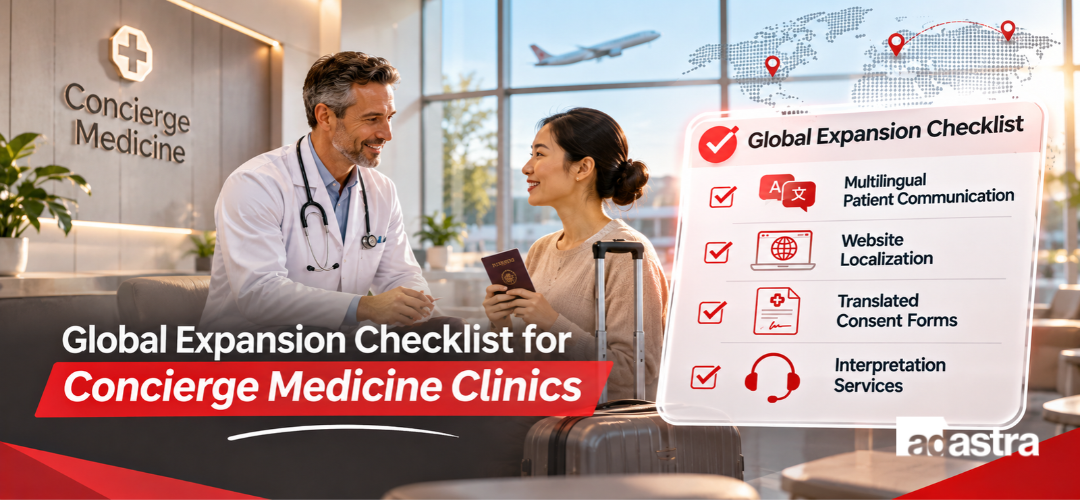
It's 2 a.m. at a concierge clinic in Miami. A Brazilian executive sends a message through WhatsApp asking about a membership and a preventive health screening. The clinic's website is English only. The membership agreement is English only. Nobody on the team speaks Portuguese, and the next free interpreter is three days away.
Most clinics in this spot don't lose the patient because of the medicine. They lose them because the first twenty minutes of the relationship felt like a wall.
Concierge medicine sells access, attention, and trust. Those things have to survive a language barrier, a time zone, and a different legal system. If your clinic is planning to grow internationally, this checklist walks through what to put in place first, and in what order.
One note: this is practical guidance, not legal advice. Licensing, advertising, privacy, and consent rules change by country, so have counsel review anything specific to your markets.
1. Decide What Kind of International Growth You're Planning
"International expansion" can mean three different things for a clinic, and each one changes the checklist.
-
Inbound patients. People travel to your clinic from abroad, a form of medical tourism.
-
Remote members abroad. Expats or overseas members get telehealth and concierge support from a distance.
-
A physical presence in a new country. You open or partner on a clinic in another market.
Before anything else:
-
Choose which model you're pursuing first
-
Confirm what licenses and registrations are needed to treat or advise patients in each target country, especially for telehealth, where rules often depend on where the patient is located
-
Check whether your malpractice coverage extends to international patients and remote care
-
Pick one or two pilot markets, not ten
2. Know Who Your International Patient Is
A market is not a language. Spanish for a Mexico City executive is not the same as Spanish for a patient in Madrid or Bogotá. Mandarin, Arabic, and Portuguese all have regional variations that change word choices, formality, and tone.
-
Identify the languages and regional variants for each pilot market
-
Find out how patients in that market prefer to communicate, for example WhatsApp, WeChat, email, or phone
-
Learn what they expect from a premium health relationship: formality, family involvement, privacy, speed of response
-
Map time zones against your availability, since 24/7 access means little if no one can respond in the patient's language
3. Build Multilingual Patient Communication
This is where concierge clinics win or lose international patients. Multilingual patient communication has to cover the whole journey, not just the first inquiry.
Before the visit
-
Respond to inquiries in the patient's language, with a stated response time
-
Prepare approved message templates for common questions: membership, pricing, scheduling, what to bring
-
Assign a bilingual patient coordinator, or a vetted interpreter-supported process, for each pilot language
During care
-
Provide appointment reminders, pre-visit instructions, and intake forms in the patient's language
-
Make sure clinicians know how to work with an interpreter
After care
-
Translate discharge and medication instructions, along with follow-up plans
-
Set up a way to handle questions after the patient returns home, including time zone differences
-
Share records with the patient's home-country providers in a usable format and language when requested
Safety
-
Give international members emergency instructions in their language, including how to reach local emergency services. A US phone number is no help to someone in another country.
4. Localize Your Website
Clinic localization starts with the website, because that's where most international patients decide whether to trust you. Translating the text is only part of it.
-
Translate the pages patients rely on: membership, services, pricing, FAQs, physician bios, booking, and contact
-
Adapt, don't just translate. Explain your credentials, training, and accreditations in terms a local patient understands
-
Show prices in local currency, or clearly explain conversions and payment options
-
Use local formats for dates, times, measurements, phone numbers, and addresses
-
Research how patients in that market actually search. The words they use for "preventive health check" may not match a literal translation
-
Set up language versions properly for search engines, with separate URLs and hreflang tags
-
Translate forms, error messages, and confirmation emails, not only the main pages
-
Localize your privacy notice and cookie consent for each market
-
Check for local language rules. Some jurisdictions, such as Quebec, have requirements around French-language commercial content
-
Have a native speaker test the full booking path before launch
One catch worth knowing early: offering your site in a local language and pricing in local currency can be read as a sign that you're targeting patients in that country. That can bring privacy laws like the EU's GDPR into play. Article 3(2) of the GDPR reaches organizations with no EU presence when they offer services to people in the EU, and health data counts as a special category with tighter rules. Talk to counsel before you localize for a European market.
5. Translate Consent Forms and Patient Documents
Informed consent is the document category where a weak translation does the most harm. A patient who signs a form they don't fully understand hasn't really consented, and that's a risk for them and for you.
Industry guidance on medical travel points the same way: consent forms may need to be translated into the languages of your primary patient target markets, interpreters should be readily available, and the consent process should be reviewed periodically through feedback from patients and staff.
Documents to plan for:
-
Consent for treatment and procedures
-
Telehealth consent
-
Membership agreement and financial policy
-
Privacy notice and any data-sharing authorizations
-
Medical history and intake forms
-
Discharge, medication, and follow-up instructions
How to handle them:
-
Use professional translators with medical experience, not general tools or bilingual staff
-
Ask whether a certified translation is needed for any document your regulators or insurers may review
-
Have a clinician check the translation for clinical accuracy
-
Use plain language. A translation of a dense legal form is still a dense legal form
-
Have a native speaker from the target market review the final version
-
Keep version control, with dates, so you always know which version a patient signed
-
Have the patient sign the language version they actually read, and keep both versions on file
-
Pair high-risk consents with a live conversation through a qualified interpreter, not a signature alone
For regulated or high-risk documents, professional medical and regulatory translation is worth the investment.
6. Set Up Interpretation Services
Concierge medicine promises that patients can reach their doctor when they need to. For international members, that promise only holds if interpretation is available at the same moments.
-
Decide which formats you need. Over-the-phone interpreting works well for quick calls and unplanned questions. Video remote interpretation suits telehealth visits where facial expressions and gestures matter. On-site interpreters make sense for procedures and long, complex consultations
-
Make sure coverage matches your hours, including nights and weekends
-
Set a clear policy against using family members or untrained staff for clinical conversations
-
Confirm that your provider uses qualified medical interpreters with healthcare training
-
Check confidentiality terms. If your clinic is a HIPAA covered entity, you'll need a Business Associate Agreement with any interpreter vendor that handles patient information
-
Decide how you'll price it, whether included in membership or charged separately, and say so upfront
-
Document when an interpreter was used in the patient record
A full overview of the formats available is on the interpretation services page.
7. Adapt Your Marketing for Each Market
Concierge medicine marketing and medical tourism marketing both rely on trust, but what builds trust changes by country. A message that works in the US can feel pushy or even break advertising rules elsewhere.
-
Review health and outcome claims against each market's advertising rules before you publish
-
Avoid guaranteeing results or using claims you can't support
-
Check the rules on patient testimonials, before-and-after images, and reviews, which vary widely
-
Adapt campaign messaging for the market instead of translating word for word. Slogans and emotional hooks often need rewriting
-
Vet any medical tourism facilitators or agents you work with. Researchers have raised concerns about aggressive marketing and unclear risk communication in this part of the industry
-
Use the channels your target patients actually use, which differ by market
-
Set up review profiles on the platforms your target patients check
-
Be upfront about continuity of care, meaning what happens if a patient has a complication after returning home
8. Cover Privacy, Data, and Payments
-
Confirm which privacy laws apply in each market, in addition to HIPAA if it applies to you
-
Review how patient data moves across borders, including through telehealth platforms, messaging apps, and cloud storage
-
Use secure messaging for clinical conversations, not consumer chat apps, where possible
-
Offer payment methods that work in the patient's country, and invoice in a way their bank and insurer can follow
-
Check what your interpreter and translation vendors do with patient data
9. Test Before You Launch, and Track After
Before opening to the public in a new language:
-
Run a mystery-shopper test. Have a native speaker inquire, book, and complete intake as a new patient would
-
Time the response from first message to a real answer
-
Have a native-speaking clinician review patient materials
-
Walk through an emergency scenario in the patient's language
After launch, track the numbers by language:
-
Inquiry-to-booking rate
-
Response time
-
Interpreter usage and wait times
-
Consent completion and any signed-version issues
-
Patient satisfaction and complaints
-
Follow-up completion after patients return home
Review them at 30, 60, and 90 days, and adjust before adding another market.
A Simple Roadmap
|
Phase |
Timing |
Focus |
|
Plan |
Weeks 1 to 4 |
Choose the model and pilot market, check licensing and legal requirements, and map languages and channels |
|
Build |
Weeks 5 to 10 |
Translate consent forms and key documents, localize the website, set up interpretation and patient communication workflows |
|
Test |
Weeks 11 to 12 |
Run mystery-shopper tests, clinical review, and an emergency walkthrough |
|
Soft launch |
Month 4 |
Open to a limited group, track the metrics, and fix what breaks |
|
Expand |
After 90 days |
Add a language or market using the same checklist |
Build the Foundation Before You Scale
International patients judge a concierge clinic by how it handles the small moments: the first reply, the consent form, the follow-up call. Each one either confirms the premium promise or undermines it.
Ad Astra supports healthcare and wellness organizations with localization services for websites and patient materials, certified and medical translation, and interpretation by phone, video, and on-site. If you're planning to expand, our healthcare team can help you work through this checklist for your first market.
Concierge Medicine Expansion: Frequently Asked Questions
What should a concierge medicine clinic do before expanding internationally?
Start by choosing which kind of growth you're pursuing: inbound patients, remote members abroad, or a physical presence in a new country. Then confirm licensing and malpractice coverage for each target market, pick one or two pilot markets, and map the languages, regional variants, and communication channels patients there prefer. Language and legal groundwork should come before any marketing spend.
Do concierge clinics need translated consent forms for international patients?
In practice, yes. Consent only means something if the patient understands what they're agreeing to, so forms should be available in the languages of your main patient markets. Use professional medical translators, have a clinician check the clinical accuracy, and keep both language versions on file. For higher-risk procedures, pair the form with a live conversation through a qualified interpreter. Legal requirements differ by country, so confirm the details with counsel.
How should a clinic handle interpretation for international members?
Match the format to the situation. Over-the-phone interpreting suits quick calls and unplanned questions. Video remote interpretation works for telehealth visits where visual cues matter. On-site interpreters fit procedures and long consultations. Make sure coverage matches your hours, avoid using family members or untrained staff for clinical conversations, and confirm confidentiality terms with your provider, including a Business Associate Agreement if you're a HIPAA covered entity.
Does localizing my clinic website trigger GDPR?
It can. Offering your site in an EU language, pricing in euros, or otherwise targeting patients in the EU may be treated as offering services there, even if your clinic is based elsewhere. Health data is a special category under the GDPR, with stricter rules. Speak with counsel before you localize for a European market so your privacy notice, consent process, and data handling are ready.
How is marketing a concierge clinic internationally different from marketing it at home?
Trust signals, advertising rules, and preferred channels change by market. Review health and outcome claims against local rules, check what's allowed for testimonials and before-and-after images, and rewrite campaign messaging for each market instead of translating it word for word. If you work with medical tourism facilitators, vet them carefully, and be upfront about what happens if a patient needs follow-up care after returning home.