
Scaling Multilingual Content for Wellness Brands
Healthcare
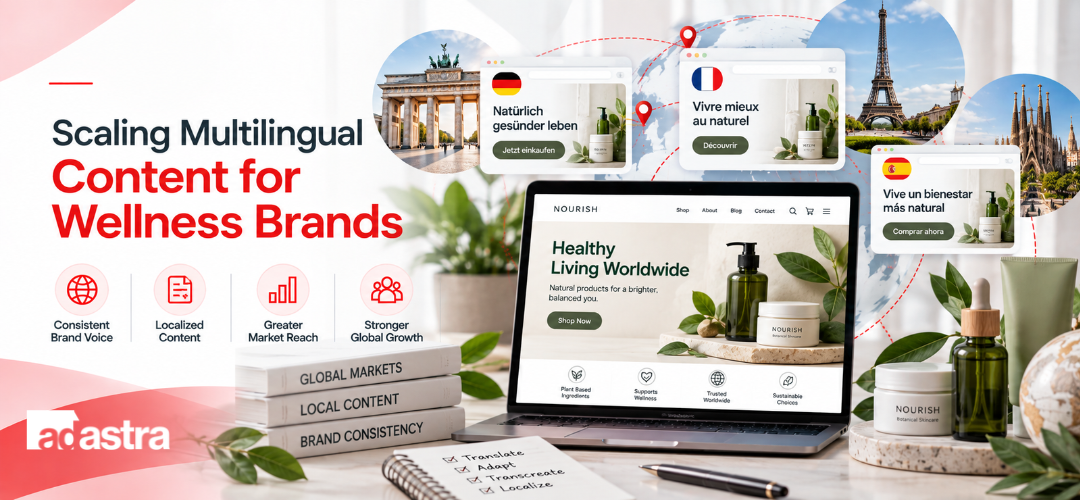
A wellness brand launches in Germany, France, and Spain in the same quarter. The English blog goes out every week. The product pages get translated once, at launch, by whoever was available. The campaign for the spring collection is translated by a freelancer the night before it goes live.
Six months later, the German site has product pages that no longer match the English ones. The French newsletter sounds like a different company from the Spanish one. The Spanish blog hasn't been touched since week two.
Nobody dropped the ball. This is just what happens when multilingual content is managed as a pile of separate tasks instead of one system. The tasks multiply with every market, and the people handling them stay the same size.
If you're past launch and trying to keep your brand coherent across languages, this article is about how to scale without losing the thread.
Why Wellness Content Is Harder Than It Looks
Wellness is a big, growing category. The Global Wellness Institute puts the global wellness economy at $6.8 trillion in 2024, with projected growth of 7.6 percent a year through 2029. That growth pulls brands into new markets quickly, often faster than their content operations can follow.
And the language piece matters more than many teams assume. In a CSA Research survey of 8,709 consumers across 29 countries, 76 percent said they prefer to buy products with information in their own language, and 40 percent said they would never buy from a website in another language. For a category built on trust, where customers are deciding what to put in their bodies or how to look after their mental health, that preference is probably stronger, not weaker.
Wellness content also has a few complications most categories don't:
-
Product claims are regulated differently in every market, so a line that works in one country can be a problem in another.
-
Tone around the body, stress, aging, and mental health varies a lot between cultures.
-
The content mix is unusually wide, from clinical ingredient explainers to emotional campaign copy, and each needs a different kind of care.
That last point is where most scaling problems begin.
Sort Your Content Before You Translate It
The most common mistake is treating all content as the same job. A blog post about magnesium and sleep, a product page for a sleep supplement, and a social campaign about winter rest are three different pieces of work. They shouldn't get the same process.
A simple way to sort them:
| Approach | Best for | What it looks like |
|---|---|---|
| Translate faithfully | Educational articles, FAQs, ingredient explainers, policies | Accurate, consistent, close to the source |
| Adapt | Product pages, onboarding emails, landing pages | Same message, adjusted for local claims, units, regulations, and imagery |
| Transcreate | Campaigns, slogans, social copy | The idea is rewritten for the market instead of translated line by line |
| Create locally | Seasonal topics, local health habits, region-specific partnerships | Written in-market, not derived from English |
Educational content is the easiest to scale because accuracy matters more than flair. Campaigns are the hardest, because humor, idioms, and emotional hooks rarely survive a word-for-word trip. If your "feel your best self" tagline lands flat in Italian, no amount of correct grammar will fix it. It needs a new line.
Once you've sorted your content this way, you can budget, schedule, and assign reviewers sensibly. A faithful translation of a FAQ shouldn't cost the same, or take the same time, as a transcreated campaign.
Give Every Market the Same Foundation
Brand consistency across languages doesn't come from policing every sentence. It comes from agreeing, in advance, on what's fixed and what can bend.
A short global brand playbook does most of the work. Keep it to a few pages and include:
-
What never changes. Brand values, product names, key terms, and the claims you will never make.
-
What can flex. Idioms, humor, examples, and how formal you sound in each market.
-
Who you're talking to. One paragraph per market about the reader, not just the language.
Your approved terminology and previously translated content belong in the same shared place, so every writer, agency, and freelancer starts from the same reference. We've covered how that works in more detail in our piece on maintaining translation quality across global teams, so I won't repeat it here. The point for scaling is simple: the playbook has to exist before the fifth market, not after the tenth complaint.
Write the English With Translation in Mind
This one is underrated, and it saves real money.
Source content that's easy to translate is cheaper, faster, and less error-prone in every language you add. A few habits make a big difference:
-
Cut idioms and wordplay from content that will be translated faithfully. "Hit the reset button on your routine" is fine in English marketing copy but awkward in a clinical explainer.
-
Avoid text baked into images. If your infographics have the words flattened into the picture, someone has to rebuild each one for every language. Keep text on an editable layer.
-
Leave room in layouts. German and Finnish can run 30 percent longer than English. A button that fits "Shop now" may not fit its translation.
-
Be careful with cultural references, seasons, and holidays. "Spring reset" means nothing in the southern hemisphere.
None of this is hard. It just has to be a habit on the content team before the translators ever see the file.
Build a Workflow That Doesn't Depend on One Person
If your multilingual content depends on one bilingual teammate who remembers which pages are out of date, you don't have a workflow. You have a person.
A scalable setup usually includes:
-
One source of truth. The English version is the master, and every update to it flags the matching pages in every other language.
-
A claims check before publishing. Anything that describes what a product does should be reviewed against local rules by someone qualified, before it goes live.
-
A native-speaking reviewer in each market. Not to rewrite the content, but to catch what sounds off to a local reader.
-
A shared calendar. Campaigns, launches, and seasonal content planned across markets together, so translators get lead time instead of last-minute drops.
The goal is for a product update in English to travel through the same steps every time, in every language, without anyone having to remember to ask.
Plan for Search and Claims in Each Market
Two things regularly get missed when content is scaled by translation alone.
Search. People don't search in other languages the way they search in English. The phrase your German customers type when they want help sleeping may not resemble a literal translation of your English keyword. Each market needs its own keyword research, and blog posts and product pages need to be written around it. Otherwise you've translated the page and made it invisible.
Claims. Wellness language is regulated in many markets, and the rules differ. A product page that says a supplement "supports immune health" may need different wording, or different evidence, somewhere else. This is why product pages belong in the "adapt" bucket, not the "translate" bucket. If you sell supplements specifically, label and packaging copy deserves its own review before anything is printed.
Decide Where to Start
You don't need to translate everything at once. In fact, you shouldn't.
A sensible order for most wellness brands:
-
Top-selling product pages and checkout flow
-
Onboarding and transactional emails
-
FAQs and customer support content
-
Your best-performing educational articles, not your whole archive
-
Campaigns, once the foundation above is in place
Then measure by market, not just overall. Track organic traffic, conversion, support tickets, and how long it takes to publish an update in each language. If German conversion lags behind French, that tells you where to look. If updates take three weeks in one market and three days in another, that tells you where your workflow is breaking.
Scale the System, Not the Workload
Brands that keep a consistent voice across markets aren't working harder than the ones that drift. They've just made decisions earlier: which content gets translated, adapted, or rewritten, who approves claims, where the shared references live, and how updates travel.
That's what scaling multilingual content really means. Less heroic effort, more repeatable process.
Ad Astra helps wellness brands build that process, from content localization for websites, campaigns, and product content to translation services for educational and regulatory material. If your content is growing faster than your ability to keep it consistent, we're glad to review where you are and suggest where to tighten things up.