
Common Localization Mistakes That Slow International Growth
Localization
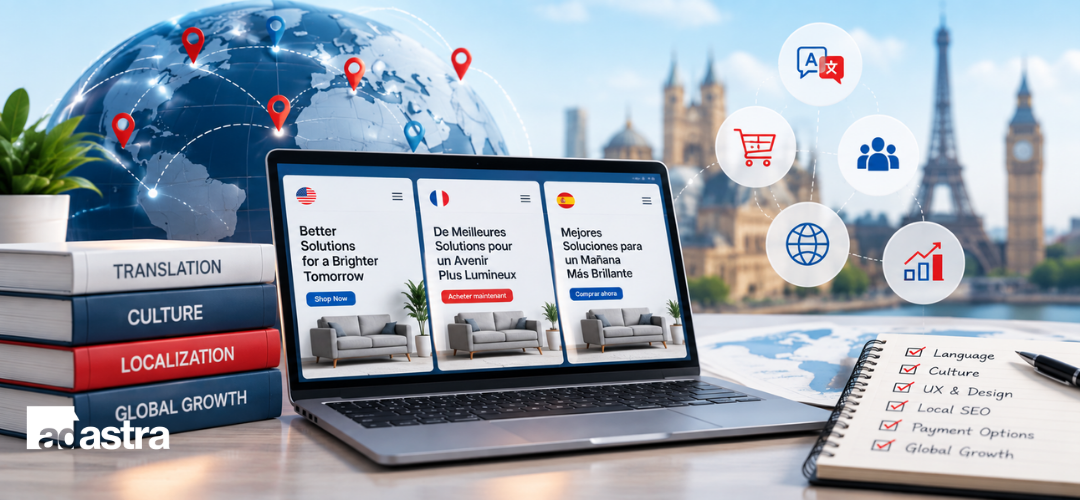
Expanding into a new market involves more than translating your website or product into another language.
A website can be grammatically accurate and still feel unfamiliar to local customers. A software product can have translated menus but confusing buttons. A marketing campaign can communicate the right words while missing the cultural context behind them.
These are common localization mistakes, and they can affect customer trust, user experience, search visibility, and ultimately international growth.
The good news is that most of these problems can be identified before they become expensive to fix.
1. Treating Localization as Translation
One of the most common localization mistakes is treating localization as a simple translation exercise.
Translation changes the language. Localization adapts the experience for a specific market.
That can include:
-
Language and terminology
-
Currency and measurements
-
Date and time formats
-
Images and cultural references
-
Website navigation
-
User interface elements
-
Local search behavior
-
Calls to action
-
Payment expectations
For example, translating an ecommerce website into another language does not automatically make it suitable for customers in that market. Product descriptions, currencies, checkout processes, and even calls to action may need to be adapted.
A translated experience can be understandable without actually feeling local.
2. Translating Without Understanding the Local Audience
Another common error is starting with the original content instead of the target audience.
Businesses often take content that performed well in their home market and translate it directly for another country. The words change, but the assumptions behind the content stay the same.
This can create problems with:
-
Tone
-
Humor
-
Cultural references
-
Images
-
Examples
-
Product positioning
-
Customer expectations
A phrase that sounds natural in one market may sound strange or overly formal in another.
Effective localization asks more than, "How do we translate this?"
It asks, "How should this message be presented so it makes sense to people in this market?"
3. Using the Same Keywords in Every Market
Multilingual websites can also struggle when businesses translate their existing keyword lists word for word.
People in different markets don't always search for the same products or services using the same terms.
A direct translation may be grammatically correct but have little search demand.
Before localizing a website, businesses should research how customers in the target market actually search. This can reveal differences in terminology, product names, search intent, and regional language.
Localization and multilingual SEO therefore need to work together.
The goal isn't simply to translate a keyword. It is to understand what the local audience is actually searching for.
4. Localizing Content but Not the Website Experience
A multilingual website can have excellent translations and still provide a poor local experience.
Consider everything around the written content:
-
Navigation
-
Forms
-
Buttons
-
Product filters
-
Currency
-
Checkout
-
Images
-
Error messages
-
Contact information
-
Payment options
If these elements remain designed around the original market, users may notice that the website was translated rather than genuinely localized.
This is especially important for ecommerce and digital businesses. A customer may understand every product description but still abandon the purchase because the overall experience feels unfamiliar.
Website localization needs to consider the complete user journey, not just the text on each page.
5. Ignoring Cultural and Visual Differences
Localization mistakes aren't limited to language.
Images, colors, symbols, gestures, clothing, and other visual elements can have different meanings across markets.
An image that works well in one country may feel irrelevant or inappropriate somewhere else.
Businesses don't necessarily need completely different creative assets for every market. However, they should review whether their visuals support the intended message and audience.
This matters particularly for:
-
Ecommerce
-
Advertising
-
Financial services
-
Education
-
Software
-
Social media
A localized experience should feel appropriate both linguistically and visually.
6. Relying Too Heavily on Machine Translation
Machine translation can help businesses manage large volumes of content quickly. The problem begins when the first automated translation becomes the final version.
Automated systems can struggle with:
-
Context
-
Brand voice
-
Industry terminology
-
Cultural references
-
Humor
-
Ambiguous language
-
Marketing copy
Technology can be valuable for speed and scale, but important content may still require human review.
A practical localization workflow can combine automation with professional linguistic and cultural review, particularly for customer-facing content where small mistakes can affect how a brand is perceived.
7. Forgetting About Design and Text Expansion
Different languages don't always take up the same amount of space.
Translated text can become longer or shorter, affecting:
-
Navigation menus
-
Buttons
-
Headings
-
Forms
-
Product cards
-
Mobile interfaces
-
Software dashboards
A design that works perfectly in English may become crowded when localized into another language.
This is especially important for software and mobile applications. Localization should be considered during product development rather than treated as something that happens after the interface is finished.
8. Ignoring Local Requirements
Localization can involve more than language and culture.
Depending on the market and industry, businesses may need to consider:
-
Product information requirements
-
Disclaimers
-
Privacy requirements
-
Accessibility
-
Financial disclosures
-
Healthcare information
-
Advertising rules
-
Packaging requirements
A business can translate its content accurately and still fail to meet local requirements.
This is why localization should be part of international market planning rather than the final step before launch.
9. Failing to Keep Localized Content Updated
Localization is not a one-time project.
Companies constantly change their websites, products, pricing, features, and marketing messages. If the original content changes but localized versions don't, customers in different markets can end up seeing outdated information.
This creates inconsistency across markets and can undermine trust.
A scalable localization process should have a clear way to identify content changes and update affected language versions.
The more markets a business enters, the more important this becomes.
10. Skipping Local Quality Assurance
A localization project shouldn't end when the translated content is delivered.
The localized experience should be reviewed in its actual environment.
For websites, this means checking:
-
Page layouts
-
Navigation
-
Forms
-
Links
-
Mobile displays
-
Metadata
-
Currency
-
User flows
For software, teams should also check buttons, menus, notifications, error messages, and text display.
Something can be linguistically correct and still be broken on the page.
That is why localization quality assurance needs to consider both language and functionality.
How to Avoid Localization Mistakes
Most localization problems become easier to prevent when businesses plan for them before launch.
Before entering a new market, ask:
Does the language sound natural?
Is it how local customers actually communicate?
Does the experience feel local?
Have the website, product, visuals, currency, and user journey been adapted?
Can customers find the business?
Have local search behavior and terminology been researched?
Does everything work correctly?
Have localized pages and interfaces been tested on desktop and mobile?
Can the process scale?
Will the same workflow still work when the business adds five, ten, or twenty more markets?
These questions can uncover problems before they reach customers.
Build Localization Into Your Growth Strategy
Localization mistakes become more expensive as a business expands.
A problem on one landing page may be easy to fix. The same problem repeated across dozens of pages, multiple products, and several markets can become much harder to resolve.
International growth therefore requires more than translating content. Businesses need to consider language, culture, search behavior, technology, user experience, and ongoing content management.
For companies expanding across markets, localization services can help bring these elements together through a structured process. Ad Astra provides localization for websites, software and mobile applications, metadata, video, multimedia, and other digital experiences.
The goal is simple: make every market feel like it was built for the people using it.