
Technical Translation Mistakes That Can Delay Global Product Launches
Translation
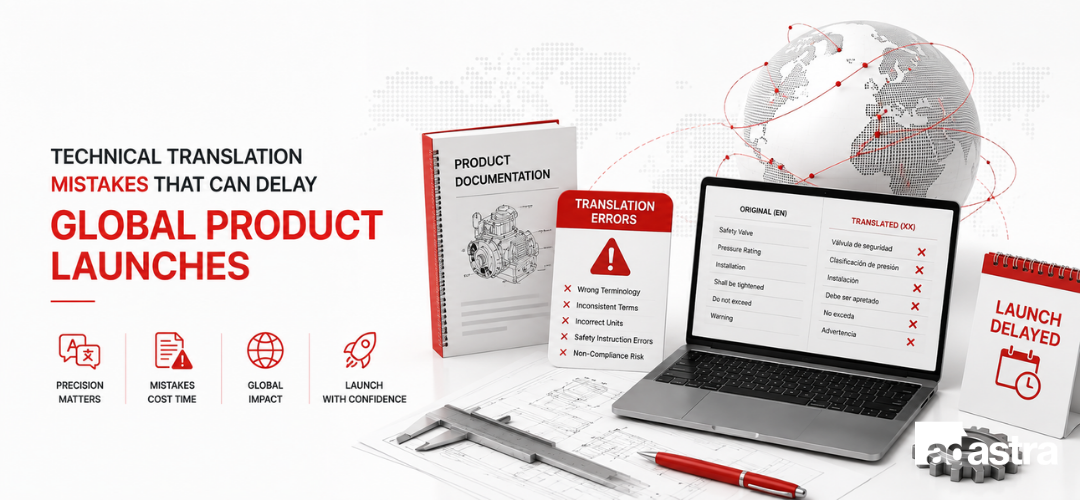
The engineering is finished. The product has passed every internal test. Regulatory submission is queued. And then the launch stalls — not because of the product itself, but because the documentation package sent to the target market regulator is rejected.
This scenario plays out regularly for manufacturers, technology companies, and industrial equipment producers expanding into new markets. The product is ready. The translation is not. Or worse, the translation appears ready but contains errors that are not visible until a regulator, a distributor, or an end user encounters them in a context where precision matters.
The global document translation services market was valued at $37 billion in 2024 and is projected to reach $62 billion by 2032, driven by demand for precision translation in engineering, software, and medicine. That growth reflects how many companies are taking their products across borders — and how much documentation those products carry with them.
Technical translation services are not a subset of general translation. They are a separate discipline with different qualification requirements, different quality standards, and a different cost of failure. Most of the launch delays and compliance rejections that companies attribute to "translation problems" are not random errors. They are the predictable result of specific, repeatable mistakes. This article covers the most common ones.
Why Technical Translation Is Its Own Discipline
General translation converts meaning between languages. Technical translation converts meaning between languages with the added requirement that every term, measurement, safety instruction, and regulatory reference must be precisely accurate within a specific domain of knowledge.
A translator handling a product manual for an industrial hydraulic press needs to understand hydraulic systems. A translator working on a medical device registration dossier needs to understand the regulatory framework of the target jurisdiction and the clinical terminology of the relevant indication. A translator localizing aerospace maintenance documentation needs to understand airworthiness standards.
As one engineering translation analysis puts it, engineering specification translation requires exact handling of standards, units, and modal verbs because specifications are legally binding documents. A modal verb error in an engineering spec — translating "shall" as "should," for instance — can change a mandatory requirement into a recommendation. In a regulated product context, that single word difference can invalidate a compliance claim.
This is what separates technical documentation translation from content that can be handled by a general linguist or a machine translation engine with light editing. The margin for approximation is zero.
The Mistakes That Delay Product Launches
Mistake 1: Machine Translation Without Qualified Expert Review
This is the most frequent mistake in technical translation, and it is becoming more common as MT tools improve in surface fluency while failing to improve in domain accuracy.
Machine translation output for technical documentation can appear convincing on a casual read. The grammar is correct. The sentences parse. A non-specialist reviewer signs off. The document goes to the regulator. Then the regulator's technical reviewer — who is a domain specialist — identifies terminology that is incorrect, safety language that is imprecise, or normative constructions that do not meet the required standard. The submission is rejected. The clock resets.
Market surveillance authorities and technical regulatory bodies recognize machine-translated documentation. They flag it routinely. For CE marking submissions, FDA device registrations, and any technical documentation that will receive expert review on the receiving end, MT without specialist human post-editing is not a cost-saving measure. It is a delay risk.
Mistake 2: Terminology Inconsistency Across Document Sets
A single product typically enters a new market with multiple documents: a user manual, installation guide, safety data sheet, declaration of conformity, maintenance procedures, and possibly a service manual. These documents are often translated separately, by different translators, at different times, sometimes through different vendors.
Without a validated technical glossary applied consistently across all documents, the same component will appear under different names across the document set. If the manual refers to a component as a "safety switch" and the declaration of conformity calls it a "disconnecting device," that ambiguity can be exploited in a liability context — and can create real confusion for technicians, inspectors, and end users working across documents simultaneously.
Inconsistent drawing terminology causes assembly errors, procurement mistakes, and production delays. This is not a theoretical risk. It is documented as a root cause of field issues, technical support calls, and installation errors in markets where the local team is working from translated documentation that contradicts itself.
The fix is establishing a validated glossary before translation begins and applying it across every document in the product package. This is a process decision, not a translator decision — and it needs to be made at the project planning stage.
Mistake 3: Translating the Manual but Not Everything Else
Some companies translate the user-facing manual and treat the rest of the documentation package as lower priority. Safety warnings stay in the source language. Maintenance procedures are provided in English only. Installation instructions are partially translated.
This is one of the most common CE marking documentation errors: translating only the immediately visible documents while overlooking maintenance or installation documentation that regulators require to be in the local language.
In the European Union, the Machinery Directive and other product regulations require that instructions for use be provided in the official language of the country where the product is placed on the market. This requirement covers the full documentation package, not just the cover pages. A company that translates the quick-start guide but leaves the maintenance manual in English is non-compliant, regardless of how accurate the translated portion is.
Beyond regulatory requirements, there is the practical reality: a technician who cannot read the maintenance documentation in their language will either avoid consulting it or misinterpret it. Both outcomes create risk.
Mistake 4: Treating International Standards as Language-Neutral
Engineering documentation references standards constantly. ASTM. ISO. DIN. IEC. EN. These references are not interchangeable across markets, and failing to map them correctly in translated documentation is a compliance error with real consequences.
Depending on the region, manufacturers may be required to comply with different editions of the same standard, sometimes simultaneously. A product documentation set translated for the North American market that simply carries its ASTM references into a European version — without mapping to the applicable EN or ISO equivalents — will fail technical review. The standards referenced in the documentation must be the standards applicable in the target jurisdiction.
This applies equally to measurement units. Engineering drawings and specifications developed in markets using imperial units need explicit conversion and verification when entering markets on metric systems. This is not a translation task that can be separated from engineering review — the translated document must be technically verified, not just linguistically reviewed.
Mistake 5: Ignoring Text Embedded in Technical Drawings and Diagrams
Engineering drawings, schematic diagrams, exploded product views, and safety pictograms regularly contain text that is embedded in the image file rather than in the editable document body. Labels, callouts, dimension annotations, safety symbols, and part numbers embedded in graphics are invisible to a translator working from a standard file.
Companies frequently discover this problem when a translated product manual reaches a distributor and the distributor's technical team points out that every diagram in the document still shows labels in the original language. At that point, the images need to be edited and re-exported, the manual needs to be rebuilt, and the timeline for market entry extends accordingly.
This is an upstream process problem. The documentation team needs to audit every file for embedded text before translation begins and ensure that editable source files — not flattened exports — are provided to the translation team.
Mistake 6: Not Updating Translations When Source Documents Change
Product documentation is not static. Engineering changes, safety updates, regulatory requirement revisions, and field-reported issues all generate updates to source documentation throughout the product lifecycle. Each update to the source creates a corresponding obligation to update every translated version.
Outdated safety data sheets are a direct regulatory risk. A product sold in a market where the translated manual describes a previous version of a safety procedure is both a compliance failure and a liability exposure. If an incident occurs and investigation reveals that the translated instructions did not reflect the current safety requirements, the documentation gap becomes a legal issue.
Managing version control across multilingual documentation requires a systematic approach: every source document update should trigger a review of translated versions, and translation workflows should be integrated with document management systems so that updates are not missed.
The Industries Where These Mistakes Cost the Most
The consequences of technical translation errors scale with the regulatory environment and the safety stakes of the product.
In medical devices, roughly 10% of recalls trace back to non-compliant labeling rather than any manufacturing or design fault. Translation errors are a significant contributor to labeling non-compliance. A 2023 FDA recall of catheter kits was triggered by a packaging error — not a translation error in that specific case, but an illustration of how labeling precision failures create costly recall events.
In pharmaceuticals, analysis of FDA data from 2012 to 2023 found that about 19% of drug recalls were attributed to labeling or packaging issues — the third most common cause of recalls after impurities and quality control failures. Translation errors are a direct contributor to this category.
In manufacturing and industrial equipment, mistranslated installation or maintenance procedures create field issues that damage distributor relationships, generate warranty claims, and in serious cases create workplace safety incidents.
In aerospace and defense, technical documentation is governed by airworthiness standards where accuracy is not a quality metric — it is a legal requirement. A single mistranslation in a maintenance procedure can ground an aircraft.
What Proper Technical Translation Practice Looks Like
The companies that avoid these mistakes treat technical translation as a controlled engineering process, not a language service ordered at the end of the product development cycle.
That means involving the translation team early — before source documentation is finalized — so that issues like embedded image text, ambiguous terminology, and unit references can be resolved before they create problems downstream.
It means building a validated technical glossary for every product before translation begins and requiring all translators and vendors working on that product to use it. One approved term per concept, across every document, in every language.
It means using translators with verified domain expertise for the specific product category and target market — not general technical translators assigned because they are available, but specialists who understand the regulatory context, the engineering vocabulary, and the applicable standards of the target jurisdiction.
It means building a version control process that connects documentation updates to translation updates, so that translated materials stay synchronized with the source throughout the product lifecycle.
And it means treating translated technical documentation as a product deliverable subject to the same quality review as the product itself — not as an administrative task completed at minimal cost and reviewed by nobody with domain expertise.
Documentation Is Part of the Product
When a product enters a new market, the documentation is not supporting material. It is a legal deliverable, a safety instrument, and the primary means by which the manufacturer communicates with installers, technicians, regulators, and end users who will never speak to anyone from the engineering team.
Getting it right is not a translation vendor problem. It is a product launch problem. The companies that understand that treat technical translation services as part of the product development process, not an afterthought scheduled for the week before submission.
Ad Astra works with manufacturers, technology companies, and industrial equipment producers on technical documentation translation across engineering, manufacturing, and regulated industries. Our translators combine linguistic expertise with domain knowledge in the specific sectors and markets they cover. If your team is planning a global product launch and needs to get the documentation right the first time, we can shelp.
Related reading: Why Translation Management Systems Matter for Enterprise Localization