
Rare Languages & Language Access: The Hidden Challenge for Global Organizations
Translation
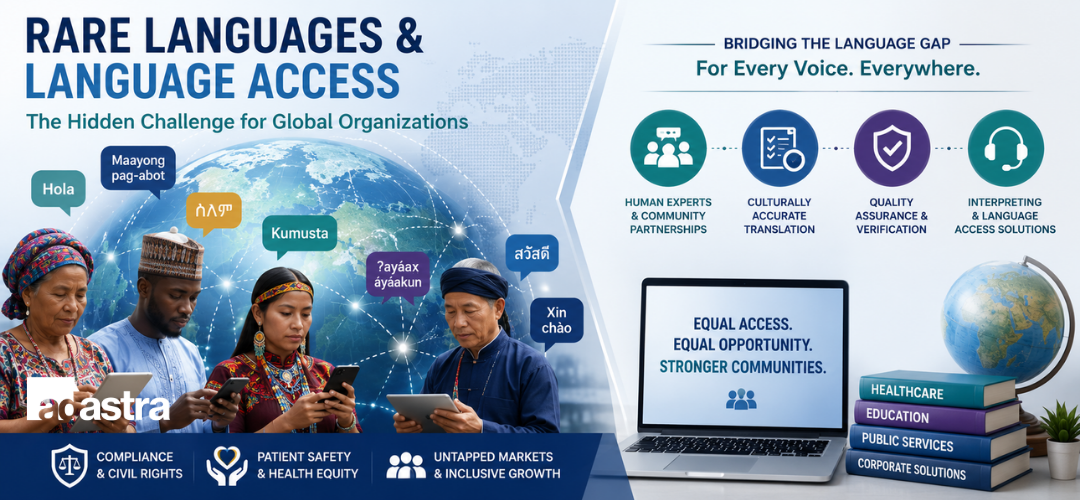
When an enterprise expands globally, the localization roadmap usually follows a predictable, well-trodden path: Spanish, French, German, Mandarin, Japanese. These high-resource languages dominate the digital world, backed by massive datasets, endless translation memories, and robust machine translation engines.
But true global operational readiness—and genuine equity—is rarely tested by the languages spoken by billions. It is tested by the languages spoken by millions, or even hundreds of thousands, that have been structurally left behind by the digital age.
For global enterprises, international NGOs, and public sector agencies alike, rare language translation services represent a critical operational frontier. From compliance under civil rights mandates to emergency healthcare delivery and deep-market entry, managing low-resource languages is no longer a niche logistical footnote. It is a core risk-management and inclusivity challenge.
What Makes a Language "Low-Resource"?
In the localization industry, terms like "rare," "underserved," or "low-resource" don't necessarily mean a language has few speakers. For instance, languages like Oromo, Fulani, or indigenous Mesoamerican languages like Mam and K'iche' are spoken by millions of people.
Instead, a language is classified as a low-resource language due to a lack of digital infrastructure:
-
Scarcity of Parallel Data: Advanced machine translation relies on web-crawled, aligned sentence pairs (e.g., an English sentence paired with its exact French translation). For thousands of the world's 7,000+ languages, this digital footprint simply does not exist.
-
Fragmented Script Standards: Many low-resource languages utilize unique abugida or abjad scripts. Standard AI tokenizers frequently fail to parse these correctly, resulting in fragmented digital text and broken encoding.
-
Absence of Monolingual Tools: Basic digital assets we take for granted—like reliable spell-checkers, standardized glossaries, and grammatical error correction tools—are entirely missing.
The Digital Divide: While mainstream AI models can effortlessly translate high-resource pairs, industry data shows an immediate, steep drop in syntactic competence and semantic accuracy when models attempt to process underserved regional languages without extensive human intervention.
The Public and Private Stakes of Language Access Services
Failing to secure reliable translation and interpretation for rare languages carries severe, real-world consequences across sectors.
1. Legal and Regulatory Compliance
In public sector communication, healthcare, and education, language access is not optional—it is a civil right. Under regulatory frameworks like Title VI of the Civil Rights Act, any organization receiving federal funding must provide meaningful access to individuals with Limited English Proficiency (LEP). If a school district, regional hospital, or state agency cannot provide a qualified interpreter for a rare indigenous language like Mam, they face immediate compliance violations, civil rights lawsuits, and a total breakdown in community trust.
2. Clinical and Humanitarian Safety
In medical translation and crisis response, an inaccurate translation is a direct threat to human safety. When a public health agency issues critical medical instructions or emergency disaster alerts, relying on generic machine translation for low-resource tongues often yields incomprehensible or dangerously misleading results. Securing specialized medical translation services with human-verified accuracy is vital to ensure patient instructions, dosage details, and consent forms are flawlessly understood.
3. Untapped Corporate Market Share
From a purely commercial standpoint, treating rare or regional languages as an afterthought means leaving vast market opportunities on the table. When a SaaS platform, fintech application, or global logistics provider adapts its digital ecosystem using structured software localization strategies for underserved regional dialects, they bypass hyper-competitive high-resource spaces and build immediate, unshakeable brand loyalty with communities that mainstream corporations ignore.
Overcoming the Hidden Bottlenecks
Providing elite translation for rare languages requires moving completely away from standard automated pipelines. Cultivating authentic niche authority involves solving three distinct human bottlenecks:
The Shortage of Certified Linguists
Because formal translation certification programs rarely exist for highly regional or oral-heavy languages, language service providers cannot rely on traditional databases. Sourcing requires deep, active partnerships with regional publishers, community advocacy groups, and local academic networks to identify and vet true native-speaking subject matter experts.
The Lore and Dialect Trap
Many low-resource languages feature immense dialectal variation over small geographic areas. A word that carries a specific medical meaning in one valley might be completely misunderstood in the next. Overcoming this requires the strict deployment of human-anchored Linguistic Quality Assurance (LQA), where multi-linguist review panels validate that the chosen terminology aligns perfectly with the target demographic's specific cultural context.
The Fallibility of Raw AI
While modern multi-lingual models show promising baseline capabilities, they are highly prone to "vocabulary contamination"—frequently bleeding words from dominant neighboring languages into the low-resource output. Deploying emergency interpreting services or specialized translation workflows that center on human-in-the-loop validation remains entirely non-negotiable. Technology can be used to assist with initial file alignment or asset management, but every single string must be curated, translated, and verified by real human eyes.
Moving Beyond Compliance to Strategic Inclusivity
True global leadership requires recognizing that every language community deserves the same clarity, dignity, and accuracy as the largest commercial markets. Organizations that proactively build comprehensive rare language workflows don't just insulate themselves from legal risk and operational friction—they build a profound, permanent competitive advantage rooted in trust.
When you solve for the hardest, most underserved language pairs, handling the rest of the world becomes second nature.
Frequently Asked Questions
What are rare and low-resource languages?
In the language industry, a low-resource or rare language is one that lacks a significant digital presence, standardized glossary tools, or large datasets of parallel text online. Many are spoken by millions of people globally but remain deeply underserved by digital technologies and automated translation tools.
Why can't global organizations rely on AI for rare language translation?
AI and neural machine translation models are trained on massive volumes of data. Because rare languages have a small digital footprint, automated engines lack the context required to translate them accurately, frequently leading to literal translation errors, nonsensical phrasing, or complete data hallucinations.
What are language access services?
Language access services encompass the operational frameworks, certified remote interpreters, and specialized translation pipelines used by healthcare networks, corporate enterprises, and government agencies to ensure that limited English proficiency (LEP) individuals have equal, seamless access to critical information, products, and public programs.