
Human First, Leader Second: Lisa Mae Brunson on Designing Belonging From the Outside In
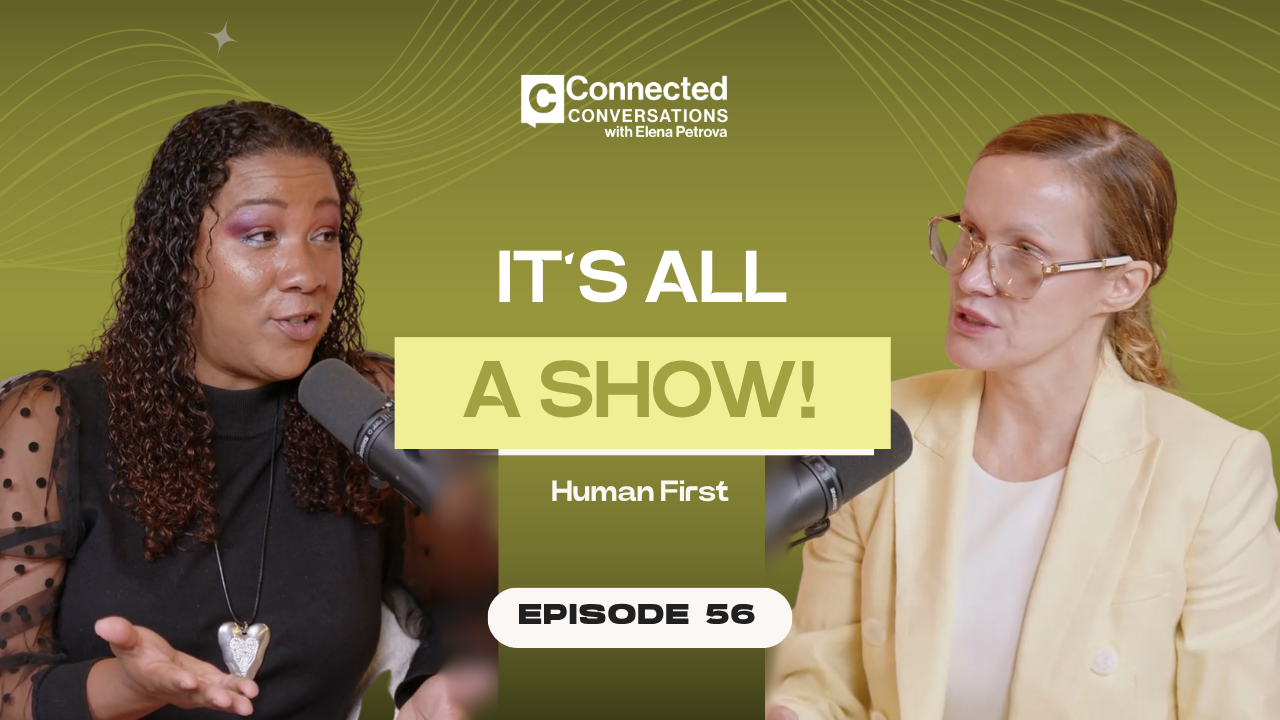
Lisa Mae Brunson has spent a decade building rooms for the people the tech industry left out. In this episode of Connected Conversations, she tells Elena Petrova why belonging is not something you find, it is something you design, and why the reframe that makes it work is simpler than most leaders expect.
The work of belonging starts with never having it
Lisa Mae Brunson builds belonging for a living. She learned the need for it the hard way, growing up othered in a place where she never quite fit, poor, multiracial, bullied for years before she learned to push back. The experience left her with a question she has spent her career answering: what would it take to build a room where the people who are usually left out are the ones who belong first?
That question became Wonder Women Tech, a decade of conferences, hackathons, and STEAM programs for communities the tech industry overlooked. But the through-line of her conversation with Elena is not the organization. It is a method. Belonging, in Lisa's telling, is not found. It is designed. And the people best equipped to design it are often the ones who were locked out to begin with.
What a hug does that words cannot
Long before the conferences, Lisa started something smaller and stranger. She began offering free hugs to strangers, thousands of them over the years, poetry in hand, on street corners and at events.
What she found was not what she expected. People were starving for it. One moment has stayed with her. A student came up to her and admitted he had never been hugged, and did not know how. Not as a hardship story, just a fact of his life. It crystallized something Lisa keeps returning to: we are living in a world that has never been more connected and never felt more alone, and a surprising amount of leadership comes down to noticing that in the people around you.
Deaf innovators in her living room
The clearest example of belonging by design started in Lisa's own home. She gathered Deaf innovators in her living room, a handful of people at first, and that small circle grew into one of the largest Deaf-in-tech communities around, with Deaf in STEAM and Deaf in tech sessions running through her conferences.
What that work taught her was uncomfortable. Most companies are simply not built to hire Deaf talent. Career fairs are rarely set up for it. In her experience, her Deaf innovators were among the least likely to be hired, not for lack of skill, but because the systems meant to include them were never designed with them in mind. Access, she realized, is not a ramp you add at the end. It is a decision you make at the beginning, or fail to make. Every room that calls itself accessible is really answering a design question, whether it knows it or not.
Theater, and how to tell it from the real thing
Elena asks the question a lot of leaders are quietly asking: how do you tell real inclusion from performance? Lisa does not soften her answer. Your actions speak louder than words, she says, and right now a lot of it is a show. Bread and circuses.
The tell is simple. Performance announces itself. Real inclusion shows up in who gets hired, who gets heard, and who stays. It is measured in decisions, not statements. And there is a sharper edge to this too. Lisa is clear-eyed that the same technology built to include people can quietly turn into technology that watches them. Tools designed to open a door can become tools that track who walks through it. For any leader adopting new systems, that is not a side issue. It is the issue.
A workforce is a community
All of this builds to the reframe at the center of the episode. Lisa describes her own role plainly. She recognizes herself as human first and leader second, and she treats her team as human first and everything else second.
It sounds soft until you follow it into practice. A workforce, she points out, is a community, the first community most organizations ever build. Treat it as a machine and people behave like parts. Treat it as a community and something changes in who shows up, who contributes, and who decides to stay. Her own compass for the work is a single question she keeps asking: why are you building the thing? Purpose first, mechanics second. The North Star before the map.
For the leaders listening
Lisa's argument is not that leaders should care more in the abstract. It is that belonging is a design problem, and design problems have solutions. Start with the human. Build access in from the beginning rather than bolting it on. Watch what your actions say when your words are not in the room. And remember that the people who were once shut out are not a burden to accommodate. They are the ones who know how to build the door.
If you lead a team, serve a community, or build anything that other people have to live inside, this one is worth your time.
Listen to Episode 56 of Connected Conversations, hosted by Elena Petrova, Founder and CEO of Ad Astra, Inc. and AdAstraConnect.
Connected Conversations is produced by Ad Astra, Inc.
You can watch/listen to this episode here:
🔴 YouTube: https://youtu.be/7UndPe001aU
🟢 Spotify: https://shorturl.at/ZS2Kl
⚫ Apple Podcast: https://shorturl.at/cRgU5
🔵 Amazon Music: https://shorturl.at/vySB4