
Website Translation vs Website Localization: What Businesses Need to Know
Translation
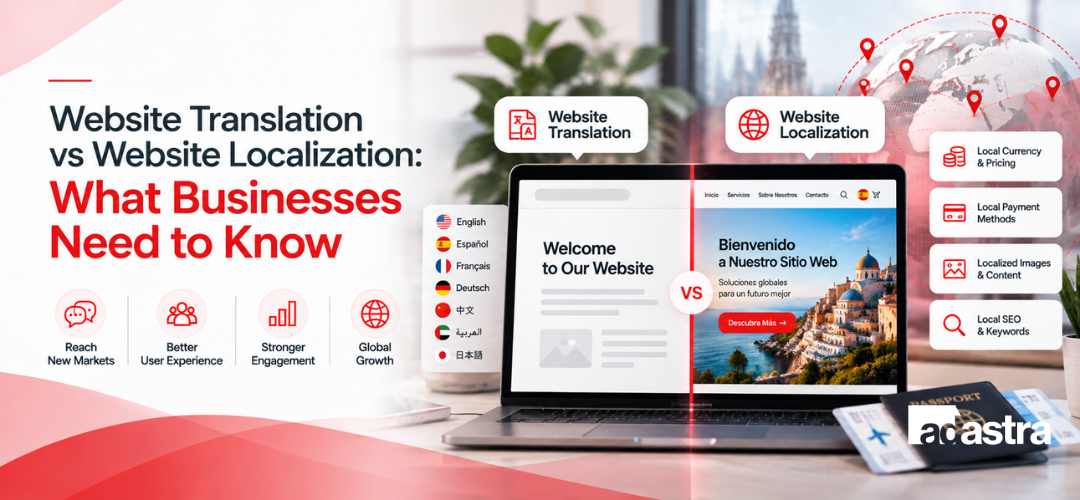
Expanding into a new market often starts with a simple decision: make the website available in another language. For businesses testing international demand, translating existing content can be a sensible first step. But as a company begins competing for customers in another country, language is only one part of the challenge.
A website can be translated accurately and still feel unfamiliar to its intended audience. Product descriptions may be clear, but prices may appear in the wrong currency. Search terms may reflect how people search in the original market rather than the new one. Calls to action, payment options, and customer information may not match local expectations.
This is where the difference between website translation and website localization becomes important.
Translation helps people understand your website in another language. Localization adapts the wider website experience to the market you want to reach. Understanding when each approach is appropriate helps businesses allocate resources, avoid unnecessary work, and prepare for international growth.
Website Translation vs Website Localization: What's the Difference?
Website translation focuses on transferring written content from one language to another while preserving its meaning, accuracy, and intent. This can include product descriptions, service pages, blog posts, navigation labels, and FAQs.
Website localization goes further. It considers whether the content, design, functionality, and overall experience are appropriate for the target market. Translation is often part of localization, but the process may also involve adapting search terms, currencies, payment methods, images, forms, and customer journeys.
The main difference is the scope of the work.
|
Website element |
Website translation |
Website localization |
|
Written content |
Translates text accurately |
Adapts language, tone, and messaging for the market |
|
SEO |
Translates relevant metadata |
Researches local keywords and adapts the SEO strategy |
|
Currency and pricing |
May retain the original presentation |
Adapts pricing displays and currency where needed |
|
Images and examples |
May retain existing visuals |
Reviews cultural relevance and local expectations |
|
Website design |
Preserves the existing layout where practical |
Adapts layouts, text space, and regional conventions |
|
Forms and checkout |
Translates labels and instructions |
Reviews local formats, payment options, and usability |
|
Ongoing updates |
Translates new content |
Maintains language versions and market-specific experiences |
Neither approach is automatically better in every situation. The right choice depends on what your business is trying to achieve in the target market.
When Is Website Translation Enough?
Not every international website requires extensive localization from the beginning. Sometimes, accurate translation is the most practical way to make existing information accessible to a new audience.
Informational websites
A business publishing company information, educational resources, or general service details may need relatively few changes beyond translation. If the information, offer, and user journey remain largely the same across markets, translating the relevant pages can be a reasonable starting point.
Early market testing
Businesses exploring a new market may want to test demand before investing in a complete localized website. Translating selected landing pages, product information, or lead generation content can help them understand whether there is enough interest to justify a larger investment.
However, results should be interpreted carefully. Weak performance does not necessarily mean there is no demand. Pricing, competition, search visibility, and the overall customer experience can also affect results.
Content with limited regional differences
Some content may not require significant adaptation. Technical documentation, general company information, or product instructions can sometimes follow the same structure across markets, provided terminology and local requirements are handled correctly.
The important point is to evaluate each type of content rather than assuming every page needs the same level of work.
When Does Your Business Need Full Website Localization?
As a business moves beyond initial market testing, the website often needs to do more than communicate information. It needs to attract relevant visitors, build confidence, explain the offer, and help customers take the next step.
That is where localization becomes more important.
When Customer Expectations Differ
Customers in different markets may have different expectations about pricing, product information, customer support, delivery, and payment.
For example, translating an ecommerce website into another language will not solve the problem if customers cannot find relevant delivery information or use a payment method available to them.
Localization helps businesses identify these gaps and adapt the parts of the website that influence the buying decision.
When Your Brand Messaging Needs to Change
A headline or call to action that performs well in one market may not communicate the same value in another.
Localization allows businesses to adapt messaging to local expectations without losing their overall brand identity. This might mean changing examples, adjusting the tone, using different product benefits, or rewriting a call to action so it feels natural in the target language.
The goal is not to create a completely different brand for every country. It is to communicate the same core value in a way that makes sense to each audience.
When the Website Supports Sales or Lead Generation
For ecommerce stores, SaaS companies, and businesses generating leads online, the entire customer journey matters.
Visitors need to understand the offer, trust the information, navigate the site, and complete the required action. If any of those steps feels unfamiliar or difficult, the translated content alone may not be enough.
Localization can involve adapting landing pages, forms, pricing displays, checkout flows, product availability, and support information to reduce unnecessary friction.
How Website Localization Affects International SEO
One of the most common mistakes businesses make is assuming that translating website content automatically creates an effective international SEO strategy.
It does not.
People in different markets may use different phrases to search for the same product or service. A direct translation of a high-volume keyword may sound unnatural or fail to reflect local search intent.
Effective website localization therefore needs to account for how the target audience searches.
Research Keywords for Each Market
Start by researching the terms people actually use in the target country and language. Consider differences in terminology, spelling, product names, and the way customers describe their problems.
Then adapt page titles, headings, product descriptions, and other relevant content to match that research naturally.
The objective is to create useful content for the local audience, not simply replace every occurrence of an English keyword with its translated equivalent.
Give Language and Regional Versions Clear URLs
Each localized version should have a clear, crawlable URL structure. Depending on the business and its international strategy, this might involve country-specific domains, subdomains, or subdirectories.
For example, a business may use separate regional websites or dedicated language folders. The right structure depends on the markets served, technical resources, and long-term maintenance requirements.
Google also recommends using appropriate hreflang annotations to help it understand relationships between language or regional page versions. These annotations support discovery and selection of the appropriate version, but they do not guarantee that a particular page will appear in search results.
Localize Content, Not Just Metadata
Changing a title tag is not enough if the page itself does not address the needs of the target audience.
Review the information customers need before making a decision. This might include local delivery details, relevant product specifications, regional service availability, or answers to market-specific questions.
For businesses preparing for international expansion, localization services can support the broader process of adapting content and digital experiences for different markets.
Website Elements Businesses Often Forget to Localize
Even when the main content has been translated, small details can make the experience feel incomplete.
Currency, Dates, and Measurements
Prices, dates, times, and measurements should follow appropriate regional conventions. A customer should not have to guess whether a date is written in month-day-year or day-month-year format, or whether a measurement uses the expected unit.
Currency presentation also needs careful consideration. Displaying a currency symbol is not the same as offering accurate local pricing.
Forms and Navigation
Forms need to accommodate differences in names, addresses, postal codes, and telephone numbers. A form built around one country's address structure may prevent users elsewhere from entering valid information.
Navigation labels and buttons also need review. Some languages require more space than English, which can affect menus, buttons, banners, and mobile layouts.
Right-to-Left Languages
Languages such as Arabic and Hebrew are written from right to left. Supporting them may require changes to layout direction, alignment, navigation, icons, and other interface elements.
Simply translating the text while leaving the interface unchanged can produce an awkward or difficult-to-use experience.
Images, Examples, and Trust Signals
Images, testimonials, examples, and references should be reviewed for relevance to the target market. Not every visual needs to change, but businesses should check whether their existing content makes sense to the audience they are trying to reach.
Localization is about making informed changes where they improve relevance, clarity, or usability.
Internationalization: Preparing Your Website for New Markets
There is another concept businesses should understand before expanding internationally: internationalization.
Internationalization means preparing the website's underlying structure so it can support different languages and regional requirements without extensive redevelopment every time a new market is added.
This may involve supporting different character sets, flexible text layouts, multiple currencies, regional formats, and right-to-left languages.
For example, if a website's buttons and menus cannot accommodate longer translated text, every new language may require additional design and development fixes. Planning for these differences early can make future localization more manageable.
Internationalization does not replace translation or localization. It provides the technical foundation that allows both processes to work more efficiently as the business expands.
How to Choose the Right Approach for Your Business
The decision between website translation and website localization should depend on the market, the website's purpose, and the experience customers need.
Before choosing an approach, consider these questions:
-
What are you trying to achieve? If your immediate goal is to make basic information accessible, translation may be enough. If you need to generate leads or sales, examine the complete customer journey.
-
How different is the target market? Differences in language, search behavior, pricing, customer expectations, and regulations may require broader localization.
-
How important is the website to revenue? The more the business relies on online conversions, the more carefully it should assess usability and market-specific requirements.
-
What needs to change first? You may not need to localize every page immediately. Start with high-value pages, key customer journeys, and the elements most likely to affect performance.
-
How will you maintain the website? New products, updated pricing, revised service information, and new campaigns need to remain consistent across market versions.
A phased approach can work well. Businesses can begin by translating priority pages, evaluate how the experience performs, and then invest in additional localization based on customer feedback, market research, and business objectives.
The important thing is to avoid treating translation as proof that the website is ready for a new market.
Build a Website That Works Across Markets
Website translation and website localization serve different but closely related purposes. Translation makes content available in another language. Localization considers the wider experience, including how people find, understand, navigate, and use the website in their market.
For businesses entering new countries, the right approach may involve a combination of both. Some pages may need accurate translation, while others require adapted messaging, local keyword research, regional information, or changes to the user experience.
The decision should be based on the needs of the target market rather than a fixed rule that every website must be fully localized.
Ad Astra helps businesses adapt multilingual content and digital experiences through its localization services. With a clear understanding of what needs to change and why, businesses can build websites that communicate more naturally with international audiences and support their wider expansion goals.