
How Translation Memory Improves Speed, Quality, and Cost Savings
Translation
Your product manual gets updated every quarter. About 80 percent of it stays the same. The new quote still arrives for the whole document.
If that sounds familiar, you're paying again for sentences you've already approved. It's one of the most common and most avoidable costs in multilingual projects, and it's the problem translation memory was built to solve.
This guide explains what translation memory is, how it works in a real project, and what it actually does for speed, quality, and budget. It also covers where it falls short, because buyers who understand the limits get better results from it.
What Translation Memory Is
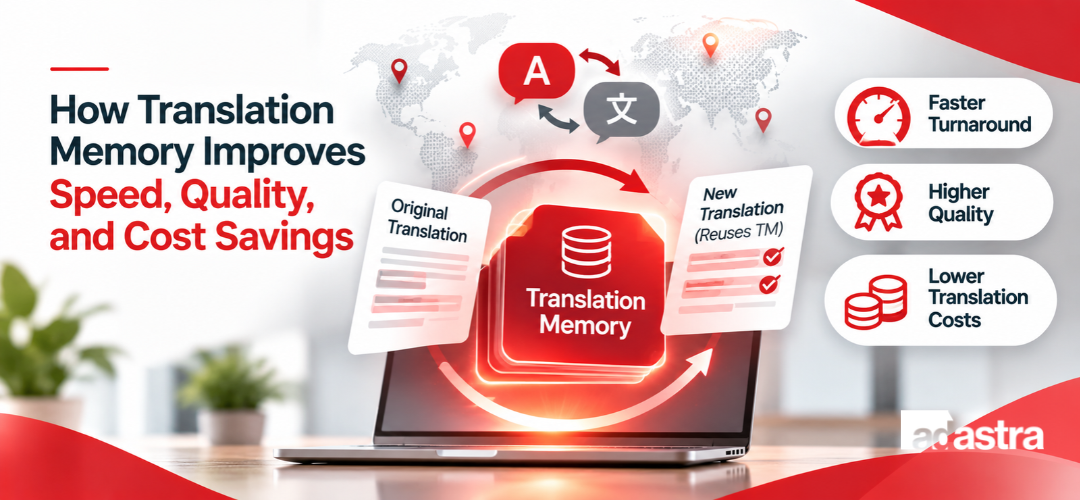
Translation memory (TM) is a database of sentences your team has already translated and approved. Each entry pairs a source sentence with its approved translation. When similar text comes up again, the system finds the earlier translation and offers it to the translator instead of starting from zero.
A few things it is not:
-
It isn't machine translation. A TM doesn't generate anything. It retrieves translations that a human already approved.
-
It isn't a glossary. A glossary stores approved terms. A TM stores approved sentences.
-
It isn't a file archive. It stores sentence-level pairs in a searchable format, not documents.
Think of it as your company's approved-translation library. The longer you use it, the more it holds.
How It Works in a Real Project
When new content comes in, the system breaks it into segments, usually sentences, and compares each one against what's already stored. Every segment lands in one of a few categories:
|
Match type |
What it means |
What happens |
|
Context match |
Identical sentence, and the surrounding text matches too |
Reused, with a quick check |
|
100% match |
Identical sentence, different context |
Reused, and the translator confirms it fits |
|
Fuzzy match |
Similar but not identical, for example one word changed |
Offered as a starting point, and the translator edits it |
|
No match |
New content |
Translated from scratch |
Say a maintenance manual from last year includes the line "Press Start to begin the cycle." This year's update says "Press Start to begin the test." The system flags the earlier sentence as a close match, and the translator changes one word instead of translating the whole line again.
After the translator finishes, the new translations are saved back to the memory. Each project makes the next one cheaper and faster.
Speed: Less Retyping, Faster Reviews
The speed gain comes from two places.
First, translators don't re-translate sentences that already exist. On updates, recurring documents, and product content with lots of repeated phrasing, that can be a large share of the word count.
Second, reviewers spend their time where it matters. Reused segments have already been approved, so reviewers can focus on the new text instead of re-reading everything. Review cycles get shorter, which matters most when you're releasing updates in several languages at once.
For teams running a regular localization workflow, this adds up. A product update that used to take two weeks across ten languages can move faster because most of the content is already settled.
Quality: Translation Consistency That Holds Up
This is the benefit people tend to underestimate.
Without a TM, the same sentence can be translated differently every time it appears. Three translators over two years might render "Contact support" three ways. None of them is wrong. Together, they make your content feel inconsistent, and customers notice.
With a TM, the same source sentence gets the same approved translation every time. That helps in places where consistency isn't optional: safety warnings, legal disclaimers, regulatory language, and instructions that have to match across documents. It also supports your terminology, since approved phrasing carries across projects and across translators.
If you've ever worked with multiple vendors or freelancers, you know how hard consistency is to maintain. A shared TM gives everyone the same reference point.
Cost: Where the Savings Come From
Most providers price translation by tiers based on match type. New text costs the full rate. Repeated and similar text costs less. The exact discounts vary by provider, but one published example puts exact matches at roughly 75 percent off, high fuzzy matches at around 50 percent off, and lower fuzzy matches at about 30 percent off.
Here's an illustrative example using those tiers. The numbers are hypothetical: a 20,000-word manual update at $0.15 per word.
|
Match type |
Words |
Rate applied |
Cost |
|
100% match |
6,000 |
25% of full rate |
$225 |
|
High fuzzy (85 to 99%) |
4,000 |
50% of full rate |
$300 |
|
Low fuzzy (75 to 84%) |
2,000 |
70% of full rate |
$210 |
|
New text |
8,000 |
Full rate |
$1,200 |
|
Total with TM |
20,000 |
$1,935 |
|
|
Total without TM |
20,000 |
Full rate |
$3,000 |
That's a saving of $1,065, or about 35 percent, on a single update. For companies that translate similar documents every quarter, the saving repeats and grows as the memory fills up. For the full picture of how to put numbers like these in front of decision-makers, our guide on measuring localization ROI walks through the formula.
The saving isn't only on invoices. Fewer revisions, less project management, and faster turnaround all show up in the budget too.
What Translation Memory Can't Do
A TM is a strong tool with clear limits.
It can repeat mistakes. If an error goes into the memory, it comes back every time that sentence appears. A TM is only as good as what's stored in it.
Context can change meaning. A sentence that was right in a maintenance chapter might be wrong in a safety chapter. Even 100% matches need a human to confirm they still fit.
It doesn't help much with creative content. Slogans, campaign copy, and brand storytelling are usually rewritten for each market, so there's little to reuse.
It goes stale. Product names change, branding evolves, and regulations get updated. Old entries need to be reviewed and retired.
None of these are reasons to skip a TM. They're reasons to manage one.
Keeping a Translation Memory Healthy
A few habits separate a useful TM from a cluttered one.
-
Review before you add. Only approved translations should enter the memory. Unreviewed drafts shouldn't.
-
Clean it periodically. Remove duplicates, outdated product names, and conflicting entries.
-
Separate by subject where it makes sense. A legal memory and a marketing memory shouldn't share entries.
-
Pair it with a glossary. Approved terms and approved sentences work best together.
-
Know who owns it. Your TM is an asset. Make sure you can export it in a standard format and take it with you if you change providers.
This also connects to the wider translation workflow. In a typical setup, new content is analyzed against the memory, translated, reviewed, and then saved back. A translation management system usually handles that loop, though the TM itself can exist without one.
Make Your Past Work Count
Every sentence you've already approved is an asset. Translation memory is how you put that asset to work, with faster turnaround, steadier quality, and lower costs on every project that follows.
If you've been translating for years without a structured memory, you may have more reusable content than you realize. Ad Astra's translation services and localization services can help you review what you already have and set up a process that keeps it working for you.
Translation Memory: Frequently Asked Questions
What is the difference between translation memory and machine translation?
Translation memory retrieves sentences that humans have already translated and approved. Machine translation generates a brand-new translation with software. A TM can only help with content similar to something you've translated before. Machine translation can handle anything, but its output needs review. Many workflows combine them: the TM handles repeated content, and machine translation is used on what's left, followed by human review.
What is the difference between translation memory and a termbase?
A termbase, or glossary, stores approved translations of individual terms, like product names and key phrases. A translation memory stores full approved sentences. They solve different problems. The termbase keeps vocabulary consistent, while the TM keeps whole sentences consistent. Most teams get the best results using both.
What is a fuzzy match in translation memory?
A fuzzy match is a stored translation that's similar to new text but not identical. It's shown as a percentage, for example 85 or 95 percent. A higher percentage means fewer edits are needed. A translator reviews the suggestion and adjusts it, which is quicker than translating the sentence from scratch. That's why fuzzy matches are usually priced at a discount, though they cost more than exact matches.
Who owns a translation memory?
It should be you. The memory is built from content your company paid to translate, so it's a business asset. Before you sign with any provider, confirm that you can request a full export in a standard format such as TMX, and that you can take it to another provider. A memory you can't access or move creates lock-in.