
How Global Companies Standardize Interpretation Across Multiple Locations
Interpretation
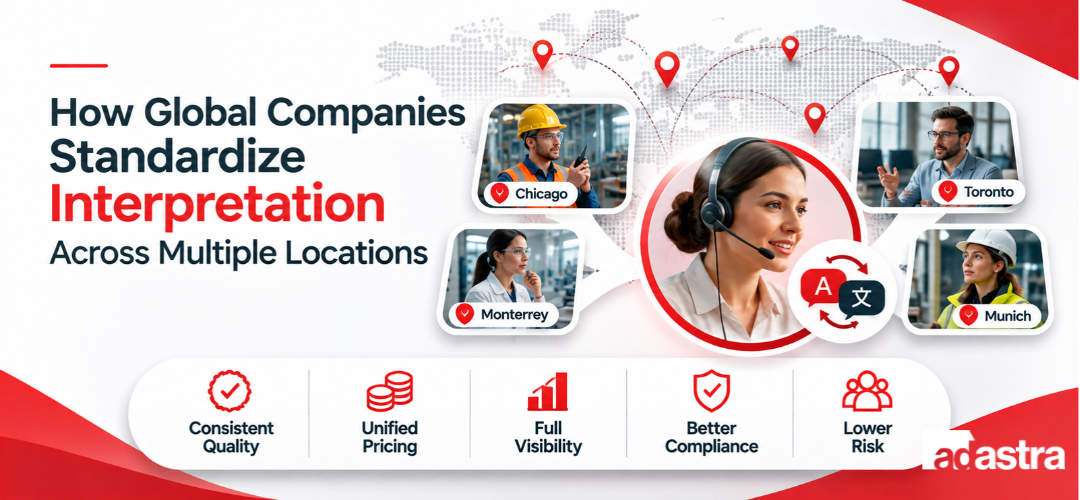
A manufacturer runs fourteen sites in six countries. Chicago books interpreters through one agency. Toronto uses another. At the Monterrey plant, a supervisor asks a bilingual line worker to translate safety briefings. In Munich, HR calls whoever has a freelancer's number.
Then headquarters asks a simple question: how many interpreted conversations happened last quarter, in which languages, and at what cost? Nobody can say.
That's the real problem with interpretation at scale. It's rarely a shortage of interpreters. It's fragmentation: different vendors, different rates, different quality bars, and no shared data. This guide walks through how multi-site organizations fix it, step by step, without turning every local decision into a ticket for headquarters.
Why Interpretation Fragments as Companies Grow
Nobody plans for this. Each site solves its own language problem the day it shows up. A manager finds a vendor that works. Regional procurement signs a local contract. Informal workarounds creep in because they're fast.
Each choice makes sense on its own. Together they add up to:
-
Uneven quality, because every site has a different standard, or none
-
Inconsistent pricing, with several contracts and several sets of minimums
-
No visibility into how much interpretation is used, where, or in what languages
-
Compliance gaps that differ from site to site
-
More risk, since informal interpreters tend to fill any gap the official process leaves open
Multilingual operations only scale if the system behind them does. Hiring more interpreters doesn't fix a system problem.
What "Standardized" Actually Means
Standardizing doesn't mean forcing one interpreter, one format, or one vendor on every site. It means agreeing on the rules, and leaving room for local needs inside them.
|
Layer |
Set centrally |
Left to the site |
|
Quality standard |
Qualifications, vetting, confidentiality, ethics |
Which specialist fits a given assignment |
|
Request process |
One way to ask for an interpreter, and response-time expectations |
Day-to-day scheduling |
|
Provider model |
A primary provider, a backup, and shared contract terms |
Local specialists when needed |
|
Data and reporting |
The same metrics at every site |
Local follow-up on what the data shows |
|
Governance |
An owner, a review schedule, and written policies |
Site champions who keep it running |
If you can fill in that table for your organization, you have a standard. If you can't, that's your starting point.
Step 1: Map What You Have Today
You can't standardize what you can't see. Before changing anything, build a baseline:
-
Which sites need interpretation, and in which languages
-
Which formats are in use: phone, video, on-site, sign language
-
Which vendors you work with and what you spend with each
-
Where the need comes from: HR, safety training, customer support, legal, clinical
-
Any incidents, complaints, or near-misses tied to language
Rough numbers are fine. They'll still reveal overlap and gaps. Ask site managers how they actually handle language needs, not how the policy says they should. You'll learn about the workarounds, and those matter most.
Step 2: Set One Quality Standard for Every Site
Quality shouldn't depend on which city a request comes from. Decide what "qualified" means for your organization, then apply it everywhere. That usually covers interpreter credentials, vetting and background checks, subject-matter training, signed confidentiality terms, and a code of ethics.
You don't need to invent this from scratch. ISO publishes a set of interpreting standards that procurement teams can reference directly. ISO 18841 covers general requirements for interpreting services, ISO 20228 covers legal interpreting, and ISO 21998 covers healthcare interpreting. There is also ISO 23155 for conference interpreting. Asking a provider how they align with these gives you a common yardstick across vendors.
One caveat if you're considering AI. ISO 18841 states that AI-driven interpreting is outside its scope, so those standards won't tell you whether an AI tool is fit for purpose. If AI is part of your plan, write your own policy on where it's allowed and where a human is required. Our overview of AI interpretation with human backup shows one way that hybrid model works.
Step 3: Standardize the Interpretation Workflow
A good interpretation workflow answers a few questions before anyone needs it:
-
Where do I go to request an interpreter? One front door, not fourteen.
-
Which format should I use? A short guide by scenario helps. Over-the-phone interpreting usually fits quick, unplanned conversations. Video remote interpretation suits situations where visuals matter. On-site is for high-stakes, planned events.
-
How fast will I get one? Set response-time expectations, including after-hours and cross-time-zone coverage.
-
What are the booking and cancellation rules? Make them the same everywhere.
-
What if something goes wrong? Define an escalation path and a way to give feedback.
The most important principle is to make the standard path the easiest path. If requesting an interpreter takes five steps and grabbing a coworker takes five seconds, people will grab the coworker.
There's evidence that this works. Researchers studying a large urban health system found multiple language service departments and inconsistent vendors. After rolling out one system-wide interpreter service built into clinical workflows, monthly interpreter calls rose from an average of about 9,700 in 2022 to more than 68,000 by the end of 2024. That's healthcare, but the lesson travels: when the official route is easy, people take it.
Step 4: Consolidate Providers, but Plan for Gaps
For most multi-site organizations, the right model is one primary provider with global reach, a named backup, and a short list of specialists for what the primary can't cover. That might include rare languages, sign languages, or highly regulated work.
Standardize the commercial terms as well. Look for:
-
A consistent pricing structure across sites, such as per-minute for phone and hourly with defined minimums for on-site
-
Service-level commitments for response time and coverage
-
Confidentiality and data-protection terms that meet the requirements of each region
-
Access to your own usage data
-
Clear exit and transition terms, so you aren't locked in
Don't choose on the lowest rate alone. A cheap provider that can't cover a language at 2 a.m. in Monterrey will cost you more in workarounds and incidents than it saves on invoices. And avoid a single point of failure. Even your best provider will have a bad day.
Step 5: Report on the Same Metrics Everywhere
Standardization pays off when you can see it. Pick a short list of metrics and track them the same way at every site:
-
Volume by site, language, and format
-
Connection and wait times
-
Cancellations and no-shows
-
Cost per interpreted encounter
-
Satisfaction and feedback from staff and the people being served
-
Incidents and complaints
Review the numbers monthly or quarterly. They support budgeting and staffing, and they give you evidence if an auditor or regulator asks how you provide language access. They also expose underuse. A site with a large multilingual workforce and almost no interpreter requests isn't doing without. It's probably relying on informal fixes.
Step 6: Assign Ownership and Train the Sites
Standards fade without an owner. Name one person or team to run the program centrally, and a champion at each site to keep it going. Set a quarterly review so problems surface early.
Then train the people who actually use the service. Managers need to know how to request an interpreter, how to pace a conversation so the interpreter can keep up, and when to insist on a professional instead of a coworker. Put the key rules in writing:
-
No informal interpreters for sensitive conversations such as discipline, safety, medical, or legal matters
-
Clear rules on when AI interpretation is acceptable
-
A requirement to document interpreted conversations where regulations call for it
Let Local Rules Stay Local
A global standard sets the floor. It doesn't replace local law. Countries and regions differ on language rights, workplace safety communication, data protection, and the availability of certain languages and dialects. Your central team should set the baseline and make sure sites meet local requirements on top of it.
Cultural fit matters too. A phone interpreter who suits a quick customer call may not be right for a sensitive HR conversation in a market where face-to-face trust matters. Good standardization leaves room for that judgment.
Mistakes That Undermine Standardization
-
Choosing on price alone. The cheapest rate rarely covers the hard cases.
-
Forcing one format everywhere. Different situations need different services.
-
Rolling out without site input. If local teams don't help design the process, they'll work around it.
-
Having no backup. One provider outage shouldn't stop a plant.
-
Skipping the data. Without it, you can't show value or find problems.
-
Ignoring workarounds. If people keep using informal fixes, the official path isn't working yet.
What Procurement Should Ask Providers
When you evaluate enterprise interpretation services, these questions separate providers who can support multiple sites from those who can't:
-
Which languages and time zones do you cover, and what are your actual response times after hours?
-
How do you keep quality consistent across regions, and how do you align with ISO standards?
-
Can we have one contract and consistent pricing across all sites?
-
Is there one platform for requesting, tracking, and reporting?
-
How do you handle confidentiality and data protection in each region we operate in?
-
Can you support both human and AI-assisted options under clear rules?
-
How will you onboard fourteen sites without disrupting operations?
A provider with real specifics here is easier to manage, and easier to measure.
Consistency Is What Scales
The companies that handle interpretation well across many locations aren't the ones with the most interpreters. They're the ones with the clearest system: one standard, one front door, shared data, and room for local judgment.
Ad Astra provides enterprise interpretation services across phone, video, on-site, and sign language, supported by AdAstraConnect, a single platform for requesting interpreters and monitoring usage and performance. Procurement and security teams can review how we handle data in our Trust Center. If you're working out how to bring several locations under one standard, we're glad to help you map where you are today and what a consistent model would look like.
Enterprise Interpretation Services: Frequently Asked Questions
What are enterprise interpretation services?
Enterprise interpretation services are language support programs built for organizations with multiple sites, departments, or countries. Instead of each location arranging its own interpreters, the organization works with a provider under shared contract terms, one request process, a common quality standard, and consolidated reporting. The service itself can include phone, video, on-site, and sign language interpreting. What makes it “enterprise” is the structure around it.
How do you standardize interpretation across multiple locations?
Start by mapping what each site uses today, including languages, vendors, formats, and spend. Then set one quality standard, one way to request an interpreter, shared contract terms, and the same reporting metrics for every site. Assign a central owner and a champion at each location. The goal is to standardize the system, not force one interpreter or format on every site, so local teams can still choose what fits a given situation.
Should a global company use one interpretation provider or several?
For most multi-site organizations, one primary provider with global coverage works best, since it gives you consistent pricing, quality, and data. Pair it with a named backup so a single outage doesn’t stop operations. Add a few specialists for what the primary can’t cover, such as rare languages, sign languages, or highly regulated work. Choosing on the lowest rate alone usually backfires when coverage gaps push people toward informal workarounds.
What metrics should we track for interpretation across sites?
Track the same short list everywhere: volume by site, language, and format; connection and wait times; cancellations and no-shows; cost per interpreted encounter; satisfaction feedback; and incidents or complaints. Review them monthly or quarterly. These numbers support budgeting and give you evidence for auditors. They also reveal underuse. A site with a multilingual workforce and almost no interpreter requests is probably relying on informal fixes.
Which standards apply to interpreting services?
ISO 18841 is the general standard for interpreting services. ISO 20228 covers legal interpreting, ISO 21998 covers healthcare interpreting, and ISO 23155 covers conference interpreting. Procurement teams can reference these in RFPs and ask providers how they align. ISO 18841 covers human interpreting and excludes AI-driven interpreting from its scope, so if you plan to use AI, you’ll need your own written policy on when it’s acceptable.