
Building a Multilingual Constituent Support Strategy for Government Agencies
multilingual customer support
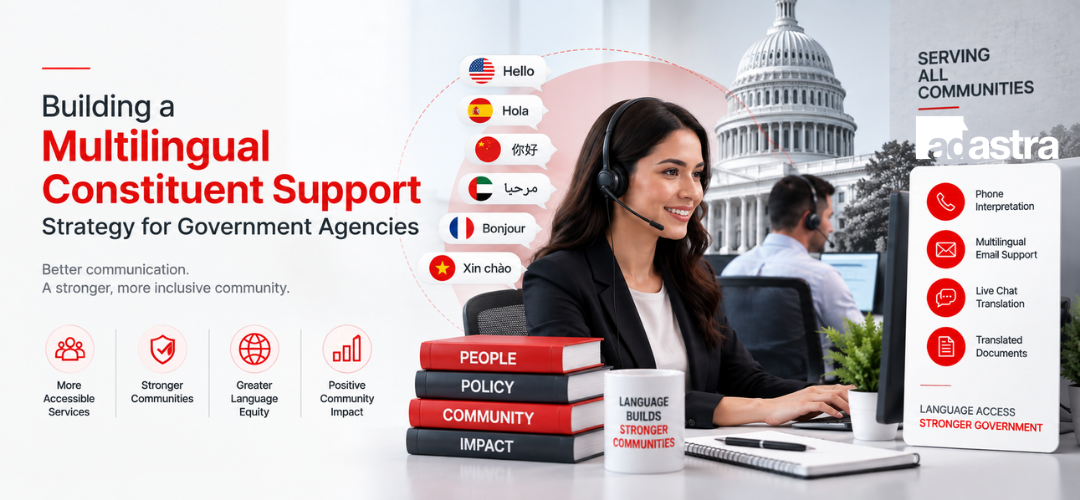
Most government agencies approach language access the same way: reactively. A constituent calls who does not speak English. The agent scrambles for a solution. The call takes three times longer than it should, ends without full resolution, and the same situation repeats tomorrow.
Reactive language access is not a strategy. It is a gap disguised as a process.
The agencies that serve diverse communities effectively have moved past the reactive model. They have built multilingual constituent services into the architecture of how they communicate, across phone, email, chat, and digital channels, so that every interaction works regardless of the language it starts in.
This article is a practical framework for building that kind of program. Not from scratch, but from wherever your agency is today.
Know Your Language Population Before You Build Anything
The most common mistake agencies make when building a multilingual constituent services program is guessing which languages to prioritize.
The right starting point is data. Most agencies already have access to the information they need, they just have not applied it to language planning.
According to 2024 Census Bureau data, 25.8% of Massachusetts households speak a language other than English at home. That figure varies significantly by county, city, and even zip code. An agency serving a largely urban population may find that five languages cover 90% of its LEP constituent interactions. A rural agency in a different state may have a completely different distribution.
Start with three data sources:
Census ACS data for your service area tells you which languages are most spoken and the approximate LEP population for each. The Census Bureau's American Community Survey provides this at the county level and often at the census tract level, giving you enough granularity to make defensible prioritization decisions.
Your own service records are often more accurate than census data for your specific program. Call logs, interpreter request records, translated document request data, and complaint records all tell you which languages your constituents are actually using when they contact your agency. If your call center already tracks interpreter requests by language, that data is invaluable.
Community organization input fills gaps that data sources miss. Immigrant services organizations, refugee resettlement agencies, and community health workers have direct knowledge of which populations in your area are most in need of government services and least likely to self-advocate when language access fails.
Once you have this picture, prioritize ruthlessly. Build first for the languages that represent the most volume and the highest-stakes interactions. Expand from there.
Channel by Channel: What Multilingual Support Actually Looks Like
Language access in a modern government agency does not happen through a single channel. Constituents reach out by phone, email, chat, and online self-service portals. Each channel has its own solution, and a complete multilingual communication strategy covers all of them.
Phone
The phone channel is where most language access programs start and where the volume is usually highest. Over-the-phone interpretation (OPI) is the backbone of phone-based multilingual support, connecting agents with professional interpreters in under 30 seconds across hundreds of languages without scheduling, staffing, or logistics overhead.
For agencies that have not yet established a structured OPI contract, this is the first thing to put in place. It covers the full language range immediately and operates on a per-minute billing model that scales with actual usage.
For a deeper look at how phone-based language access works operationally, our guide on government call centers and language access covers the infrastructure decisions, efficiency gains, and common implementation pitfalls in detail.
Email and Written Correspondence
Written constituent communications present a different challenge. A constituent who emails in Spanish needs a response in Spanish, not an English response with a note that says "translation available upon request."
Most agencies lack the internal capacity to draft original responses in multiple languages. The practical solution is a library of pre-approved response templates in the languages most commonly used by your constituent population. A constituent submitting a benefits inquiry in Vietnamese receives a response built from an approved Vietnamese template, customized with the relevant case details.
Templates need to be developed by qualified translators who understand both the language and the program terminology, not auto-translated and reviewed by a bilingual staff member who may not have formal translation training. An inaccurate template gets used hundreds of times before anyone catches the error.
For correspondence that falls outside template coverage, complex case communications, legal notices, hearing decisions, professional document translation is required. These are vital documents, and they carry the same accuracy requirement as any other official communication.
Chat and Digital Messaging
71.5% of member states now operate at high or very high digital government development levels, and government agencies at every level are expanding their digital service channels. Chat is increasingly where constituents expect to reach agencies outside business hours and for quick, transactional inquiries.
Multilingual chat support operates in two modes. Automated chatbots built on modern language models can communicate in 80 or more languages without separate training for each one, useful for routing inquiries, answering FAQ-level questions, and collecting case information before handing off to a human agent. For complex interactions that require live support, real-time interpretation can be integrated into chat sessions similarly to how OPI works on phone calls.
The limitation of automated multilingual chat is precision. A chatbot can handle "what are your office hours" in Portuguese without difficulty. It should not be handling a constituent's appeal of a benefits denial in any language without human review in the loop. Set clear escalation rules so that complex or sensitive conversations reach a qualified human agent regardless of the language.
Website and Self-Service Digital Content
Digital government development has moved fast, but multilingual digital content has not kept pace in most agencies. The proportion of populations lacking access to digital government services decreased from 45% in 2022 to just 22.4% in 2024, but that improvement is largely in digital availability, not in language accessibility of the content itself.
Most agencies cannot translate their entire website. Nor should they try. The priority is vital content: the pages and documents that a constituent must understand to access services, apply for benefits, meet a legal obligation, or make a consequential decision about their case. Application forms, eligibility information, hearing notices, rights and appeals information, and contact pages meet this standard. News releases about the agency director's schedule do not.
Identify your vital web content using the same framework you applied to document translation. Prioritize it for multilingual versions. Build a content update process so that when the English version of a vital page changes, the translated versions are flagged for review rather than quietly going out of sync.
Training Staff to Use the Systems You Build
Language access infrastructure only works if the people responsible for constituent interactions know how to use it.
This is where many programs underperform. An OPI contract goes live and utilization is low for the first three months because agents are uncertain about how to initiate a three-way interpretation call and feel awkward about the few seconds of silence before the interpreter joins. Email templates are created but agents continue writing English responses because the template library is hard to navigate. The infrastructure exists. The behavior has not changed.
Staff training for multilingual constituent services should cover three things specifically:
How to initiate and manage an OPI call, including what to say when the interpreter joins, how to pace conversation so the interpreter can render each exchange accurately, and how to handle the occasional technical issue without abandoning the interaction.
When to escalate from automated or template-based responses to professional human interpretation or translation, and how to do it quickly enough that the constituent does not experience significant delay.
How to recognize when a constituent may have limited English proficiency and how to respond in a way that opens rather than closes the interaction. An agent who responds to a hesitant caller by speaking more loudly and more slowly in English is not providing language access. An agent who knows to ask "would you prefer to speak with an interpreter?" and then initiates an OPI call is.
Measure What Matters
A multilingual constituent services program that is not measured cannot be improved.
The metrics that matter most are not the ones that are easiest to collect. OPI usage volume is easy to track. What tells you more is first-contact resolution rate by language, whether constituents who interact in languages other than English are having their issues resolved in the first interaction at the same rate as English speakers. If they are not, that gap tells you where the program is breaking down.
Track repeat contact rates by language. Track complaint volume from LEP constituents. Track the languages represented in unresolved cases. These are the indicators that tell you whether your multilingual constituent services program is actually closing the access gap or just creating the appearance of it.
Set a review cycle, quarterly at minimum, where this data is examined and compared to your language population baseline. Programs that review the data regularly identify gaps while they are small. Programs that do not review it discover gaps when a constituent complaint makes the news or a federal audit finds deficiencies.
A Strategy, Not a One-Time Project
Multilingual constituent support is not a problem you solve once. Constituent populations shift. Languages change in frequency. New digital service channels create new language access requirements. Staff turns over.
The agencies that maintain effective multilingual public engagement over time treat it as an ongoing operational function with its own governance, its own metrics, and its own review cycle, the same way they treat any other dimension of service quality.
For agencies navigating the compliance environment around language access obligations while also trying to build practical multilingual infrastructure, the combination of legal clarity and operational strategy is what moves programs forward.
Ad Astra works with government agencies and public sector organizations on the full range of multilingual constituent services, from over-the-phone interpretation and document translation to multilingual call center support and language access program assessment. If your agency is building or expanding its multilingual constituent support capacity, our team can help you assess your current gaps and identify the right approach for your population and your channels.