
How Supplement Companies Can Expand into Global Markets
Localization
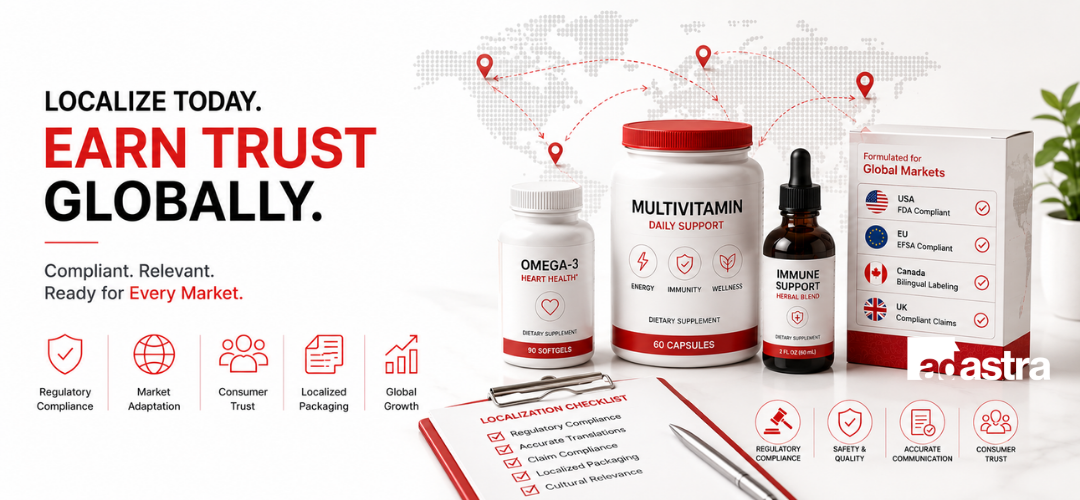
The global dietary supplements market was worth more than $209 billion in 2025 and is projected to more than double to over $430 billion by 2033. Asia Pacific is growing at 8.4% annually. Latin America is accelerating. European consumers are spending more on preventive health than ever before.
For supplement manufacturers and nutraceutical brands, the growth opportunity abroad is impossible to ignore.
But here is the problem. Most brands that attempt international expansion treat it as a logistics challenge. They sort out shipping, find a distributor, and then do the bare minimum to localize their product. That usually means running the label copy through a translation tool, changing the currency on the website, and calling it done.
Then they wonder why the product doesn't move.
International expansion in the supplement industry does not fail because of inferior products. It fails because brands underestimate how differently their product needs to communicate in each new market. Regulatory bodies reject non-compliant labels. Consumers don't trust unfamiliar claims. Packaging that performs well in the US falls flat in Germany or Japan.
Supplement localization is the bridge between a product that sells in your home market and a product that earns trust and meets compliance requirements in a new one. This article covers what that actually looks like in practice.
Why Supplement Brands Struggle When Entering New Markets
Supplement brands often discover the hard way that what works in one country rarely transfers directly to another.
A protein powder sold in North America might feature bold claims about muscle recovery and peak performance. That exact language could be prohibited in the EU, where health claims on food supplements must be pre-approved by the European Food Safety Authority (EFSA) before they can appear anywhere on the label or in advertising.
A herbal supplement popular with US consumers for its "immune support" positioning might contain an ingredient that is considered a novel food in the UK post-Brexit, requiring separate authorization before it can be sold at all.
In Canada, Health Canada mandates that all food labeling appear in both English and French. A brand that ships to Canada with English-only packaging is not just missing an opportunity. It is non-compliant.
These are not edge cases. They are the standard operating conditions of international supplement expansion, and they catch brands off guard every time.
The mistake brands make is thinking that once the product formulation is solid, the rest is just paperwork. In reality, the product is only the starting point. How it is described, labeled, sold, and positioned needs to be rebuilt from the ground up for each new market.
Translation Is Not Localization
This distinction matters more in the supplement industry than in almost any other.
Translation converts words from one language to another. A translator takes your existing product description and renders it in Spanish, French, or Mandarin. The words change. Everything else stays the same.
Localization takes a different approach entirely. It asks whether the existing content, the claims, the tone, the ingredient names, the visual design, and the cultural references, actually works for the new audience in the way it was intended. Often, the answer is no. And changing just the words while leaving everything else intact is one of the fastest ways to damage a brand's credibility in a new market.
Consider a supplement marketed in the US with the phrase "clinically proven to boost energy." In the EU, that claim cannot appear on the label unless it has been reviewed and approved by EFSA under Regulation (EC) No 1924/2006. Translating that claim into German or Italian does not make it compliant. It just makes the non-compliant claim available in another language.
Or consider a brand that sells a stress-relief supplement with messaging built around Western concepts of individual productivity and performance. In a market like Japan, where concepts of wellbeing are often more community-oriented and where understatement is valued over bold claims, that same messaging can feel jarring or untrustworthy.
Multilingual supplements require far more than translated text. They require content that has been rebuilt for the market it is entering.
The Real Localization Challenges Supplement Brands Face
Packaging and Labeling
Packaging is where localization requirements hit hardest and where the cost of getting it wrong is most visible.
Every market has its own mandatory labeling requirements. In the EU, under Regulation (EU) No 1169/2011, supplement labels must include the product name, a complete ingredient list, the recommended daily dose, a warning not to exceed that dose, a statement that supplements are not a substitute for a varied diet, and storage instructions. All of this must appear in the official language of the country where the product is being sold. Selling in France, Germany, and Spain means three separate label versions.
Canada requires bilingual labeling, with all mandatory information appearing in both English and French. Health Canada also introduced new Supplemented Foods Regulations that include specific cautionary labeling requirements for products containing certain added ingredients like caffeine or vitamins above a certain threshold. Any brand expanding into Canada needs to account for these requirements at the packaging design stage, not after the first shipment has already been printed.
Beyond the regulatory requirements, there is the practical reality of physical space. Different languages take up different amounts of space on a label. German and French tend to run longer than English. Mandarin can be significantly more compact. A label that works as a design in English may become completely unreadable or legally non-compliant when you add a French translation in the same space. Packaging localization needs to be a design conversation, not just a content one.
Ingredient Names and Dosage Units
Ingredients have different names, different accepted forms, and different regulatory statuses in different markets.
Ashwagandha, widely used in US and UK supplements under that name, is also known as Withania somnifera in scientific literature and may need to be referenced differently on labels in markets where the botanical name is required. Certain forms of magnesium accepted freely in the US may face restrictions in some EU member states. An ingredient classified as a supplement in the US might be classified as a drug in another country, which changes the entire regulatory pathway.
Dosage units create their own challenges. Milligrams, micrograms, international units, and percentage of daily reference values all need to be presented correctly for each market, using the reference values that apply in that region rather than those of the originating country.
These are not details that a translation tool can handle. They require people with regulatory knowledge who understand how ingredient classifications and measurement standards work in each target market.
Regulatory Compliance and Health Claims
This is where supplement localization goes well beyond language and into genuine legal territory.
In the EU, all nutrition and health claims on supplement labels and advertising must comply with Regulation (EC) No 1924/2006. Only claims that have been assessed and authorized by EFSA can be used. That means a claim like "supports bone health" can only appear on a label if it is listed in the EU's approved health claims register and used under the conditions set out for that specific claim.
In the EU, health claims must be EU Register-approved under Regulation EC No. 1924/2006, and terms like "clinically proven" and "natural" must match approved scientific data and be non-misleading. Despite EU-wide harmonization efforts, Germany, France, Italy, and Spain apply additional country-level requirements, especially around botanicals, maximum and minimum dosages, and dosage form warnings.
In Canada, Natural Health Products (NHPs) require pre-market authorization from Health Canada. The brand must submit evidence of the product's safety and efficacy before it can be sold. That is a fundamentally different regulatory model than the US, where most supplements reach market without pre-approval.
In Japan, the FOSHU system (Food for Specified Health Uses) governs which health claims are permitted on functional foods and supplements, and earning that designation requires its own approval process.
The point is this: what your product claims to do, and how it is allowed to say it, is entirely market-dependent. A product localization strategy that doesn't start with a regulatory review in each target market is not a strategy. It's a risk.
Marketing Claims and Product Descriptions
Even where claims are technically permitted, the language used to make them needs to be rethought for each market.
US supplement marketing tends to be direct and assertive. Terms like "maximum strength," "advanced formula," and "scientifically formulated" are familiar to American consumers and are generally well received. That same directness can read as aggressive or unsubstantiated to consumers in markets where understatement is more culturally trusted.
Product descriptions on e-commerce listings and websites face a double challenge. They need to be written in a way that resonates with local consumers, and they need to be optimized for local search behavior. The search terms a German consumer uses to look for a joint health supplement will differ from those used in Brazil or South Korea, even when the underlying intent is the same.
Effective supplement translation at the product description level means understanding not just what the product does, but what local consumers prioritize, what language they use when they talk about their health goals, and what level of technical detail they expect to see.
Cultural Adaptation
Culture shapes how consumers make decisions about health, and it shapes what they trust.
In many Asian markets, traditional medicine frameworks influence how people think about supplementation. A product positioned purely through a Western clinical lens may not resonate with consumers who are more familiar with herbal and botanical frameworks. A brand entering Japan or South Korea needs to understand those frameworks well enough to position its products within a context that makes sense to local buyers.
Color plays a role too. Packaging colors carry different associations in different cultures. Green signals health and nature in most Western markets. In parts of East Asia, the associations can be quite different. This is the kind of detail that sits entirely outside the scope of translation but directly affects whether a product feels trustworthy on a shelf.
Trust signals also vary significantly. Certifications that carry weight in the US, such as NSF International, USP, or Informed Sport, may be completely unfamiliar to consumers in other markets. Meanwhile, local quality marks or partnerships with regional health bodies can carry far more credibility than any US-based certification.
For global supplement brands, cultural adaptation is not a soft concern. It is a commercial one.
Building Trust with International Consumers
Trust is not transferable across borders. A brand that has spent years building consumer confidence in one country starts from near zero in a new market.
The supplement industry is particularly sensitive here. Consumers are ingesting these products. They want to know the company behind them is credible, that the formulation is safe, and that the claims are real. In a new market where consumers have no prior relationship with the brand, everything they see on the label, the website, and the product description becomes the entire basis for that trust decision.
A few things consistently undermine trust in international supplement markets:
-
Labels that appear to have been machine-translated, with slightly awkward phrasing or grammatical inconsistencies
-
Health claims that don't match the approved claims for that market, which create regulatory red flags and consumer skepticism
-
Customer service and product information available only in the brand's home language
-
Website content that hasn't been adapted, so prices are in US dollars, contact forms reference US business hours, and the cultural framing of the content feels foreign
Each of these signals to the consumer that the brand has not invested seriously in their market. And in the supplement industry, where trust is the primary purchase driver, that perception is genuinely damaging.
Product localization done well has the opposite effect. When a German consumer reads supplement packaging that accurately reflects the terminology they are familiar with, references the daily reference values used in the EU, displays compliant health claims, and presents the brand in a tone that feels native rather than translated, it builds the impression that this is a brand that understands them. That impression translates directly into first purchases and repeat customers.
Preparing for Scalable Global Growth
The brands that expand internationally most successfully treat localization as a strategic function, not a one-time project.
That means building a localization process that can scale as the brand enters new markets, rather than starting from scratch in each one. It means creating a translation memory so that approved terminology, ingredient names, and compliant claim language are consistent across all markets and can be updated efficiently when regulations change. It means having the infrastructure to update labels and digital content quickly when regulators release new requirements, which they do regularly.
A few practical steps for supplement brands preparing to expand:
Start with a regulatory landscape review. Before any localization work begins, understand the regulatory environment in each target market. Know which of your ingredients are approved, which claims are permitted, and what the labeling requirements are. This determines what content you are actually allowed to communicate, and that drives everything else.
Build a market-specific content framework. Do not simply adapt your home market content. Build a framework that identifies what health concerns, wellness priorities, and purchase motivations are most relevant to consumers in each target market. Use this to shape how the product is positioned and described.
Work with specialists who understand both language and regulation. A general translator can convert your label into French. A specialist in supplement translation can convert your label into compliant French that reflects the terminology familiar to French consumers, uses the correct daily reference values, presents only permitted claims, and meets the specific formatting requirements for the French market.
Treat digital content as part of the localization scope. Packaging compliance gets most of the attention, but your website product pages, e-commerce listings, and marketing content all carry the same risks and opportunities. Localized digital content also significantly improves search visibility in each market, since local consumers search in their own language using their own terminology.
Plan for ongoing updates. Regulatory requirements change. Ingredient classifications are reviewed. Health claim approvals are revised. A localization strategy needs to include a process for monitoring these changes in each target market and updating content accordingly. Brands that treat localization as a one-time task find themselves out of compliance faster than they expect.
Turning Localization Into a Competitive Advantage
The supplement industry's global growth opportunity is real, but it is not equally accessible to every brand. The brands that win internationally are the ones that understand that success in a new market is built on compliance, clarity, and consumer trust, and that all three require genuine localization investment.
Getting the translation right is the baseline. Building content that resonates culturally, meets each market's regulatory requirements, and positions the brand credibly with local consumers is the actual work.
For supplement manufacturers and nutraceutical brands ready to move beyond their home market, the path forward starts with a localization partner who understands the industry. Ad Astra works with health and wellness brands navigating the complexities of international expansion, from regulatory-compliant supplement translation to full packaging localization and multilingual digital content. If your team is preparing to enter new markets, that is a conversation worth having early.