
How Certified Translation Services Reduce Business Risk
Translation
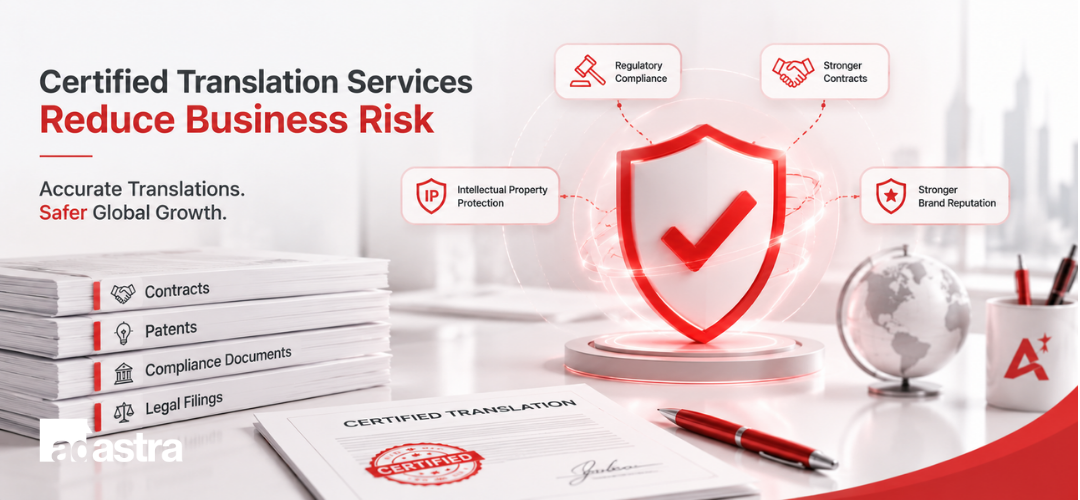
Expanding into new markets creates exciting opportunities, but it also introduces new risks. While most businesses focus on growth, sales, and market entry, one detail is often overlooked: the accuracy of the documents that support those plans.
A contract, patent application, or compliance document that works perfectly in one language can create serious problems if it's translated incorrectly. In international business, language isn't just about communication. It can directly affect compliance, legal protection, and business operations.
While standard translation is sufficient for general marketing copy or internal guides, high-stakes documentation demands a more rigorous standard. Investing in certified translation services helps businesses avoid costly mistakes before they happen.
What Makes a Translation "Certified"?
Before looking at the risk factors, it is important to clarify what a certified translation actually entails.
Many people assume a certified translation is simply a better translation. It isn't. It is a translation accompanied by a formal, signed Certificate of Accuracy (issued by a professional translator or translation agency). This document attests that the translation is a complete, true, and legally defensible representation of the original text.
Important Distinction: In many jurisdictions (such as the United States), a notary public does not certify the accuracy of the translation. A notary only verifies and witnesses the identity of the person signing the Certificate of Accuracy. True legal defensibility relies on the credentials and documented quality control of the translation partner.
4 Critical Business Risks Mitigated by Certified Translation
Treating translation as a simple administrative task rather than a compliance protocol exposes your organization to severe vulnerabilities. Working with a professional, certified provider directly mitigates four primary business risks.
1. Regulatory Rejection and Launch Delays
When submitting documents to foreign governments, court systems, or regulatory bodies (such as the European Medicines Agency or financial authorities), certified translations are almost always a strict prerequisite.
-
The Risk: Submitting uncertified or poorly translated documents can lead to immediate rejection by local authorities.
-
The Cost: A rejected patent filing, delayed product certification, or stalled visa application can push back your market entry by months, costing millions in lost opportunity and redundant administrative fees.
2. Contractual Ambiguity and Litigation
Legal terminology is highly system-dependent. A legal concept in a common-law system (like the US or UK) may not have a direct equivalent in a civil-law system (like France or Germany). Literal, word-for-word translation in these scenarios is incredibly dangerous.
[Original English Contract] ---> (Literal/Uncertified Translation) ---> [Altered Legal Meaning] ---> Contract Dispute
|
[Original English Contract] ---> (Certified Translation Workflow) ---> [Identical Legal Intent] ---> Risk Mitigated
-
The Risk: An uncertified translator may use a generic target-language word that subtly alters the meaning of a liability clause, intellectual property boundary, or payment term.
-
The Cost: If a dispute arises, an ambiguous translation can render a contract unenforceable in a foreign court, exposing your business to severe financial liabilities and costly international litigation.
3. Intellectual Property (IP) Vulnerability
Securing patents and trademarks internationally requires absolute precision. Patent offices require highly technical descriptions of inventions, processes, and chemical compositions.
-
The Risk: Even a minor linguistic error in a patent translation can narrow the scope of your legal protection or invalidate the patent application entirely.
-
The Cost: Competitors can exploit these gaps to duplicate your technology legally in that jurisdiction, destroying your competitive advantage and devaluing your R&D investment.
4. Severe Reputational Damage
Your brand's reputation is built on trust, safety, and professionalism. When corporate policies, terms of service, or critical safety manuals contain translation errors, your credibility suffers.
-
The Risk: Poorly translated compliance materials or user safety guides can result in operational accidents, product misuse, or compliance failures.
-
The Cost: Beyond immediate regulatory fines, public relations crises and the loss of consumer trust in a new market can be nearly impossible—and incredibly expensive—to rebuild.
The Certified Translation Workflow: Built-In Risk Control
Certified document translation reduces risk because it relies on a highly structured, auditable quality assurance framework rather than a single bilingual individual.
1. Subject-Matter Expert Assignment: Step 1.
Every certified translation begins with assigning the document to someone who understands both the language and the subject matter. A legal contract, for example, should be translated by a linguist with legal expertise, while medical records require someone familiar with healthcare terminology.
2. Rigorous Dual-Review (TEP): Step 2.
Professional translation providers don't rely on one person's work alone. After the initial translation, another qualified linguist carefully reviews every sentence to make sure nothing has been misunderstood or omitted.
3. Terminology and Glossary Alignment: Step 3.
The translation is cross-referenced with your company’s approved, country-specific legal and technical glossaries to ensure absolute consistency across all corporate assets.
4. Certification and Delivery: Step 4.
A signed, dated Certificate of Accuracy is issued on the provider's official letterhead, establishing a legal paper trail and ensuring the document is ready for official submissions worldwide.
Safeguard Your Global Growth
Translation is not the place to cut corners. While raw machine translation or unvetted bilingual staff may seem cost-effective initially, the downstream risks of a single linguistic error can be devastating to your bottom line, legal standing, and global reputation.
Businesses spend years building their reputation, protecting their intellectual property, and earning the trust of customers and regulators. A single translation mistake shouldn't put those efforts at risk.
Certified translation services provide an extra layer of confidence when accuracy matters most. Whether you're entering a new market, submitting regulatory documents, or signing international contracts, investing in the right translation partner helps protect your business long after the translation is complete.