
How Continuous Localization Helps Global Businesses Launch Faster
Localization
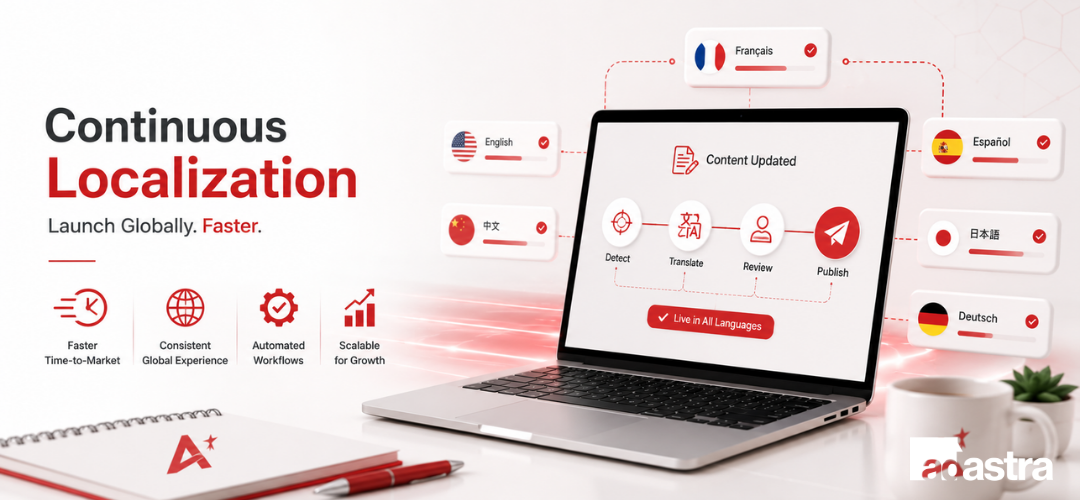
To win in the global market, speed is everything. Yet, many expanding businesses find themselves trapped in a frustrating paradox: their product and marketing teams move at lightning speed, but their international launches drag on for weeks—or even months.
The culprit? A legacy, linear localization workflow.
Historically, translation was treated as a final, isolated gatekeeper. A product, campaign, or resource was fully finalized in English, packaged into spreadsheets, and sent off to a translation agency. This created a massive bottleneck. If your engineering team is deploying code daily, or your content team is pushing updates weekly, this "batch-and-wait" approach breaks down entirely.
Modern global scale requires a modern framework: Continuous Localization. By embedding translation directly into your existing content and development lifecycles, continuous localization allows you to launch simultaneously across multiple markets without missing a beat.
The Bottleneck: Traditional vs. Continuous Workflows
To understand why global campaigns stall, it helps to look at the structural differences between traditional, agile, and continuous localization models.
|
Feature |
Traditional (Waterfall) |
Agile Localization |
Continuous Localization |
|
Execution |
Starts only after the source content/code is 100% complete. |
Done in staggered sprints alongside development. |
Real-time, automated, and "always-on". |
|
Handoff Process |
Manual file exports (CSV, JSON, XLSX) via email or portals. |
Periodic manual or semi-automated file transfers. |
Direct API integrations with CMS or code repositories. |
|
Delivery Model |
Batch-based. One slow language holds up the entire release. |
Sprint-based. Delivered at the end of a developmental cycle. |
Incremental. Translations flow back automatically as they are finished. |
|
Release Cadence |
Months or quarters. |
Weeks (aligned to sprints). |
Daily or real-time. |
The Continuous Localization Process: How It Works
Continuous localization aligns your translation pipeline with continuous integration and continuous delivery (CI/CD) practices. The goal is to make localization completely invisible to your content creators and developers so they can focus entirely on their primary roles.
1. Direct System Integration: Step 1: Set up the pipe.
Your content repositories (like GitHub, GitLab, or enterprise CMS platforms) are connected directly to a cloud-based Translation Management System (TMS) via native connectors or APIs.
2. Automated Content Detection: Step 2: Instant triggers.
As soon as a developer commits a new text string or a marketer updates a blog post, the TMS automatically detects, extracts, and packages the updated text. No manual file exporting required.
3. Parallel Translation & Review: Step 3: Work in lockstep.
Linguists or machine engines are immediately notified of the new micro-segments of content. Translation and human QA occur in real-time, matching the style and context of existing brand libraries.
4. Automated Synchronization: Step 4: Push back to live.
Once approved, the completed translations are automatically pushed back into your system. The updated multilingual content goes live instantly without halting deployment cycles.
Key Benefits of Continuous Localization for Global Scale
Adopting an "always-on" approach to translation offers significant strategic advantages beyond simply speeding up translation turnarounds.
1. Drastically Faster Time-to-Market
In international expansion, being first to market is a major competitive advantage. Continuous localization eliminates the "translation lag"—the weeks of waiting for localized versions to catch up to the master launch. New features, marketing campaigns, and resources can launch globally on day one.
2. Elimination of Administrative Overhead
Traditional localization requires extensive project management: chasing files, sending emails, keeping track of version histories, and manually copying translations back into your systems. Automation removes these tedious, error-prone tasks. Your teams can focus on strategic growth while the software handles the pipeline.
3. Consistent Global Brand Experience
When updates are handled in tiny, continuous increments rather than massive, stressful batches, it is much easier to maintain stylistic consistency. Translation memories, terminological glossaries, and automated QA parameters are applied instantly to every new string of text, ensuring your brand speaks with one cohesive voice across all markets.
4. Scalable Resource Management
Instead of overloading internal reviewers and external translation partners with sudden, massive dumps of content right before a product launch, continuous localization distributes the workload evenly. Small, bite-sized tasks are easier to process, leading to higher translation accuracy and less cognitive fatigue for linguists.
The Developer Impact: Under a continuous localization model, developers never have to worry about translation file structures or freeze their release dates. They write code, use descriptive string keys, push their changes, and the localization engine handles the rest in the background.
Moving to a continuous framework transitions translation from a disruptive blocker into a silent, seamless utility. It is the key to unlocking true global agility, ensuring that your international customers receive the exact same high-quality, up-to-date experience as your domestic ones.