
Loneliness Is Not a Feeling. It Is a Design Choice.
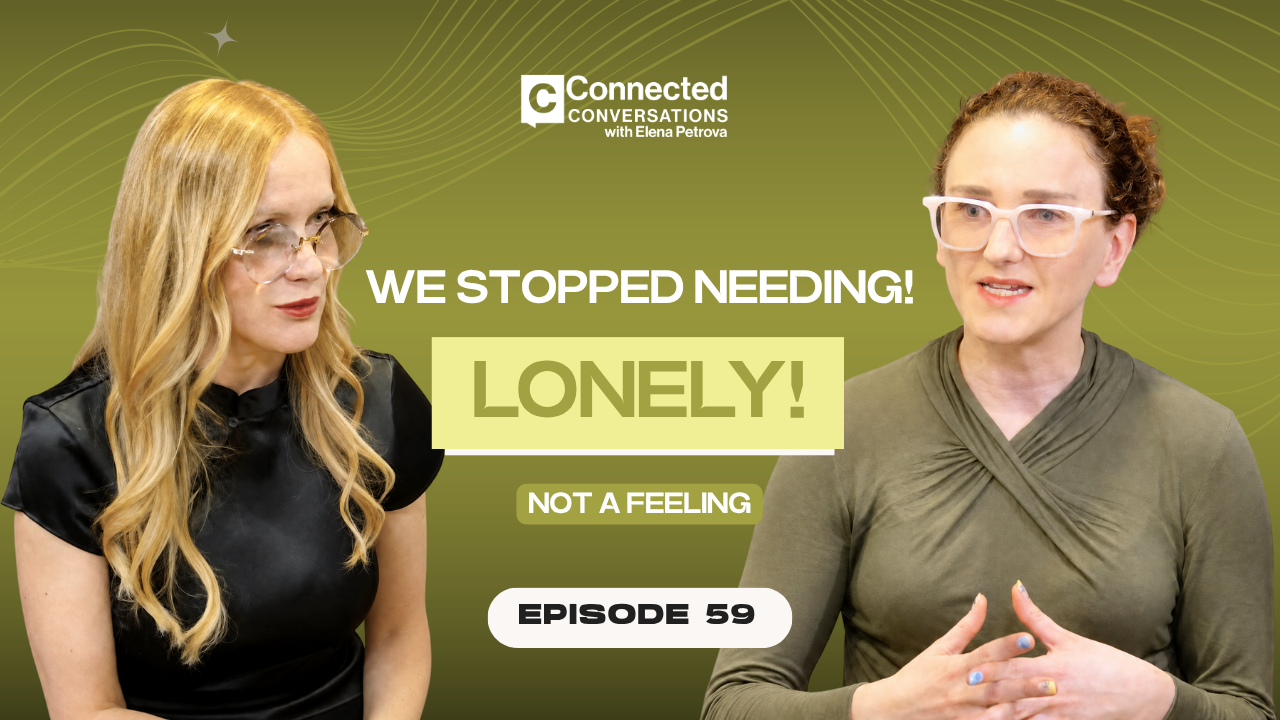
Camilla Halford argues that isolation was built into the way we live, in our housing, our payment systems, and the shape of our working week. In this episode of Connected Conversations, she tells Elena Petrova what it would take to build our way back out.
The village we did not notice losing
Camilla Halford used to produce theater. A random group of people would come together, lighting directors, choreographers, actors, all interdependent, all pushing toward one show date. Then she would go home to a good family life and feel something missing.
It took her a long time to name it. The nuclear family, she realized, works when it is embedded in community, when there is an extended family or a neighborhood or a congregation around it. Modern life quietly removed that scaffolding. The village eroded, and almost nobody noticed while it was happening.
Community is not being nice. It is needing each other.
The image Camilla uses to explain this is a tea station in a nice office. Individually packaged milk. Individual stirrers. Everything clean, nothing to argue about. Coming from the arts and charity sector, where budgets were thin and someone always had to ask whose turn it was to buy the milk, she initially found it wonderful.
Then she realized what had gone missing along with the argument. Drawing on the book Sacred Economics by Charles Eisenstein, she puts it this way: community is not created by being nice to each other. It comes from interdependence, from needing your neighbors. And we stopped needing them. The shops stay open late. We hire the childcare and the gardening that community used to provide for free. Every house has its own lawnmower. We bought our way out of needing anyone, and the bond went out with the inconvenience.
She is also clear that the cost of this has not fallen evenly. When the village disappeared, the invisible labor that held it together did not. It largely fell to women, uncounted, on top of paid work.
The five-day week was never about your happiness
The sharpest structural example is the one most of us live inside without ever questioning. Camilla traces the working week from agrarian life, where the weather set the pace, through the factories of the industrial revolution, where a seven-day week was normal. The church pushed back for one day. Then people worked six, disliked it, and rioted. Five days was where the rioting stopped.
That is the whole origin. As she puts it, the five-day working week is not built around human happiness. It is built around the point at which people stop complaining. And it was calibrated for a household with someone at home full time, which the economics no longer support. Two earners, forty hours each, and the spare time that community requires simply is not there.
Her conclusion is not that everyone should work less, which she acknowledges is a luxury most people do not have. It is that if we are going to work this way, we have to deliberately design connection back in, because it will not happen on its own.
The question to ask any system
Underneath all of this sits Camilla's test, and it is the most portable thing in the episode. For any system you live inside, ask whether it is built to serve people or to serve power. Ask what it is optimizing for.
She applies the same lens to data, which is where her company Artega comes in. Her argument is not that privacy matters because you have something to hide. It is that data outlives the moment it was collected in, and the intentions of whoever holds it next are not knowable. What counts as acceptable shifts with the morals and politics of the day, and information given freely under one set of conditions can be used under another. Her Artega work is an attempt to build payments that prove a transaction happened without handing over a profile, with the technical jargon stripped out.
Historical note: in the episode, Camilla references the Netherlands' population registration system and its role in the high death toll among Dutch Jews during the Holocaust, the highest proportion in Western Europe. Historians treat registration as one of several significant factors, alongside the nature of the occupation administration and other country-specific conditions. Further reading: the Anne Frank House and the United States Holocaust Memorial Museum.
Where a leader actually starts
Asked where you would begin building community on a street in Denver, Camilla answers in two words. Have a party.
She means it literally, and she has the receipts. When she moved into her home, she put a flyer through every letterbox: we are having a party, and here is a QR code for a WhatsApp group. Ten years on, that group is thriving. Neighbors organize spontaneous afternoons. They campaigned together for a local grant to improve a nearby alleyway. None of it would have happened without the first drink together.
Her favorite proof is smaller. Locked out one day, dressed head to toe in purple and smelling of cat litter, she knocked on a neighbor's door and was handed a bank card so she could get across town for a spare key. Who hands a near-stranger their bank card? Someone who came to the party.
For workplaces, she offers two structures worth stealing. The first is a rotating captain social: every year a different person owns organizing the social events, which means the events stop being the same golf outing and start reflecting the whole team. Crucially, it happens during paid work hours, not as three unpaid evening hours at a pub. The second is flexible, front-loaded hours built on trust, so that people with school runs and caring commitments are not quietly excluded from everything that builds belonging.The principle underneath both: do not rely on one kind of gathering. If your only social ritual requires drinking, staying late, or playing golf, you have already decided who belongs.
Make friends with your fear
Elena closes by asking what conversation more people should be having. Camilla's answer is fear. That we should talk about it with the people we love, that it can motivate us but can also stop us from living, and that the goal is not to conquer it. Make friends with your fear.
It is a fitting end to an episode about structures, because it points at the thing no structure fixes on its own. You can redesign a week, a street, or a workplace. You still have to be the person who knocks on the door.
Listen to Episode 59 of Connected Conversations, hosted by Elena Petrova, Founder and CEO of Ad Astra, Inc. and AdAstraConnect.
Connected Conversations is produced by Ad Astra, Inc.
You can watch/listen to this episode here:
🔴 YouTube: https://youtu.be/tftoizHyOjM
🟢 Spotify: https://shorturl.at/92Fox
⚫ Apple Podcast: https://shorturl.at/4Qd1F
🔵 Amazon Music: https://shorturl.at/tykpW