
Slavery in Plain Sight: Evelyn Chumbow on the Hello That Never Came
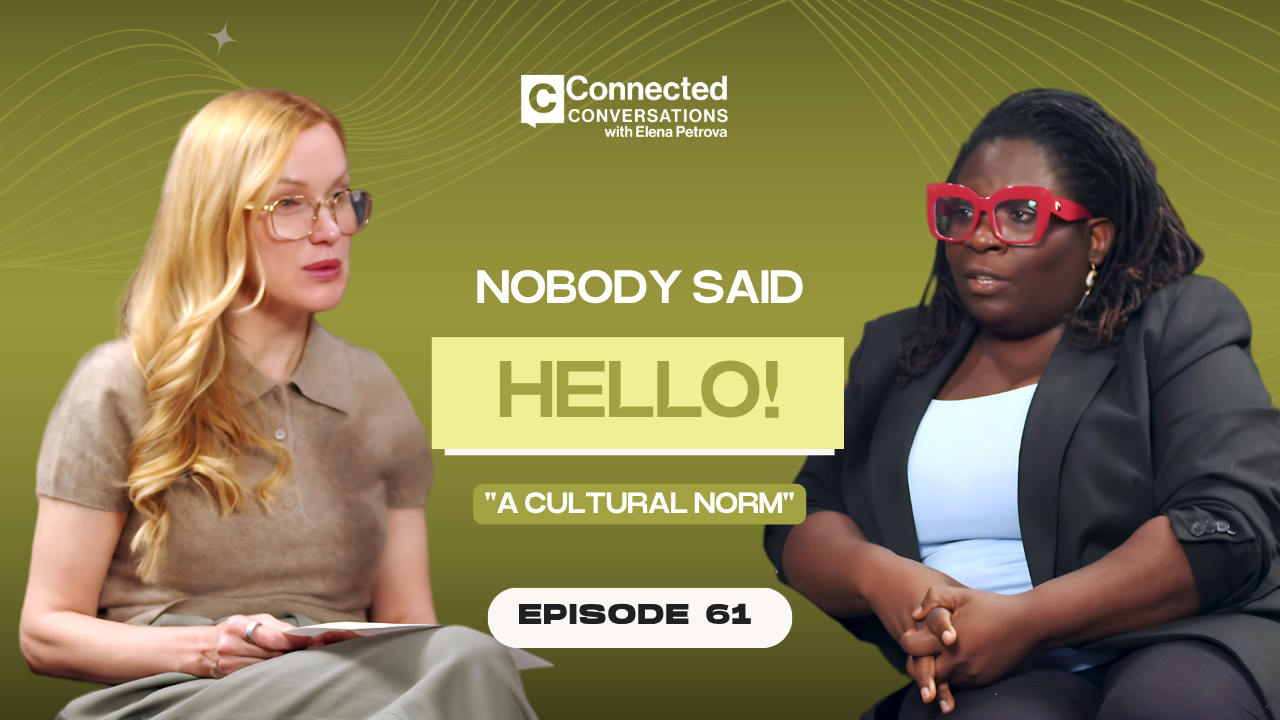
Evelyn Chumbow was nine when she was brought from Cameroon to a home in Silver Spring, Maryland, a few miles from the U.S. Capitol, and forced to work without pay. In this episode of Connected Conversations, she tells Elena Petrova what people saw, what they missed, and what it would have taken to reach her.
Slavery didn't end. It was redesigned.
Most of us file slavery under history. Evelyn hears that every time she speaks. "Slavery in America was abolished in 1865," she says, "but it has been redesigned."
The numbers back her up. An estimated 50 million people were living in modern slavery in 2021, including 28 million in forced labor, according to the International Labour Organization, Walk Free, and the International Organization for Migration. In the United States, Walk Free's Global Slavery Index estimates about 1.1 million people, or 3.3 in every 1,000. Evelyn wants people to understand that much of it is labor trafficking, not the version that usually makes the news.
The promise was school
Growing up in Cameroon, Evelyn's picture of America came from television. She expected an adoptive mother, a classroom, and, as she laughs, a future married to Will Smith. Her family believed she was being sent toward education and opportunity.
Instead, she cooked, cleaned, and cared for two children around the clock. She slept on the floor, went days without enough to eat, and was beaten. By her account, she did not go to school from age nine to seventeen. She also didn't know any of it had a name. "We don't know that we are survivors," she says. It took a lawyer, after she escaped, to tell her plainly that what happened to her was wrong.
Everyone saw her
What stays with you is how many people crossed her path. She walked to the grocery store across the street for milk and sometimes slipped cookies under her clothes because she was hungry. She walked a little boy to the school bus every morning and envied the kids climbing on. She babysat neighbors' children. Visitors asked why she wasn't in school and accepted the answer that she was just short.
Elena asks the obvious question. People saw you? "So many people saw me," Evelyn says. Nobody said anything.
Culture as a cover story
One moment captures the whole problem. Evelyn burned food while cooking alone, and firefighters arrived to find a young girl with a baby wrapped on her back. The firefighter told her to be careful and left. In his mind, she believes, it was a cultural norm. He didn't see the bruivses, the hunger, or the silence.
Today Evelyn trains law enforcement, firefighters, and medical staff. Her message is simple: observe before you assume. Culture can explain a lot, but it should never be the reason a question goes unasked.
The same thing happened in an emergency room, where staff treated her injuries while her trafficker stood beside her and did all the talking. For hospital leaders, her advice is practical. Train everyone, not just clinicians: nurses, doctors, security guards, and staff who are themselves from other countries and may share a patient's background. Keep training, because it's never too late. And get that training from organizations with survivors on their staff or boards, because firsthand experience teaches what a checklist can't.
Trust before translation
Language runs through Evelyn's story. She grew up speaking French, lost it when she moved to an English-speaking region of Cameroon, and never learned her family's dialect. Years later, she spent seven hours interpreting in Pidgin English for a fellow Cameroonian survivor at an immigration appointment.
But first, she made sure the woman felt safe with her. "Just because you're from my community and you speak my language," she says, "doesn't mean I'm going to trust you to translate for me." Evelyn was trafficked by someone from her own community. For anyone who works with vulnerable people, the lesson is clear: a shared language is a starting point. Trust and safety have to come first.
The story without the person
Evelyn is direct about what happens after survivors find their voice. Conferences pay celebrities and moderators, then ask survivors to share their deepest trauma for nothing. Many use their own vacation days to attend. Once, after speaking at a White House event, she had no money to get home. Another survivor gave her ten dollars.
When Elena asks what she wishes people would ask her, she pauses. "How are you really doing?" Not the story. The person.
Freedom means economic power
That's why Evelyn built the Harriet Tubman Fellowship with the Human Trafficking Legal Center. In her description, it gives labor trafficking survivors $10,000 toward the education of their choice and a $500 monthly stipend, no strings attached. More than 80 survivors applied for seven spots in the first class. One fellow used the stipend to buy a car. "That's freedom," Evelyn says. "True freedom means economic empowerment."
She adds a caution for employers. Being a survivor is not a skill set. Hire survivors for their skills, and invest in them so they can build more.
A hello that could save a life
So what should the rest of us do? Evelyn doesn't want people hunting for trouble. She wants them paying attention. Be friendly. Say hello. Give someone a reason to trust you. "If someone was my friend in that neighborhood," she says, "I probably would have talked." Then, if something is wrong, call the National Human Trafficking Hotline or reach out to an organization that can help.
Elena closes on the idea behind the show: we have never been more connected, and we may be living through the loneliest time in human connection. Evelyn's story shows the cost of that gap. It also shows how small the first step can be.
If you or someone you know may be experiencing trafficking, call the National Human Trafficking Hotline at 1-888-373-7888 or text 233733.
Listen to Episode 61 of Connected Conversations, hosted by Elena Petrova, Founder and CEO of Ad Astra, Inc. and AdAstraConnect.
Connected Conversations is produced by Ad Astra, Inc.
Sources:
-
International Labour Organization, Walk Free, and IOM, Global Estimates of Modern Slavery (2022): https://www.ilo.org/resource/news/50-million-people-worldwide-modern-slavery-0
-
Walk Free, Global Slavery Index 2023, United States: https://walkfree.org/global-slavery-index/country-studies/united-states/
-
Human Trafficking Legal Center, Harriet Tubman Fellowship: https://htlegalcenter.org/our-work/harriet-tubman-fellowship/
-
National Human Trafficking Hotline (operated by Polaris): https://humantraffickinghotline.org
You can watch/listen to this episode here:
🔴 YouTube: https://youtu.be/5MXbfQfgfto
🟢 Spotify: https://shorturl.at/YuYX7
⚫ Apple Podcast: https://shorturl.at/ASoQT
🔵 Amazon Music: https://shorturl.at/MinwS