
What Anonymity Reveals: Kyle Venn on Belonging, Trust, and Yik Yak's Difficult History
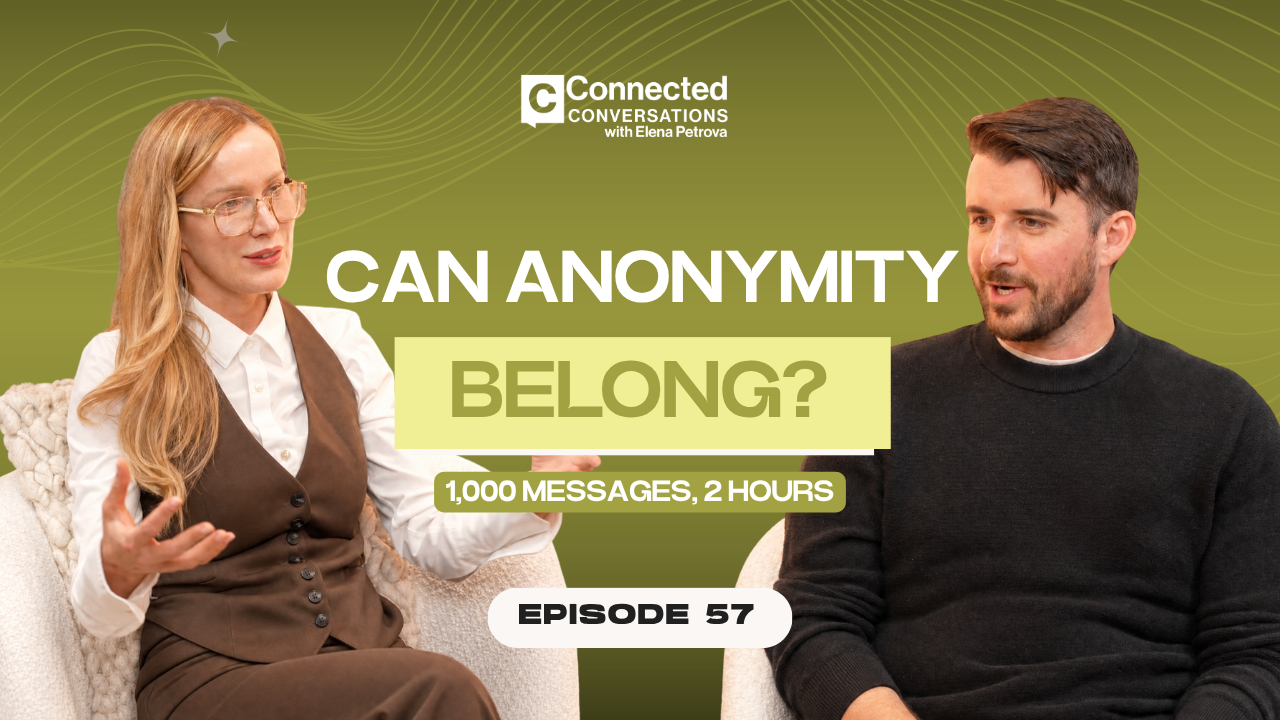
When no one knows your name, do you tell the truth, or show your worst? In this episode of Connected Conversations, Elena Petrova puts that question to Kyle Venn, CEO of Yik Yak, in a conversation that does not look away from the platform's history.
The question under the platform
Yik Yak is one of the cleanest tests of a question this show keeps returning to. Can a digital tool that strips away identity actually build belonging, or does it just remove the brakes and call the result community? Kyle Venn, who took over as CEO about a year ago, spends the hour making his case. Elena spends it pressing on where that case holds and where it strains.
Honest when no one is watching
Kyle's central claim is that anonymity, handled well, brings out a truer version of people. On his own platform, he says, the overwhelming majority of what people post is either building each other up or sharing an honest take they might not attach their name to. He reaches for a comparison most leaders will recognize: the anonymous portion of a 360 review, where people finally say the thing they would not say to your face. Take the name away, his argument goes, and you often get closer to the truth, not further from it.It is a genuinely interesting idea, and it cuts against the instinct many leaders have, which is that anonymity mostly licenses the worst in people. The honest answer, as the conversation makes clear, is that it does both. Which one wins depends almost entirely on what the platform is built to reward.
The history it cannot skip
To his credit, Kyle does not dodge the platform's past. He walks through it plainly. When Yik Yak launched around 2014, it paired anonymity with a five-mile radius and got picked up heavily by high schoolers, and, in his telling, just about everything that could go wrong on an anonymous platform did. Harassment. Bomb threats. Not enough safeguards for what the moment had unleashed. The original company raised a great deal of money, could not solve the problem fast enough, and shut down.What brought it back, he argues, was a structural change. After later relaunches and an acquisition, the platform began requiring a school email to sign on. You are verified as a real student tied to a real institution, and you stay anonymous to everyone else. Kyle calls this verified anonymity, and credits it as the change that let the platform address the toxicity that defined its early reputation. Break the rules and you can be removed for good.Elena does not let the story end on the founder's version. She raises the recent university bans and asks how it felt. Kyle's answer is measured. He thinks some of the reaction is the platform's old reputation following it, argues that taking away a place to talk can create more safety problems than it solves, and accepts that the decision is the university's to make. It is a reasonable answer. It is also, notably, still his answer to give, and the schools have given theirs.
Belonging you do not have to perform
The warmest stretch of the conversation is about a feature built to do the opposite of endless scrolling. Students filled out a questionnaire, part personality test and part the important questions, like whether a hot dog is a sandwich. Over three weeks they were matched: first one to one, then into interest-based group chats, then, if they wanted, romantically.The group chats surprised even Kyle. One group matched on a shared love of baking. Within two hours, he says, they had exchanged a thousand messages. Within the first thirty seconds, they had dropped the anonymity, revealed who they were, and started planning a bake off in real life. That is the version of the technology Kyle wants to build more of: people who might otherwise be lonely finding each other and choosing to show up. Belonging you do not have to perform for.
Attention or belonging
The sharpest exchange is about the line every social product walks. Elena asks what he would remove tomorrow if it would not cost engagement. Kyle's claim is that the question does not apply to his product, because they never add a feature purely to extract time. He is candid that every other platform has felt the pull to do exactly that, adding things engineered to be addictive rather than good for you.Whether Yik Yak lives up to that standard is not something a single conversation can settle. But the distinction he draws is the useful takeaway for anyone building anything people spend time inside. Some tools are designed to hold your attention. Some are designed to help you belong. You can usually feel the difference, and so can the people you are building for.
For the leaders listening
You do not have to reach a verdict on Yik Yak to take something from this one. The reframe worth keeping is that the same design choice can produce honesty or harm, connection or cruelty, and the outcome is not an accident. It is built. When Kyle closes on the conversation he wishes more people were having, he lands on authenticity, on people being their truest selves online and off, and on the psychological safety that lets them. That is a conversation worth having, wherever you lead.
Listen to Episode 57 of Connected Conversations, hosted by Elena Petrova, Founder and CEO of Ad Astra, Inc. and AdAstraConnect.
Connected Conversations is produced by Ad Astra, Inc.
You can watch/listen to this episode here:
🔴 YouTube: https://youtu.be/-HM4uQ2ebq0
🟢 Spotify: https://shorturl.at/tLUol
⚫ Apple Podcast: https://shorturl.at/7gueU
🔵 Amazon Music: https://shorturl.at/9Hzmu