
Best Practices for Multilingual Crisis Hotline and Emergency Response Communications
Interpretation
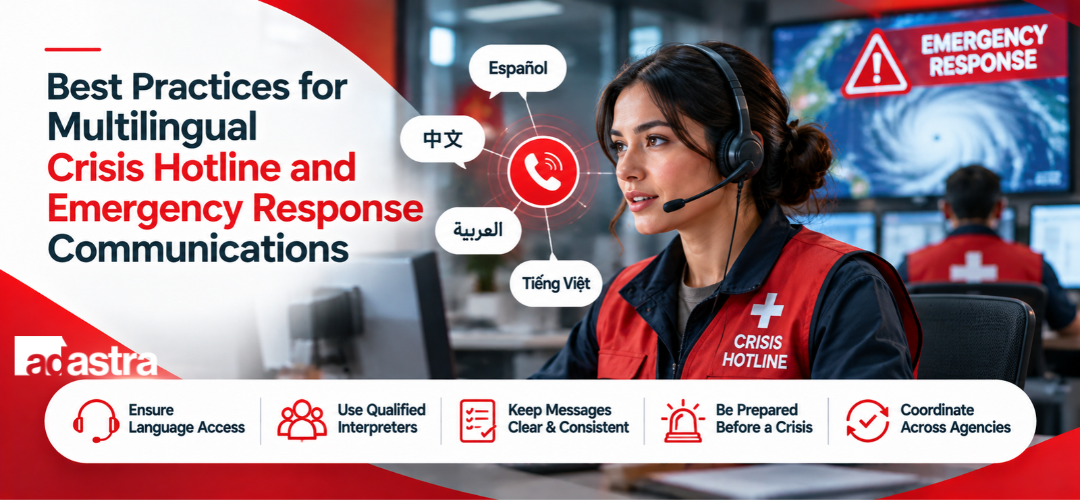
Picture a wildfire evacuation order going out at 11 p.m. The alert is in English and Spanish. In one apartment, a family that speaks Cantonese looks at their phones, can't read the message, and waits for a relative to call and explain. The call comes ten minutes later. In an evacuation, ten minutes is a long time.
This isn't far-fetched. A UCLA study of the 2025 Los Angeles County wildfires estimated that more than 12,000 Asian immigrants and their descendants in the evacuation zones needed language assistance, while the county's alert system supported only English and Spanish.
The same gap shows up on crisis hotlines, in shelters, on emergency information lines, and in recovery paperwork. Multilingual crisis communication is the work of closing it before the next emergency, not during it. This guide covers the practices that matter most, whether you run a hotline, a 911 center, an emergency management office, or a public information team.
Why Crisis Communication Is Different
In everyday service, a confusing message costs time. In a crisis, it can cost safety.
Three things change. Time compresses, because people have minutes instead of days to act. Stress is high, which makes unfamiliar language even harder to process. And there's rarely a second chance to clarify.
The Congressional Research Service notes that people with limited English proficiency may not understand evacuation notices or instructions, which raises the risk of casualties, and may not understand emergency relief providers, which can block access to medical care and shelter. The same report points out that language barriers can undermine trust between survivors and responders. That matters because people act on information they believe.
The practices below are built around those three pressures: speed, clarity, and trust.
1. Plan Before the Crisis by Knowing Your Languages
You can't translate on the fly during a disaster. Start by finding out which languages your community actually speaks.
Useful sources include Census language data, school district home-language surveys, 211 and hotline call logs, interpreter request records, health department data, and community organizations. The groups that work with immigrant and refugee communities often know about populations the numbers miss.
Then sort languages into tiers:
-
Tier 1: your largest language groups. These get fully translated materials and a dedicated option on your hotline.
-
Tier 2: smaller but significant groups. Key messages are pre-translated, and interpreters are available on demand.
-
Tier 3: everyone else. Interpreters are available on demand, and you have simple visual guidance ready.
Review the tiers every year, because communities change.
This planning isn't just good practice. In the US, federal law directs FEMA to work with state and local governments to identify LEP populations and include them in disaster planning, as the same CRS report describes. Agencies at every level benefit from doing the same. Legal duties vary by jurisdiction, so check with counsel on yours.
2. Make Help Reachable in Any Language
For hotlines and emergency lines, crisis hotline interpretation comes down to how fast a caller gets from the first ring to a conversation they can understand.
-
Identify the language quickly. Offer menu options in your top languages, and add a prompt that lets callers say what language they need. Don't make someone navigate an English-only menu to ask for help.
-
Connect an interpreter right away. Use a three-way call and keep the caller on the line. Avoid transfers and "please call back" messages.
-
Train call-takers to work with interpreters. Use short sentences, speak to the caller instead of the interpreter, pause often, and confirm the location and a callback number early.
-
Plan for dropped calls. Record the language in the call record so a callback reaches the caller in the right language.
-
Don't rely on family members, children, or bystanders to interpret. If someone is already on the line, treat it as a stopgap while a professional connects.
The national 988 Lifeline shows how layering works. Its call, chat, and text services are available in English and Spanish, and callers who speak other languages receive interpretation in more than 240 additional languages at no cost. That's dedicated service for the largest language group and on-demand interpreters for everyone else. The same structure works at any scale.
3. Pre-Translate and Pre-Approve Critical Messages
The worst time to write an evacuation notice in six languages is during an evacuation.
Build a library of messages for the emergencies most likely in your area: evacuation, shelter-in-place, boil-water advisory, extreme heat or cold, power outage, road closures, and public health notices. Write each with blanks for time, place, and instructions. Have professional translators produce the translations, and have native speakers from the community test them.
A few writing rules help:
-
Put the action first: "Leave now. Go to the high school on Main Street."
-
Use plain language and short sentences
-
Avoid idioms, jargon, and unexplained acronyms
-
Write place names the way local residents say them
-
Add maps or pictograms where they help
Research on inclusive alerting points to lack of messaging in people's own languages and unclear alert wording as key gaps. Machine translation can speed up drafting, but a human should review every critical message before it goes out. A mistranslated evacuation route is worse than none.
4. Reach People Through Channels and Messengers They Trust
Good disaster communication never depends on a single system, because one alert channel won't reach everyone. The Los Angeles example shows what happens when a single channel supports only a few languages.
Layer your channels:
-
Text and social media in each priority language
-
A website with a clear language selector
-
Multilingual radio, television, and community media
-
Community organizations, faith leaders, schools, and 211
-
Door-to-door outreach in evacuation zones and apartment buildings
Build those relationships now. Give your partners pre-translated materials and a direct line to your office, so they can pass accurate information along instead of improvising. Track which channels reach which communities, and fill the gaps.
5. Include Deaf, Hard-of-Hearing, and Other Access Needs
Language access and disability access overlap, and the best plans address them together. That means text and video options for callers who are Deaf or hard of hearing, captioning on live updates, and sign language interpreting at briefings and shelters. American Sign Language interpreting and other Deaf and Hard-of-Hearing services should be part of the plan from the start, not added after an incident.
6. Train, Drill, and Test
A plan that hasn't been tested is a guess.
-
Run tabletop exercises with language scenarios, such as a caller who speaks a Tier 3 language during a medical emergency
-
Test how fast interpreters connect at 3 a.m. and on weekends
-
Have native speakers check your alert translations
-
Include community partners in your drills
-
After every drill or real event, review which languages were reached and which weren't
Also think about the interpreters themselves. Crisis calls are heavy work. Ask vendors whether their interpreters receive crisis-specific training and debriefing support. It affects both interpreter wellbeing and call quality.
7. Line Up Surge Capacity Before You Need It
In a disaster, call volume spikes in every language at once, so your emergency language services contracts should reflect that. Look for:
-
Round-the-clock availability, including holidays
-
Response-time targets for connecting an interpreter
-
Surge provisions for high-volume events
-
Coverage for less common languages
-
A backup provider if the primary one is unavailable
-
Integration with your call or dispatch platform
-
Confidentiality and data-handling terms
Ask to see how failover works, and test it.
This is also where the Human + AI question comes up. AI can help translate public information quickly and answer routine questions on information lines, such as shelter locations or road closures, as long as humans have approved the source content. Live crisis calls and high-stakes alerts should stay with qualified human interpreters. AI interpretation with human backup is one way agencies are structuring that split.
8. Measure and Improve
What gets measured gets fixed. Track:
-
Languages requested, by call, by hour, and by event
-
Time to connect an interpreter
-
Abandoned calls by language
-
Call outcomes by language
-
Alert reach by language, where you can measure it
-
Feedback from community partners
The CRS report notes that FEMA's National Advisory Council has proposed tracking the languages used to reach survivors as a way to assess how equitably programs perform. The same idea works locally. After every event, hold a review, update your tiers and templates, and share the results with your partners.
If You're Starting With Limited Resources
You don't have to do everything at once. Three moves make a real difference:
-
Find your top five languages. Use the data sources above.
-
Pre-translate and test your top five messages in those languages: evacuation, shelter-in-place, and the three most likely hazards in your area.
-
Put an interpreter contract in place with 24/7 coverage and surge terms, and train your call-takers to use it.
Then expand to the next tier.
The Time to Translate Is Before the Emergency
Emergencies don't wait for translation. The agencies that communicate well across languages in a crisis are the ones that did the work in advance: they know their languages, they have messages ready, they've tested their interpreter access, and they have trusted partners in the community.
Ad Astra supports government agencies and public safety organizations with interpretation services by phone and video, along with government call center services and translation of critical public information. If your team is reviewing its emergency language access plan, our public sector team can help you identify gaps and build a plan that holds up under pressure.
Multilingual Crisis Communication: Frequently Asked Questions
What is multilingual crisis communication?
It's the planning, translation, and delivery of emergency information and crisis support in the languages a community speaks. It covers hotlines, emergency alerts, shelter and recovery information, and the interpreters and call-takers who handle live conversations. The goal is for people to understand what's happening and what to do, regardless of the language they speak.
How should a crisis hotline handle callers who speak a language its staff doesn't?
Identify the language quickly, then connect a professional interpreter on a three-way call and keep the caller on the line. Call-takers should speak directly to the caller, use short sentences, and confirm location and callback details early. Avoid transfers, and record the language in the call record in case of a dropped call.
Which languages should an agency prioritize for emergency messages?
Start with your largest language groups, using Census data, school surveys, call logs, and community input. Fully translate materials for those groups, pre-translate key messages for smaller groups, and make interpreters available on demand for everyone else. Review the list every year.
Can machine translation be used for emergency alerts?
It can help with drafting, but critical alerts should be reviewed by a qualified human before release. Errors in evacuation routes, times, or instructions can put people at risk. A safer approach is to pre-translate and test your most important messages in advance, with professional translators and native-speaker review.
Is it acceptable for family members or bystanders to interpret in an emergency?
Only as a brief stopgap while a professional interpreter connects. Untrained interpreters may omit or change information, and the stress of an emergency makes errors more likely. Children in particular shouldn't be asked to interpret during a crisis. A trained interpreter also follows confidentiality and impartiality standards that informal helpers aren't bound by.