
Why Your Team Misreads You, and How to Close the Gap
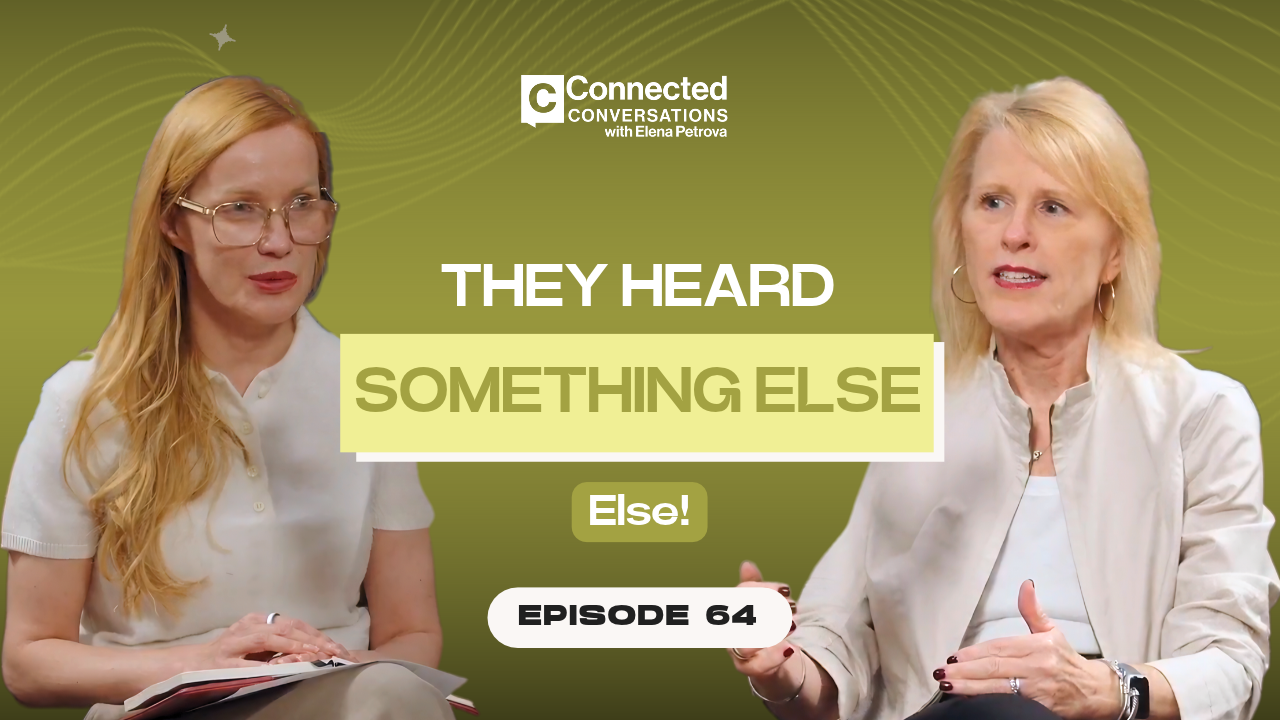
Leslie Ferry once drove home convinced she had lost her ability to communicate. In this episode of Connected Conversations, she tells Elena Petrova what she discovered instead: most friction at work comes not from what we say, but from how we're read.
Competitive, and even uncaring
Elena opens with a direct question about Zee, the AI career growth partner Leslie built: what was the first thing Zee told her that she didn't like?
Leslie's answer: that people wired differently from her might read her as competitive, and even uncaring. "That is disorienting when you first hear it," she says. But she has come to see that someone's perception isn't wrong. It's their perception, based on how they're wired.
That idea sits at the center of her work. We're all wired differently, and none of those wirings is better or worse. But the differences create what she calls misreads. Our intent gets received in a different way, so it has a different impact. Leslie calls the space between the two The Wiring Gap™.
"I have lost my ability to communicate"
The idea came from a hard stretch in her own career. Leslie joined a new company and inherited a tight, long-tenured marketing team. The shortest-tenured person had been there three years, and many were close friends. She was the new element, and she wasn't connecting.
The signs were subtle but clear. People looked deflated when she redirected work. Brainstorming sessions went flat. Team members started asking for step-by-step direction, which told her she wasn't communicating the strategy clearly enough for them to figure it out on their own.
Driving home one night, replaying another frustrating day, she remembers the thought so vividly it feels like she said it out loud: "I have lost my ability to communicate."
The coach's question
Her organization paired her with a career coach, and one question changed her thinking. How do you adjust your message when you speak to different team members? Leslie didn't understand the question. She assumed everyone worked the way she did.
It took years for the full lesson to land. Leslie is goal-oriented. Her competition, she says, is the goal, not the person beside her. But when she's focused on the goal, she doesn't always show care the way people need it.The difference comes down to a starting point. Some people approach work task first: what needs to get done. Others start people first: how this affects people and relationships. Neither is right or wrong, and organizations need both. Without that balance, Leslie warns, you risk burnout, missed ideas, and unintended consequences.
Building trust in opposite directions
The real insight was about trust. Leslie describes three elements: ability, integrity, and benevolence, which means showing that you care. All three need to be strong for someone to see you as trustworthy.
Task-first people like Leslie tend to build trust by proving their ability and integrity first, then building the relationship. Most of her new team were people first. They built trust by connecting first, then proving their work. "We were building trust in different directions," she says, which is why they kept missing each other.
The fix was simple. Leslie always checked in on people in one-on-ones, but at the end. She moved it to the start: how are you doing, what's going on, is everything okay? Then the work. That small adjustment shifted the whole dynamic.
How to spot the difference
Without a tool, it takes observation and reflection. Leslie's quick indicator: present a new idea and watch the response. People-first colleagues tend to look inward, at processes, people, and impact. Task-first colleagues look outward, at the customer, the deadline, and the goal. When a people-first colleague slows things down to check that everyone will be okay, a task-first leader can read it as resistance. It deserves the same consideration as any deadline.
She also learned something about her own instincts. When someone brought her a problem, she jumped straight into fixing it. Some people needed a moment to sit with it first. Now she tells new team members when she's slipping into problem-solving mode, and gives them permission to slow her down.
Prepare their message, not yours
Leslie expects these skills to matter more, not less, as technology speeds everything up. Her view is that the people who strengthen their human knowledge first will be the ones who show leadership and earn promotions, and that many "why didn't I get promoted?" conversations will come down to how someone connects with people.
advice for any important conversation: "We stop preparing our message and start preparing theirs." Think about what you need to say from the audience's point of view, and if the room has different work styles, shape the message so none of them gets lost.
That thinking shaped Zee. Leslie's own coach changed her career, but there aren't enough human coaches, and they cost more. Zee is built on psychology and coaching methods, and unlike a chatbot, she leads the conversation. She starts with self-discovery, then helps you think through the people you work with and adjust, using Leslie's Performance Loop™ of knowledge, reflection, and adjustment.
Listening is the harder half
Misreads happen at home too. Leslie laughs that her husband is sometimes completely sure she said something she didn't. Often it's because he thought he knew where the conversation was going while his mind was somewhere else. Communication, she says, is more about listening and observation than what you say.
That gets harder when the workday is a string of back-to-back video calls. Her advice is to cross the threshold on purpose: before the next meeting, consciously set the last one aside. Build in five or fifteen minutes between calls if you can. And notice when you're forming your answer instead of listening.
Give yourself grace
Asked what this work cost her, Leslie is candid. For a while, she suspected she wasn't a good person because of how some people seemed to see her. What helped was grace. She did the best she could at the time, learned, and grew. You can't change a past interaction, she says, but you can change what comes next.
Her one question before any hard conversation is simple: how strong is your relationship with this person? And the conversation she wants more of is about understanding. Not agreeing, understanding. Different isn't better or worse. It's just different.
Listen to Episode 64 of Connected Conversations, hosted by Elena Petrova, Founder and CEO of Ad Astra, Inc. and AdAstraConnect.
Connected Conversations is produced by Ad Astra, Inc.
You can watch/listen to this episode here:
🔴 YouTube: https://www.youtube.com/watch?v=o2K8kP-HVlo
🟢 Spotify: https://shorturl.at/hJuVR
⚫ Apple Podcast: https://shorturl.at/0Uv9B
🔵 Amazon Music: https://shorturl.at/SHnXi