
Healthcare

As healthcare systems become more diverse, providers must ensure that multilingual communication does not compromise patient privacy. Healthcare organizations frequently rely on interpreters and translators to communicate with patients who have limited English proficiency (LEP). However, every interaction involving patient data must comply with the Health Insurance Portability and Accountability Act (HIPAA).
Staying HIPAA-compliant while offering interpretation and translation services requires secure technology, trained professionals, and structured workflows.
In this guide, we explain how healthcare providers can maintain HIPAA compliance when using medical interpretation and translation services.
What Does HIPAA Compliance Mean in Multilingual Healthcare?
HIPAA compliance refers to the protection of Protected Health Information (PHI) during any form of healthcare communication.
This includes:
- verbal communication through interpreters
- written communication through translated documents
- electronic communication through telehealth or remote interpreting platforms
Healthcare providers must ensure that patient data remains secure regardless of the language used during care delivery.
Key requirements include:
- safeguarding PHI during interpreted conversations
- limiting access to patient data to authorized personnel
- using secure platforms for telehealth and remote interpreting
Failure to follow these standards can lead to regulatory penalties, legal risks, and compromised patient trust.
Benefits of HIPAA-Compliant Language Services
Ensuring HIPAA-compliant language access in healthcare protects both patients and providers while improving the quality of care.
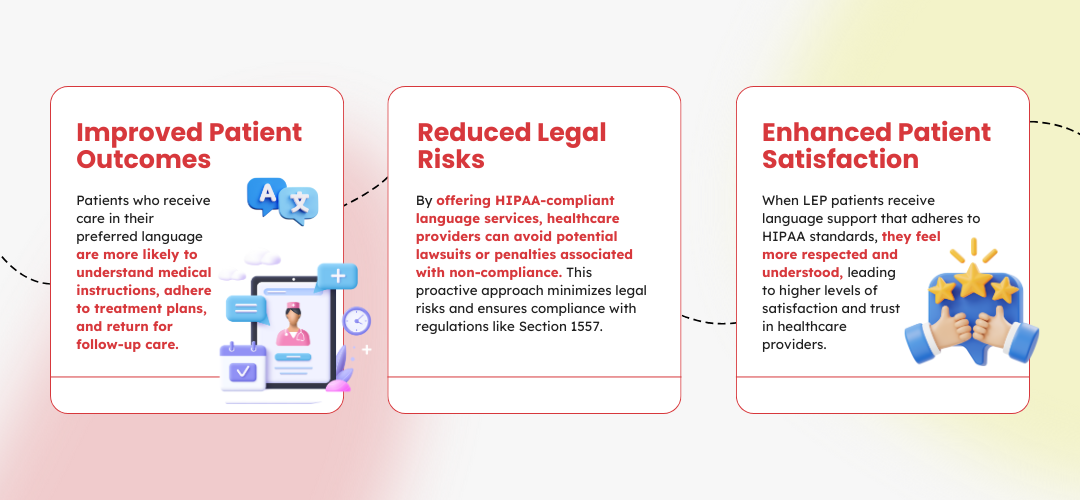
Improved Patient Outcomes
Patients who receive care in their preferred language are more likely to understand medical instructions, follow treatment plans, and return for follow-up care.
Reduced Legal Risks
By offering HIPAA-compliant language services, healthcare providers can avoid lawsuits or regulatory penalties associated with privacy violations.
This approach also helps organizations maintain compliance with additional regulations such as Section 1557 of the Affordable Care Act.
Enhanced Patient Satisfaction
Patients who receive language support that protects their privacy often feel more respected, understood, and confident in their healthcare providers.
This improves patient trust and overall healthcare experiences.

Steps to Ensure HIPAA Compliance with Language Services
1. Partner with HIPAA-Compliant Language Service Providers
Healthcare organizations should work with language service providers that understand healthcare privacy regulations.
When selecting a provider, verify that:
- interpreters and translators complete HIPAA training
- secure communication channels are used for interpreting sessions
- translation workflows protect patient information
Professional providers such as Ad Astra operate within secure environments designed to protect sensitive healthcare data.
2. Use HIPAA-Compliant Telehealth and Interpreting Platforms
Remote healthcare communication requires secure technology.
Platforms used for telehealth interpreting should include:
- end-to-end encryption
- secure authentication protocols
- restricted access to patient data
- secure storage of communication records
These features help protect PHI during video remote interpreting (VRI) and over-the-phone interpretation (OPI).
3. Implement Secure Medical Translation Workflows
Healthcare providers frequently need to translate sensitive documents, such as:
- patient records
- consent forms
- discharge instructions
- insurance documentation
To maintain HIPAA compliance, translation workflows should include:
- encrypted file transfer
- secure document storage
- certified medical translators trained in confidentiality
This ensures patient information remains protected throughout the translation process.

How Medical Interpretation Services Maintain HIPAA Compliance
Remote Interpreting for Real-Time Care
Remote interpreting services allow providers to communicate with patients instantly while maintaining privacy protections.To stay compliant:
- use HIPAA-compliant interpreting platforms
- ensure interpreters understand confidentiality obligations
- conduct regular security audits of interpreting systems
These measures allow healthcare providers to deliver safe and accessible multilingual care.
Challenges of Maintaining Compliance in Multilingual Healthcare
Balancing Speed and Security
Healthcare environments often require immediate communication with patients. Emergency situations may require rapid access to interpreters, but privacy protections must remain intact.
Secure on-demand interpreting solutions can help providers meet both requirements.
Technical Risks in Remote Interpreting
Remote interpreting depends on digital platforms that must be carefully secured.
Healthcare organizations should verify that interpreting providers use encrypted communication channels and secure networks.
Limited Access to HIPAA-Trained Linguists
For rare languages, finding interpreters who understand both medical terminology and HIPAA compliance can be challenging.
Working with experienced language service providers helps healthcare organizations access qualified interpreters across many languages.
Best Practices for HIPAA-Compliant Multilingual Communication
Healthcare providers can strengthen compliance by implementing these practices:
Provide Ongoing HIPAA Training
Ensure interpreters, translators, and staff receive regular training on handling PHI and maintaining confidentiality during language services.
Monitor Language Service Quality
Conduct regular audits of translation and interpreting services to identify compliance gaps and maintain quality standards.
Use Secure Multilingual Communication Channels
Secure messaging platforms that comply with HIPAA can support ongoing patient communication while protecting sensitive information.
Final Thoughts: HIPAA Compliance and Language Access Go Hand in Hand
Providing language access in healthcare is essential for delivering equitable care to diverse populations. However, multilingual communication must always be implemented in ways that protect patient privacy.
By using secure technologies, partnering with HIPAA-compliant language service providers, and implementing clear privacy protocols, healthcare organizations can provide safe, compliant, and effective multilingual healthcare communication.
Organizations seeking reliable healthcare translation and interpretation services often partner with providers like Ad Astra, where trained medical linguists work within secure workflows designed to protect patient confidentiality.
FAQs: HIPAA and Language Services
Are interpreters required to follow HIPAA rules?
Yes. Interpreters working in healthcare settings must follow HIPAA regulations because they may access protected health information during interpreted conversations.
Is remote medical interpreting HIPAA compliant?
Remote interpreting can be HIPAA compliant if the platform uses secure encryption, access controls, and interpreters are trained in patient privacy practices.
Do medical translators need HIPAA training?
Yes. Medical translators handling patient records or healthcare documents should understand HIPAA requirements and follow secure document handling practices.
Why is HIPAA compliance important for language services?
HIPAA compliance protects patient privacy and ensures healthcare providers avoid legal risks when delivering multilingual communication.